

66
5 How to Conduct an Experiment in the Field …
spot to keep out sunshine and winds. At the lower right corner of Fig. 5.1b, an
MX-2010-G topography meter was working.
The 3D digital models of the unsheltered surface of the ground were valuable
supports for geomorphological studies because they provided scientists with a full
and immediate perception of the represented ground surface trends (Zhang et al. 2014,
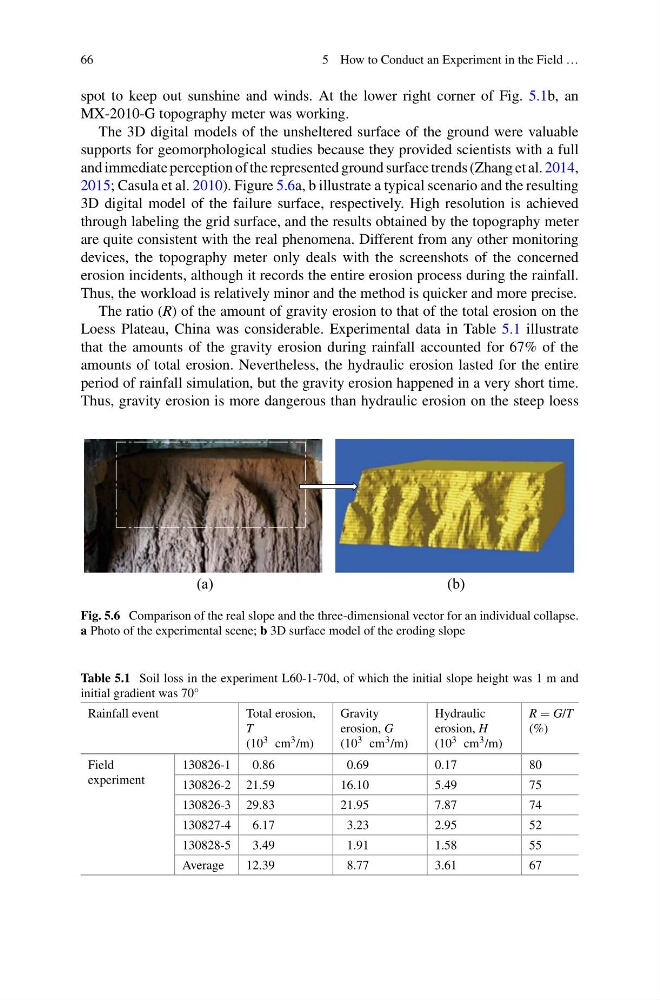
2015; Casula et al. 2010). Figure 5.6a, b illustrate a typical scenario and the resulting
3D digital model of the failure surface, respectively. High resolution is achieved
through labeling the grid surface, and the results obtained by the topography meter
are quite consistent with the real phenomena. Different from any other monitoring
devices, the topography meter only deals with the screenshots of the concerned
erosion incidents, although it records the entire erosion process during the rainfall.
Thus, the workload is relatively minor and the method is quicker and more precise.
The ratio (R) of the amount of gravity erosion to that of the total erosion on the
Loess Plateau, China was considerable. Experimental data in Table 5.1 illustrate
that the amounts of the gravity erosion during rainfall accounted for 67% of the
amounts of total erosion. Nevertheless, the hydraulic erosion lasted for the entire
period of rainfall simulation, but the gravity erosion happened in a very short time.
Thus, gravity erosion is more dangerous than hydraulic erosion on the steep loess
(a)
(b)
Fig. 5.6 Comparison of the real slope and the three-dimensional vector for an individual collapse.
a Photo of the experimental scene; b 3D surface model of the eroding slope
Table 5.1 Soil loss in the experiment L60-1-70d, of which the initial slope height was 1 m and
initial gradient was 70°
Rainfall event
Total erosion,
T
(10 3 cm 3 /m)
Gravity
erosion, G
(10 3 cm 3 /m)
Hydraulic
erosion, H
(10 3 cm 3 /m)
R = G/T
(%)
Field
experiment
130826-1
0.86
0.69
0.17
80
130826-2 21.59
16.10
5.49
75
130826-3 29.83
21.95
7.87
74
130827-4
6.17
3.23
2.95
52
130828-5
3.49
1.91
1.58
55
Average
12.39
8.77
3.61
67
5 How to Conduct an Experiment in the Field …
spot to keep out sunshine and winds. At the lower right corner of Fig. 5.1b, an
MX-2010-G topography meter was working.
The 3D digital models of the unsheltered surface of the ground were valuable
supports for geomorphological studies because they provided scientists with a full
and immediate perception of the represented ground surface trends (Zhang et al. 2014,
2015; Casula et al. 2010). Figure 5.6a, b illustrate a typical scenario and the resulting
3D digital model of the failure surface, respectively. High resolution is achieved
through labeling the grid surface, and the results obtained by the topography meter
are quite consistent with the real phenomena. Different from any other monitoring
devices, the topography meter only deals with the screenshots of the concerned
erosion incidents, although it records the entire erosion process during the rainfall.
Thus, the workload is relatively minor and the method is quicker and more precise.
The ratio (R) of the amount of gravity erosion to that of the total erosion on the
Loess Plateau, China was considerable. Experimental data in Table 5.1 illustrate
that the amounts of the gravity erosion during rainfall accounted for 67% of the
amounts of total erosion. Nevertheless, the hydraulic erosion lasted for the entire
period of rainfall simulation, but the gravity erosion happened in a very short time.
Thus, gravity erosion is more dangerous than hydraulic erosion on the steep loess
(a)
(b)
Fig. 5.6 Comparison of the real slope and the three-dimensional vector for an individual collapse.
a Photo of the experimental scene; b 3D surface model of the eroding slope
Table 5.1 Soil loss in the experiment L60-1-70d, of which the initial slope height was 1 m and
initial gradient was 70°
Rainfall event
Total erosion,
T
(10 3 cm 3 /m)
Gravity
erosion, G
(10 3 cm 3 /m)
Hydraulic
erosion, H
(10 3 cm 3 /m)
R = G/T
(%)
Field
experiment
130826-1
0.86
0.69
0.17
80
130826-2 21.59
16.10
5.49
75
130826-3 29.83
21.95
7.87
74
130827-4
6.17
3.23
2.95
52
130828-5
3.49
1.91
1.58
55
Average
12.39
8.77
3.61
67