

198
12 Effects of Gravity Erosion on Particle Size Distribution …
0%
20%
40%
60%
80%
100%
US
PSD (%)
Sand 0.05-2 mm Silt 0.05-0.002 mm Clay < 0.002 mm
0%
20%
40%
60%
80%
100%
LS
PSD (%)
Sand 0.05-2 mm Silt 0.05-0.002 mm Clay < 0.002 mm
LS
ES
GS
WS
ES
GS
WS
SD
(a)
(b)
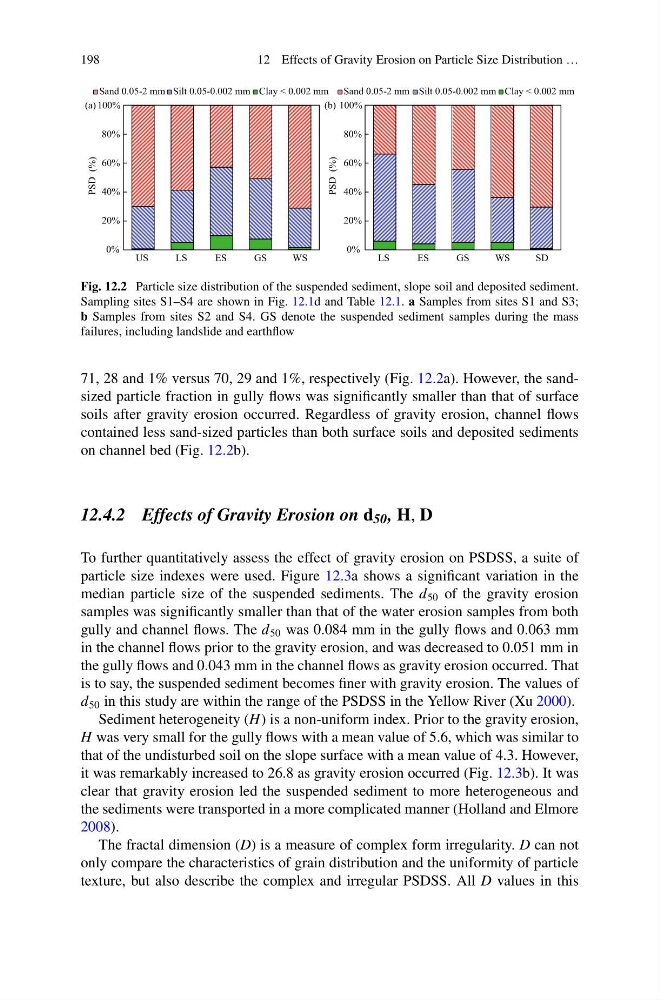
Fig. 12.2 Particle size distribution of the suspended sediment, slope soil and deposited sediment.
Sampling sites S1–S4 are shown in Fig. 12.1d and Table 12.1. a Samples from sites S1 and S3;
b Samples from sites S2 and S4. GS denote the suspended sediment samples during the mass
failures, including landslide and earthflow
71, 28 and 1% versus 70, 29 and 1%, respectively (Fig. 12.2a). However, the sandsized particle fraction in gully flows was significantly smaller than that of surface
soils after gravity erosion occurred. Regardless of gravity erosion, channel flows
contained less sand-sized particles than both surface soils and deposited sediments
on channel bed (Fig. 12.2b).
12.4.2 Effects of Gravity Erosion on d 50 , H, D
To further quantitatively assess the effect of gravity erosion on PSDSS, a suite of
particle size indexes were used. Figure 12.3a shows a significant variation in the
median particle size of the suspended sediments. The d 50 of the gravity erosion
samples was significantly smaller than that of the water erosion samples from both
gully and channel flows. The d 50 was 0.084 mm in the gully flows and 0.063 mm
in the channel flows prior to the gravity erosion, and was decreased to 0.051 mm in
the gully flows and 0.043 mm in the channel flows as gravity erosion occurred. That
is to say, the suspended sediment becomes finer with gravity erosion. The values of
d 50 in this study are within the range of the PSDSS in the Yellow River (Xu 2000).
Sediment heterogeneity (H) is a non-uniform index. Prior to the gravity erosion,
H was very small for the gully flows with a mean value of 5.6, which was similar to
that of the undisturbed soil on the slope surface with a mean value of 4.3. However,
it was remarkably increased to 26.8 as gravity erosion occurred (Fig. 12.3b). It was
clear that gravity erosion led the suspended sediment to more heterogeneous and
the sediments were transported in a more complicated manner (Holland and Elmore
2008).
The fractal dimension (D) is a measure of complex form irregularity. D can not
only compare the characteristics of grain distribution and the uniformity of particle
texture, but also describe the complex and irregular PSDSS. All D values in this
12 Effects of Gravity Erosion on Particle Size Distribution …
0%
20%
40%
60%
80%
100%
US
PSD (%)
Sand 0.05-2 mm Silt 0.05-0.002 mm Clay < 0.002 mm
0%
20%
40%
60%
80%
100%
LS
PSD (%)
Sand 0.05-2 mm Silt 0.05-0.002 mm Clay < 0.002 mm
LS
ES
GS
WS
ES
GS
WS
SD
(a)
(b)
Fig. 12.2 Particle size distribution of the suspended sediment, slope soil and deposited sediment.
Sampling sites S1–S4 are shown in Fig. 12.1d and Table 12.1. a Samples from sites S1 and S3;
b Samples from sites S2 and S4. GS denote the suspended sediment samples during the mass
failures, including landslide and earthflow
71, 28 and 1% versus 70, 29 and 1%, respectively (Fig. 12.2a). However, the sandsized particle fraction in gully flows was significantly smaller than that of surface
soils after gravity erosion occurred. Regardless of gravity erosion, channel flows
contained less sand-sized particles than both surface soils and deposited sediments
on channel bed (Fig. 12.2b).
12.4.2 Effects of Gravity Erosion on d 50 , H, D
To further quantitatively assess the effect of gravity erosion on PSDSS, a suite of
particle size indexes were used. Figure 12.3a shows a significant variation in the
median particle size of the suspended sediments. The d 50 of the gravity erosion
samples was significantly smaller than that of the water erosion samples from both
gully and channel flows. The d 50 was 0.084 mm in the gully flows and 0.063 mm
in the channel flows prior to the gravity erosion, and was decreased to 0.051 mm in
the gully flows and 0.043 mm in the channel flows as gravity erosion occurred. That
is to say, the suspended sediment becomes finer with gravity erosion. The values of
d 50 in this study are within the range of the PSDSS in the Yellow River (Xu 2000).
Sediment heterogeneity (H) is a non-uniform index. Prior to the gravity erosion,
H was very small for the gully flows with a mean value of 5.6, which was similar to
that of the undisturbed soil on the slope surface with a mean value of 4.3. However,
it was remarkably increased to 26.8 as gravity erosion occurred (Fig. 12.3b). It was
clear that gravity erosion led the suspended sediment to more heterogeneous and
the sediments were transported in a more complicated manner (Holland and Elmore
2008).
The fractal dimension (D) is a measure of complex form irregularity. D can not
only compare the characteristics of grain distribution and the uniformity of particle
texture, but also describe the complex and irregular PSDSS. All D values in this