

2 Systematic Descriptions
73
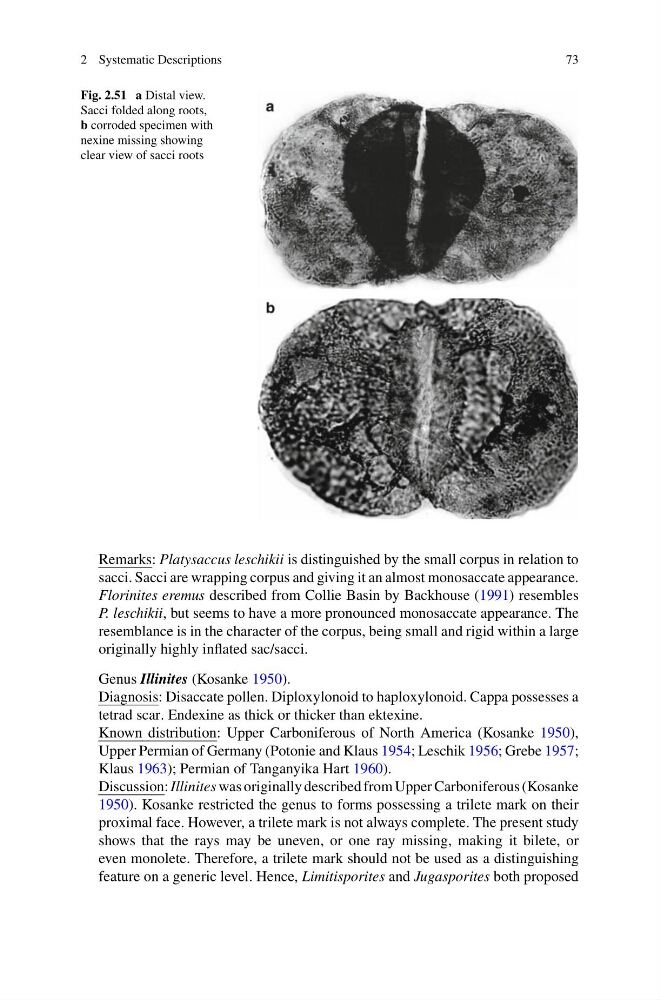
Fig. 2.51 a Distal view.
Sacci folded along roots,
b corroded specimen with
nexine missing showing
clear view of sacci roots
Remarks: Platysaccus leschikii is distinguished by the small corpus in relation to
sacci. Sacci are wrapping corpus and giving it an almost monosaccate appearance.
Florinites eremus described from Collie Basin by Backhouse (1991) resembles
P. leschikii, but seems to have a more pronounced monosaccate appearance. The
resemblance is in the character of the corpus, being small and rigid within a large
originally highly inflated sac/sacci.
Genus Illinites (Kosanke 1950).
Diagnosis: Disaccate pollen. Diploxylonoid to haploxylonoid. Cappa possesses a
tetrad scar. Endexine as thick or thicker than ektexine.
Known distribution: Upper Carboniferous of North America (Kosanke 1950),
Upper Permian of Germany (Potonie and Klaus 1954; Leschik 1956; Grebe 1957;
Klaus 1963); Permian of Tanganyika Hart 1960).
Discussion: Illinites was originally described from Upper Carboniferous (Kosanke
1950). Kosanke restricted the genus to forms possessing a trilete mark on their
proximal face. However, a trilete mark is not always complete. The present study
shows that the rays may be uneven, or one ray missing, making it bilete, or
even monolete. Therefore, a trilete mark should not be used as a distinguishing
feature on a generic level. Hence, Limitisporites and Jugasporites both proposed
73
Fig. 2.51 a Distal view.
Sacci folded along roots,
b corroded specimen with
nexine missing showing
clear view of sacci roots
Remarks: Platysaccus leschikii is distinguished by the small corpus in relation to
sacci. Sacci are wrapping corpus and giving it an almost monosaccate appearance.
Florinites eremus described from Collie Basin by Backhouse (1991) resembles
P. leschikii, but seems to have a more pronounced monosaccate appearance. The
resemblance is in the character of the corpus, being small and rigid within a large
originally highly inflated sac/sacci.
Genus Illinites (Kosanke 1950).
Diagnosis: Disaccate pollen. Diploxylonoid to haploxylonoid. Cappa possesses a
tetrad scar. Endexine as thick or thicker than ektexine.
Known distribution: Upper Carboniferous of North America (Kosanke 1950),
Upper Permian of Germany (Potonie and Klaus 1954; Leschik 1956; Grebe 1957;
Klaus 1963); Permian of Tanganyika Hart 1960).
Discussion: Illinites was originally described from Upper Carboniferous (Kosanke
1950). Kosanke restricted the genus to forms possessing a trilete mark on their
proximal face. However, a trilete mark is not always complete. The present study
shows that the rays may be uneven, or one ray missing, making it bilete, or
even monolete. Therefore, a trilete mark should not be used as a distinguishing
feature on a generic level. Hence, Limitisporites and Jugasporites both proposed