

2 Systematic Descriptions
63
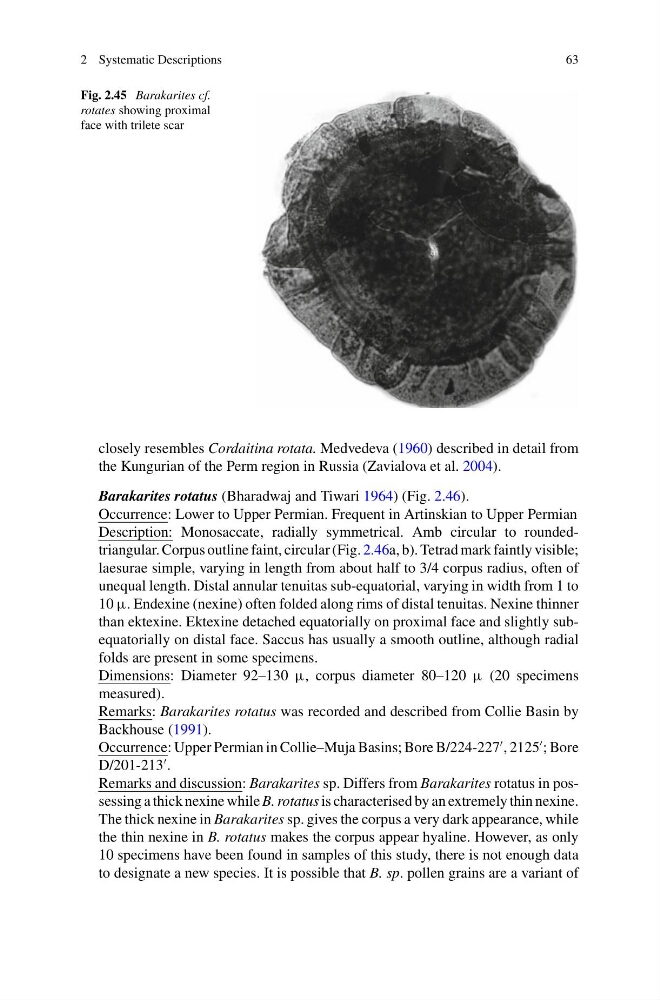
Fig. 2.45 Barakarites cf.
rotates showing proximal
face with trilete scar
closely resembles Cordaitina rotata. Medvedeva (1960) described in detail from
the Kungurian of the Perm region in Russia (Zavialova et al. 2004).
Barakarites rotatus (Bharadwaj and Tiwari 1964) (Fig. 2.46).
Occurrence: Lower to Upper Permian. Frequent in Artinskian to Upper Permian
Description: Monosaccate, radially symmetrical. Amb circular to roundedtriangular. Corpus outline faint, circular (Fig. 2.46a, b). Tetrad mark faintly visible;
laesurae simple, varying in length from about half to 3/4 corpus radius, often of
unequal length. Distal annular tenuitas sub-equatorial, varying in width from 1 to
10 µ. Endexine (nexine) often folded along rims of distal tenuitas. Nexine thinner
than ektexine. Ektexine detached equatorially on proximal face and slightly subequatorially on distal face. Saccus has usually a smooth outline, although radial
folds are present in some specimens.
Dimensions: Diameter 92–130 µ, corpus diameter 80–120 µ (20 specimens
measured).
Remarks: Barakarites rotatus was recorded and described from Collie Basin by
Backhouse (1991).
Occurrence: Upper Permian in Collie–Muja Basins; Bore B/224-227
, 2125
; Bore
D/201-213
.
Remarks and discussion: Barakarites sp. Differs from Barakarites rotatus in possessing a thick nexine while B. rotatus is characterised by an extremely thin nexine.
The thick nexine in Barakarites sp. gives the corpus a very dark appearance, while
the thin nexine in B. rotatus makes the corpus appear hyaline. However, as only
10 specimens have been found in samples of this study, there is not enough data
to designate a new species. It is possible that B. sp. pollen grains are a variant of
63
Fig. 2.45 Barakarites cf.
rotates showing proximal
face with trilete scar
closely resembles Cordaitina rotata. Medvedeva (1960) described in detail from
the Kungurian of the Perm region in Russia (Zavialova et al. 2004).
Barakarites rotatus (Bharadwaj and Tiwari 1964) (Fig. 2.46).
Occurrence: Lower to Upper Permian. Frequent in Artinskian to Upper Permian
Description: Monosaccate, radially symmetrical. Amb circular to roundedtriangular. Corpus outline faint, circular (Fig. 2.46a, b). Tetrad mark faintly visible;
laesurae simple, varying in length from about half to 3/4 corpus radius, often of
unequal length. Distal annular tenuitas sub-equatorial, varying in width from 1 to
10 µ. Endexine (nexine) often folded along rims of distal tenuitas. Nexine thinner
than ektexine. Ektexine detached equatorially on proximal face and slightly subequatorially on distal face. Saccus has usually a smooth outline, although radial
folds are present in some specimens.
Dimensions: Diameter 92–130 µ, corpus diameter 80–120 µ (20 specimens
measured).
Remarks: Barakarites rotatus was recorded and described from Collie Basin by
Backhouse (1991).
Occurrence: Upper Permian in Collie–Muja Basins; Bore B/224-227
, 2125
; Bore
D/201-213
.
Remarks and discussion: Barakarites sp. Differs from Barakarites rotatus in possessing a thick nexine while B. rotatus is characterised by an extremely thin nexine.
The thick nexine in Barakarites sp. gives the corpus a very dark appearance, while
the thin nexine in B. rotatus makes the corpus appear hyaline. However, as only
10 specimens have been found in samples of this study, there is not enough data
to designate a new species. It is possible that B. sp. pollen grains are a variant of