

2 Systematic Descriptions
57
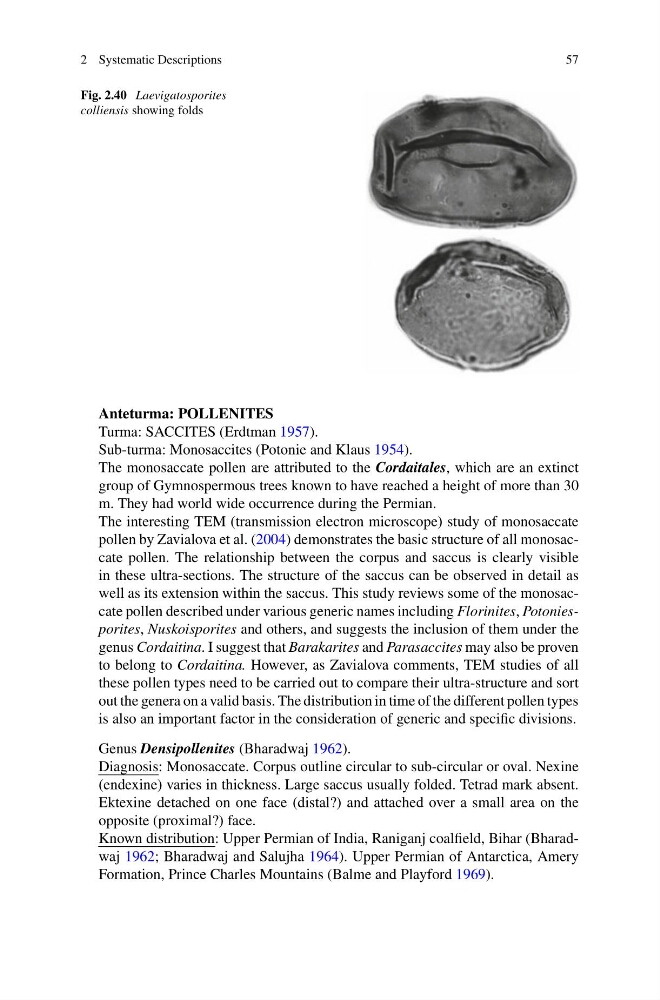
Fig. 2.40 Laevigatosporites
colliensis showing folds
Anteturma: POLLENITES
Turma: SACCITES (Erdtman 1957).
Sub-turma: Monosaccites (Potonie and Klaus 1954).
The monosaccate pollen are attributed to the Cordaitales, which are an extinct
group of Gymnospermous trees known to have reached a height of more than 30
m. They had world wide occurrence during the Permian.
The interesting TEM (transmission electron microscope) study of monosaccate
pollen by Zavialova et al. (2004) demonstrates the basic structure of all monosaccate pollen. The relationship between the corpus and saccus is clearly visible
in these ultra-sections. The structure of the saccus can be observed in detail as
well as its extension within the saccus. This study reviews some of the monosaccate pollen described under various generic names including Florinites, Potoniesporites, Nuskoisporites and others, and suggests the inclusion of them under the
genus Cordaitina. I suggest that Barakarites and Parasaccites may also be proven
to belong to Cordaitina. However, as Zavialova comments, TEM studies of all
these pollen types need to be carried out to compare their ultra-structure and sort
out the genera on a valid basis. The distribution in time of the different pollen types
is also an important factor in the consideration of generic and specific divisions.
Genus Densipollenites (Bharadwaj 1962).
Diagnosis: Monosaccate. Corpus outline circular to sub-circular or oval. Nexine
(endexine) varies in thickness. Large saccus usually folded. Tetrad mark absent.
Ektexine detached on one face (distal?) and attached over a small area on the
opposite (proximal?) face.
Known distribution: Upper Permian of India, Raniganj coalfield, Bihar (Bharadwaj 1962; Bharadwaj and Salujha 1964). Upper Permian of Antarctica, Amery
Formation, Prince Charles Mountains (Balme and Playford 1969).
57
Fig. 2.40 Laevigatosporites
colliensis showing folds
Anteturma: POLLENITES
Turma: SACCITES (Erdtman 1957).
Sub-turma: Monosaccites (Potonie and Klaus 1954).
The monosaccate pollen are attributed to the Cordaitales, which are an extinct
group of Gymnospermous trees known to have reached a height of more than 30
m. They had world wide occurrence during the Permian.
The interesting TEM (transmission electron microscope) study of monosaccate
pollen by Zavialova et al. (2004) demonstrates the basic structure of all monosaccate pollen. The relationship between the corpus and saccus is clearly visible
in these ultra-sections. The structure of the saccus can be observed in detail as
well as its extension within the saccus. This study reviews some of the monosaccate pollen described under various generic names including Florinites, Potoniesporites, Nuskoisporites and others, and suggests the inclusion of them under the
genus Cordaitina. I suggest that Barakarites and Parasaccites may also be proven
to belong to Cordaitina. However, as Zavialova comments, TEM studies of all
these pollen types need to be carried out to compare their ultra-structure and sort
out the genera on a valid basis. The distribution in time of the different pollen types
is also an important factor in the consideration of generic and specific divisions.
Genus Densipollenites (Bharadwaj 1962).
Diagnosis: Monosaccate. Corpus outline circular to sub-circular or oval. Nexine
(endexine) varies in thickness. Large saccus usually folded. Tetrad mark absent.
Ektexine detached on one face (distal?) and attached over a small area on the
opposite (proximal?) face.
Known distribution: Upper Permian of India, Raniganj coalfield, Bihar (Bharadwaj 1962; Bharadwaj and Salujha 1964). Upper Permian of Antarctica, Amery
Formation, Prince Charles Mountains (Balme and Playford 1969).