

50
2 Systematic Descriptions
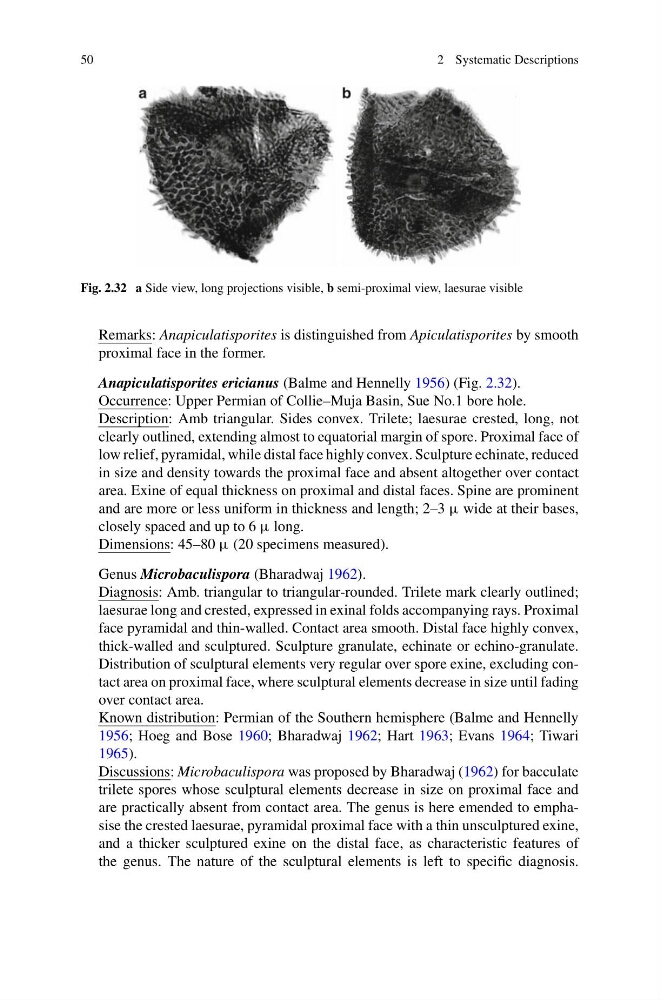
Fig. 2.32 a Side view, long projections visible, b semi-proximal view, laesurae visible
Remarks: Anapiculatisporites is distinguished from Apiculatisporites by smooth
proximal face in the former.
Anapiculatisporites ericianus (Balme and Hennelly 1956) (Fig. 2.32).
Occurrence: Upper Permian of Collie–Muja Basin, Sue No.1 bore hole.
Description: Amb triangular. Sides convex. Trilete; laesurae crested, long, not
clearly outlined, extending almost to equatorial margin of spore. Proximal face of
low relief, pyramidal, while distal face highly convex. Sculpture echinate, reduced
in size and density towards the proximal face and absent altogether over contact
area. Exine of equal thickness on proximal and distal faces. Spine are prominent
and are more or less uniform in thickness and length; 2–3 µ wide at their bases,
closely spaced and up to 6 µ long.
Dimensions: 45–80 µ (20 specimens measured).
Genus Microbaculispora (Bharadwaj 1962).
Diagnosis: Amb. triangular to triangular-rounded. Trilete mark clearly outlined;
laesurae long and crested, expressed in exinal folds accompanying rays. Proximal
face pyramidal and thin-walled. Contact area smooth. Distal face highly convex,
thick-walled and sculptured. Sculpture granulate, echinate or echino-granulate.
Distribution of sculptural elements very regular over spore exine, excluding contact area on proximal face, where sculptural elements decrease in size until fading
over contact area.
Known distribution: Permian of the Southern hemisphere (Balme and Hennelly
1956; Hoeg and Bose 1960; Bharadwaj 1962; Hart 1963; Evans 1964; Tiwari
1965).
Discussions: Microbaculispora was proposed by Bharadwaj (1962) for bacculate
trilete spores whose sculptural elements decrease in size on proximal face and
are practically absent from contact area. The genus is here emended to emphasise the crested laesurae, pyramidal proximal face with a thin unsculptured exine,
and a thicker sculptured exine on the distal face, as characteristic features of
the genus. The nature of the sculptural elements is left to specific diagnosis.
2 Systematic Descriptions
Fig. 2.32 a Side view, long projections visible, b semi-proximal view, laesurae visible
Remarks: Anapiculatisporites is distinguished from Apiculatisporites by smooth
proximal face in the former.
Anapiculatisporites ericianus (Balme and Hennelly 1956) (Fig. 2.32).
Occurrence: Upper Permian of Collie–Muja Basin, Sue No.1 bore hole.
Description: Amb triangular. Sides convex. Trilete; laesurae crested, long, not
clearly outlined, extending almost to equatorial margin of spore. Proximal face of
low relief, pyramidal, while distal face highly convex. Sculpture echinate, reduced
in size and density towards the proximal face and absent altogether over contact
area. Exine of equal thickness on proximal and distal faces. Spine are prominent
and are more or less uniform in thickness and length; 2–3 µ wide at their bases,
closely spaced and up to 6 µ long.
Dimensions: 45–80 µ (20 specimens measured).
Genus Microbaculispora (Bharadwaj 1962).
Diagnosis: Amb. triangular to triangular-rounded. Trilete mark clearly outlined;
laesurae long and crested, expressed in exinal folds accompanying rays. Proximal
face pyramidal and thin-walled. Contact area smooth. Distal face highly convex,
thick-walled and sculptured. Sculpture granulate, echinate or echino-granulate.
Distribution of sculptural elements very regular over spore exine, excluding contact area on proximal face, where sculptural elements decrease in size until fading
over contact area.
Known distribution: Permian of the Southern hemisphere (Balme and Hennelly
1956; Hoeg and Bose 1960; Bharadwaj 1962; Hart 1963; Evans 1964; Tiwari
1965).
Discussions: Microbaculispora was proposed by Bharadwaj (1962) for bacculate
trilete spores whose sculptural elements decrease in size on proximal face and
are practically absent from contact area. The genus is here emended to emphasise the crested laesurae, pyramidal proximal face with a thin unsculptured exine,
and a thicker sculptured exine on the distal face, as characteristic features of
the genus. The nature of the sculptural elements is left to specific diagnosis.