

4.5 Methods and Techniques Employed in the Pilot Study
123
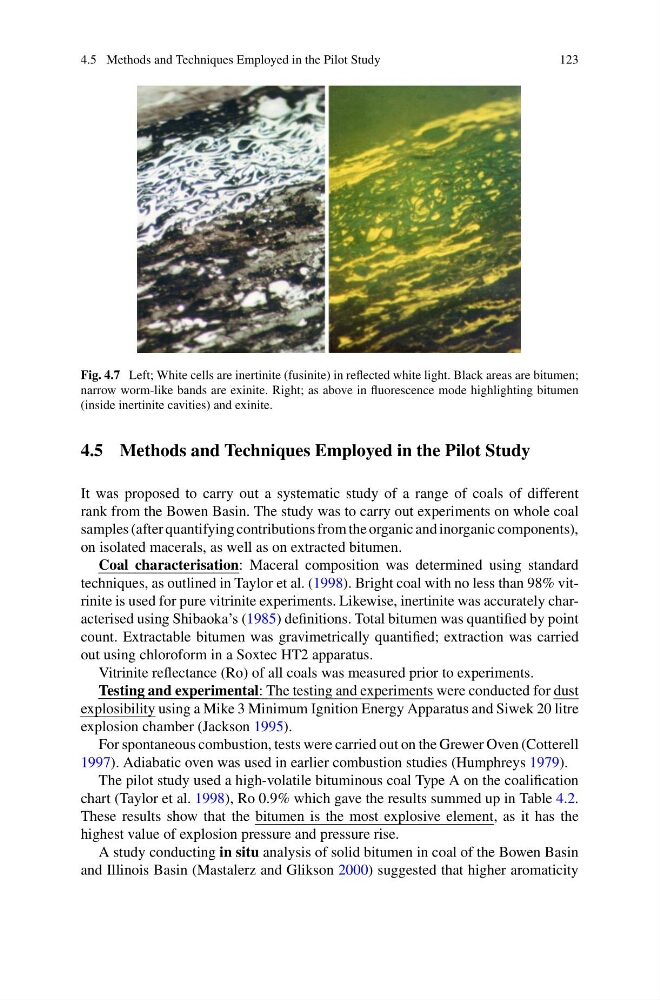
Fig. 4.7 Left; White cells are inertinite (fusinite) in reflected white light. Black areas are bitumen;
narrow worm-like bands are exinite. Right; as above in fluorescence mode highlighting bitumen
(inside inertinite cavities) and exinite.
4.5 Methods and Techniques Employed in the Pilot Study
It was proposed to carry out a systematic study of a range of coals of different
rank from the Bowen Basin. The study was to carry out experiments on whole coal
samples (after quantifying contributions from the organic and inorganic components),
on isolated macerals, as well as on extracted bitumen.
Coal characterisation: Maceral composition was determined using standard
techniques, as outlined in Taylor et al. (1998). Bright coal with no less than 98% vitrinite is used for pure vitrinite experiments. Likewise, inertinite was accurately characterised using Shibaoka’s (1985) definitions. Total bitumen was quantified by point
count. Extractable bitumen was gravimetrically quantified; extraction was carried
out using chloroform in a Soxtec HT2 apparatus.
Vitrinite reflectance (Ro) of all coals was measured prior to experiments.
Testing and experimental: The testing and experiments were conducted for dust
explosibility using a Mike 3 Minimum Ignition Energy Apparatus and Siwek 20 litre
explosion chamber (Jackson 1995).
For spontaneous combustion, tests were carried out on the Grewer Oven (Cotterell
1997). Adiabatic oven was used in earlier combustion studies (Humphreys 1979).
The pilot study used a high-volatile bituminous coal Type A on the coalification
chart (Taylor et al. 1998), Ro 0.9% which gave the results summed up in Table 4.2.
These results show that the bitumen is the most explosive element, as it has the
highest value of explosion pressure and pressure rise.
A study conducting in situ analysis of solid bitumen in coal of the Bowen Basin
and Illinois Basin (Mastalerz and Glikson 2000) suggested that higher aromaticity
123
Fig. 4.7 Left; White cells are inertinite (fusinite) in reflected white light. Black areas are bitumen;
narrow worm-like bands are exinite. Right; as above in fluorescence mode highlighting bitumen
(inside inertinite cavities) and exinite.
4.5 Methods and Techniques Employed in the Pilot Study
It was proposed to carry out a systematic study of a range of coals of different
rank from the Bowen Basin. The study was to carry out experiments on whole coal
samples (after quantifying contributions from the organic and inorganic components),
on isolated macerals, as well as on extracted bitumen.
Coal characterisation: Maceral composition was determined using standard
techniques, as outlined in Taylor et al. (1998). Bright coal with no less than 98% vitrinite is used for pure vitrinite experiments. Likewise, inertinite was accurately characterised using Shibaoka’s (1985) definitions. Total bitumen was quantified by point
count. Extractable bitumen was gravimetrically quantified; extraction was carried
out using chloroform in a Soxtec HT2 apparatus.
Vitrinite reflectance (Ro) of all coals was measured prior to experiments.
Testing and experimental: The testing and experiments were conducted for dust
explosibility using a Mike 3 Minimum Ignition Energy Apparatus and Siwek 20 litre
explosion chamber (Jackson 1995).
For spontaneous combustion, tests were carried out on the Grewer Oven (Cotterell
1997). Adiabatic oven was used in earlier combustion studies (Humphreys 1979).
The pilot study used a high-volatile bituminous coal Type A on the coalification
chart (Taylor et al. 1998), Ro 0.9% which gave the results summed up in Table 4.2.
These results show that the bitumen is the most explosive element, as it has the
highest value of explosion pressure and pressure rise.
A study conducting in situ analysis of solid bitumen in coal of the Bowen Basin
and Illinois Basin (Mastalerz and Glikson 2000) suggested that higher aromaticity