

120
4 Spontaneous Combustion of Coal
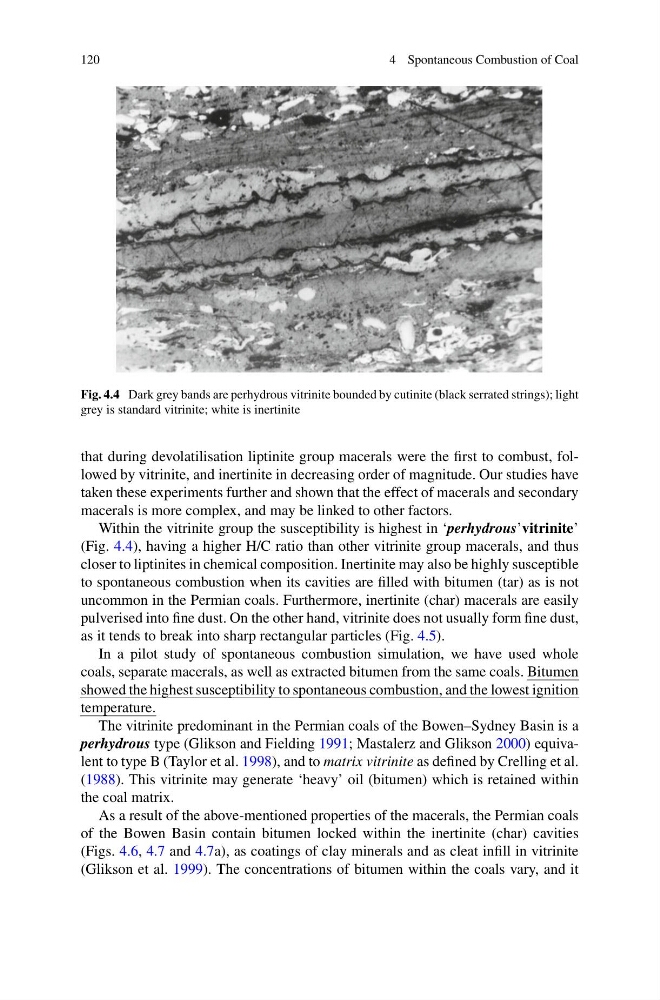
Fig. 4.4 Dark grey bands are perhydrous vitrinite bounded by cutinite (black serrated strings); light
grey is standard vitrinite; white is inertinite
that during devolatilisation liptinite group macerals were the first to combust, followed by vitrinite, and inertinite in decreasing order of magnitude. Our studies have
taken these experiments further and shown that the effect of macerals and secondary
macerals is more complex, and may be linked to other factors.
Within the vitrinite group the susceptibility is highest in ‘perhydrous’vitrinite’
(Fig. 4.4), having a higher H/C ratio than other vitrinite group macerals, and thus
closer to liptinites in chemical composition. Inertinite may also be highly susceptible
to spontaneous combustion when its cavities are filled with bitumen (tar) as is not
uncommon in the Permian coals. Furthermore, inertinite (char) macerals are easily
pulverised into fine dust. On the other hand, vitrinite does not usually form fine dust,
as it tends to break into sharp rectangular particles (Fig. 4.5).
In a pilot study of spontaneous combustion simulation, we have used whole
coals, separate macerals, as well as extracted bitumen from the same coals. Bitumen
showed the highest susceptibility to spontaneous combustion, and the lowest ignition
temperature.
The vitrinite predominant in the Permian coals of the Bowen–Sydney Basin is a
perhydrous type (Glikson and Fielding 1991; Mastalerz and Glikson 2000) equivalent to type B (Taylor et al. 1998), and to matrix vitrinite as defined by Crelling et al.
(1988). This vitrinite may generate ‘heavy’ oil (bitumen) which is retained within
the coal matrix.
As a result of the above-mentioned properties of the macerals, the Permian coals
of the Bowen Basin contain bitumen locked within the inertinite (char) cavities
(Figs. 4.6, 4.7 and 4.7a), as coatings of clay minerals and as cleat infill in vitrinite
(Glikson et al. 1999). The concentrations of bitumen within the coals vary, and it
4 Spontaneous Combustion of Coal
Fig. 4.4 Dark grey bands are perhydrous vitrinite bounded by cutinite (black serrated strings); light
grey is standard vitrinite; white is inertinite
that during devolatilisation liptinite group macerals were the first to combust, followed by vitrinite, and inertinite in decreasing order of magnitude. Our studies have
taken these experiments further and shown that the effect of macerals and secondary
macerals is more complex, and may be linked to other factors.
Within the vitrinite group the susceptibility is highest in ‘perhydrous’vitrinite’
(Fig. 4.4), having a higher H/C ratio than other vitrinite group macerals, and thus
closer to liptinites in chemical composition. Inertinite may also be highly susceptible
to spontaneous combustion when its cavities are filled with bitumen (tar) as is not
uncommon in the Permian coals. Furthermore, inertinite (char) macerals are easily
pulverised into fine dust. On the other hand, vitrinite does not usually form fine dust,
as it tends to break into sharp rectangular particles (Fig. 4.5).
In a pilot study of spontaneous combustion simulation, we have used whole
coals, separate macerals, as well as extracted bitumen from the same coals. Bitumen
showed the highest susceptibility to spontaneous combustion, and the lowest ignition
temperature.
The vitrinite predominant in the Permian coals of the Bowen–Sydney Basin is a
perhydrous type (Glikson and Fielding 1991; Mastalerz and Glikson 2000) equivalent to type B (Taylor et al. 1998), and to matrix vitrinite as defined by Crelling et al.
(1988). This vitrinite may generate ‘heavy’ oil (bitumen) which is retained within
the coal matrix.
As a result of the above-mentioned properties of the macerals, the Permian coals
of the Bowen Basin contain bitumen locked within the inertinite (char) cavities
(Figs. 4.6, 4.7 and 4.7a), as coatings of clay minerals and as cleat infill in vitrinite
(Glikson et al. 1999). The concentrations of bitumen within the coals vary, and it