

116
4 Spontaneous Combustion of Coal
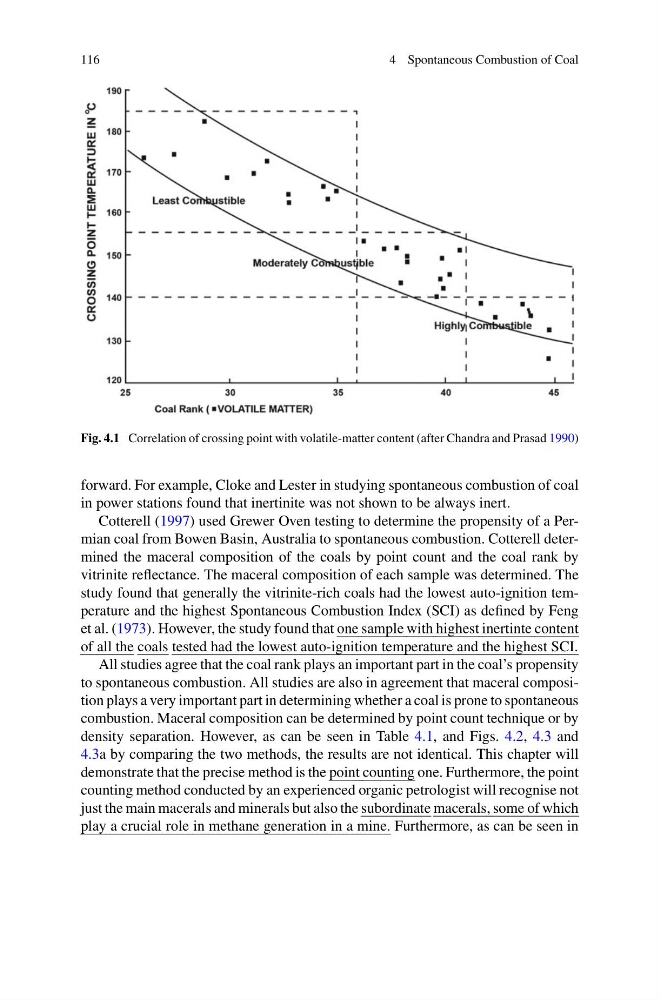
Fig. 4.1 Correlation of crossing point with volatile-matter content (after Chandra and Prasad 1990)
forward. For example, Cloke and Lester in studying spontaneous combustion of coal
in power stations found that inertinite was not shown to be always inert.
Cotterell (1997) used Grewer Oven testing to determine the propensity of a Permian coal from Bowen Basin, Australia to spontaneous combustion. Cotterell determined the maceral composition of the coals by point count and the coal rank by
vitrinite reflectance. The maceral composition of each sample was determined. The
study found that generally the vitrinite-rich coals had the lowest auto-ignition temperature and the highest Spontaneous Combustion Index (SCI) as defined by Feng
et al. (1973). However, the study found that one sample with highest inertinte content
of all the coals tested had the lowest auto-ignition temperature and the highest SCI.
All studies agree that the coal rank plays an important part in the coal’s propensity
to spontaneous combustion. All studies are also in agreement that maceral composition plays a very important part in determining whether a coal is prone to spontaneous
combustion. Maceral composition can be determined by point count technique or by
density separation. However, as can be seen in Table 4.1, and Figs. 4.2, 4.3 and
4.3a by comparing the two methods, the results are not identical. This chapter will
demonstrate that the precise method is the point counting one. Furthermore, the point
counting method conducted by an experienced organic petrologist will recognise not
just the main macerals and minerals but also the subordinate macerals, some of which
play a crucial role in methane generation in a mine. Furthermore, as can be seen in
4 Spontaneous Combustion of Coal
Fig. 4.1 Correlation of crossing point with volatile-matter content (after Chandra and Prasad 1990)
forward. For example, Cloke and Lester in studying spontaneous combustion of coal
in power stations found that inertinite was not shown to be always inert.
Cotterell (1997) used Grewer Oven testing to determine the propensity of a Permian coal from Bowen Basin, Australia to spontaneous combustion. Cotterell determined the maceral composition of the coals by point count and the coal rank by
vitrinite reflectance. The maceral composition of each sample was determined. The
study found that generally the vitrinite-rich coals had the lowest auto-ignition temperature and the highest Spontaneous Combustion Index (SCI) as defined by Feng
et al. (1973). However, the study found that one sample with highest inertinte content
of all the coals tested had the lowest auto-ignition temperature and the highest SCI.
All studies agree that the coal rank plays an important part in the coal’s propensity
to spontaneous combustion. All studies are also in agreement that maceral composition plays a very important part in determining whether a coal is prone to spontaneous
combustion. Maceral composition can be determined by point count technique or by
density separation. However, as can be seen in Table 4.1, and Figs. 4.2, 4.3 and
4.3a by comparing the two methods, the results are not identical. This chapter will
demonstrate that the precise method is the point counting one. Furthermore, the point
counting method conducted by an experienced organic petrologist will recognise not
just the main macerals and minerals but also the subordinate macerals, some of which
play a crucial role in methane generation in a mine. Furthermore, as can be seen in