

3 The Microfloral Assemblages—Their Environmental and Climatic …
103
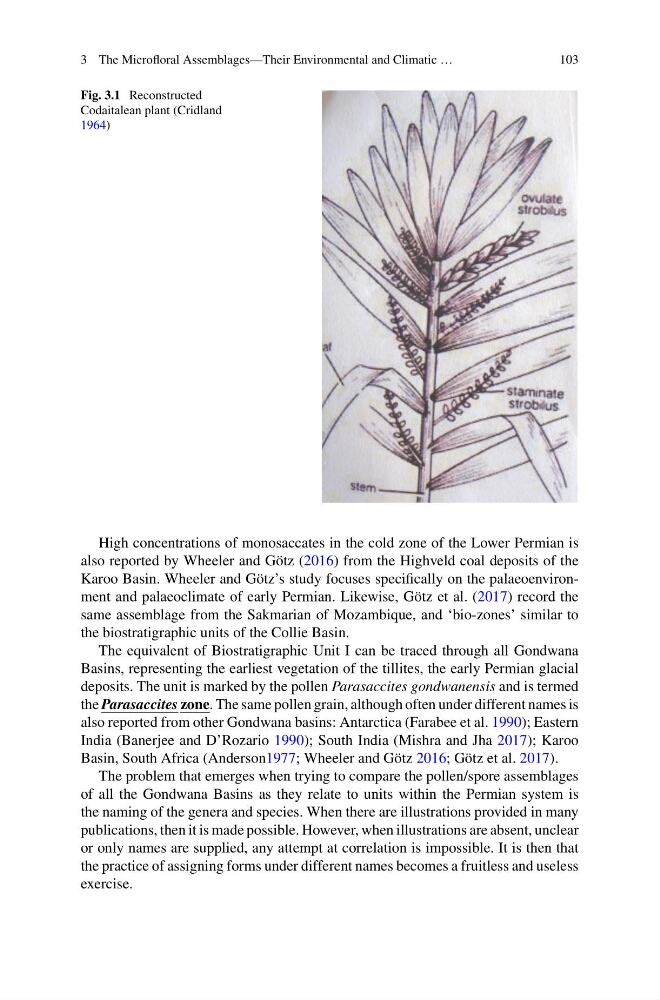
Fig. 3.1 Reconstructed
Codaitalean plant (Cridland
1964)
High concentrations of monosaccates in the cold zone of the Lower Permian is
also reported by Wheeler and Götz (2016) from the Highveld coal deposits of the
Karoo Basin. Wheeler and Götz’s study focuses specifically on the palaeoenvironment and palaeoclimate of early Permian. Likewise, Götz et al. (2017) record the
same assemblage from the Sakmarian of Mozambique, and ‘bio-zones’ similar to
the biostratigraphic units of the Collie Basin.
The equivalent of Biostratigraphic Unit I can be traced through all Gondwana
Basins, representing the earliest vegetation of the tillites, the early Permian glacial
deposits. The unit is marked by the pollen Parasaccites gondwanensis and is termed
the Parasaccites zone. The same pollen grain, although often under different names is
also reported from other Gondwana basins: Antarctica (Farabee et al. 1990); Eastern
India (Banerjee and D’Rozario 1990); South India (Mishra and Jha 2017); Karoo
Basin, South Africa (Anderson1977; Wheeler and Götz 2016; Götz et al. 2017).
The problem that emerges when trying to compare the pollen/spore assemblages
of all the Gondwana Basins as they relate to units within the Permian system is
the naming of the genera and species. When there are illustrations provided in many
publications, then it is made possible. However, when illustrations are absent, unclear
or only names are supplied, any attempt at correlation is impossible. It is then that
the practice of assigning forms under different names becomes a fruitless and useless
exercise.
103
Fig. 3.1 Reconstructed
Codaitalean plant (Cridland
1964)
High concentrations of monosaccates in the cold zone of the Lower Permian is
also reported by Wheeler and Götz (2016) from the Highveld coal deposits of the
Karoo Basin. Wheeler and Götz’s study focuses specifically on the palaeoenvironment and palaeoclimate of early Permian. Likewise, Götz et al. (2017) record the
same assemblage from the Sakmarian of Mozambique, and ‘bio-zones’ similar to
the biostratigraphic units of the Collie Basin.
The equivalent of Biostratigraphic Unit I can be traced through all Gondwana
Basins, representing the earliest vegetation of the tillites, the early Permian glacial
deposits. The unit is marked by the pollen Parasaccites gondwanensis and is termed
the Parasaccites zone. The same pollen grain, although often under different names is
also reported from other Gondwana basins: Antarctica (Farabee et al. 1990); Eastern
India (Banerjee and D’Rozario 1990); South India (Mishra and Jha 2017); Karoo
Basin, South Africa (Anderson1977; Wheeler and Götz 2016; Götz et al. 2017).
The problem that emerges when trying to compare the pollen/spore assemblages
of all the Gondwana Basins as they relate to units within the Permian system is
the naming of the genera and species. When there are illustrations provided in many
publications, then it is made possible. However, when illustrations are absent, unclear
or only names are supplied, any attempt at correlation is impossible. It is then that
the practice of assigning forms under different names becomes a fruitless and useless
exercise.