

2 Systematic Descriptions
89
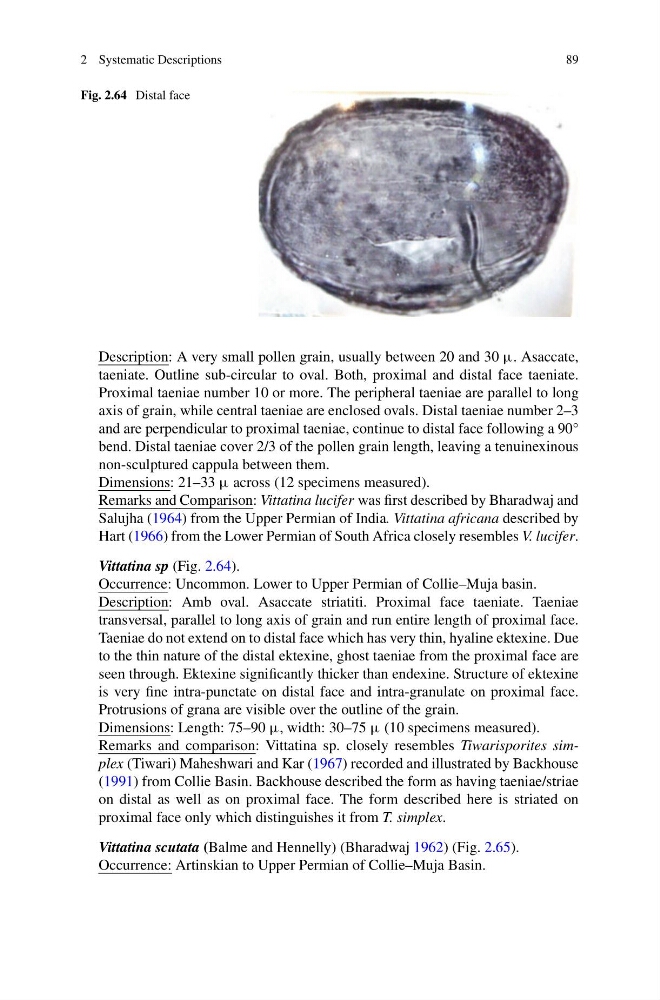
Fig. 2.64 Distal face
Description: A very small pollen grain, usually between 20 and 30 µ. Asaccate,
taeniate. Outline sub-circular to oval. Both, proximal and distal face taeniate.
Proximal taeniae number 10 or more. The peripheral taeniae are parallel to long
axis of grain, while central taeniae are enclosed ovals. Distal taeniae number 2–3
and are perpendicular to proximal taeniae, continue to distal face following a 90°
bend. Distal taeniae cover 2/3 of the pollen grain length, leaving a tenuinexinous
non-sculptured cappula between them.
Dimensions: 21–33 µ across (12 specimens measured).
Remarks and Comparison: Vittatina lucifer was first described by Bharadwaj and
Salujha (1964) from the Upper Permian of India. Vittatina africana described by
Hart (1966) from the Lower Permian of South Africa closely resembles V. lucifer.
Vittatina sp (Fig. 2.64).
Occurrence: Uncommon. Lower to Upper Permian of Collie–Muja basin.
Description: Amb oval. Asaccate striatiti. Proximal face taeniate. Taeniae
transversal, parallel to long axis of grain and run entire length of proximal face.
Taeniae do not extend on to distal face which has very thin, hyaline ektexine. Due
to the thin nature of the distal ektexine, ghost taeniae from the proximal face are
seen through. Ektexine significantly thicker than endexine. Structure of ektexine
is very fine intra-punctate on distal face and intra-granulate on proximal face.
Protrusions of grana are visible over the outline of the grain.
Dimensions: Length: 75–90 µ, width: 30–75 µ (10 specimens measured).
Remarks and comparison: Vittatina sp. closely resembles Tiwarisporites simplex (Tiwari) Maheshwari and Kar (1967) recorded and illustrated by Backhouse
(1991) from Collie Basin. Backhouse described the form as having taeniae/striae
on distal as well as on proximal face. The form described here is striated on
proximal face only which distinguishes it from T. simplex.
Vittatina scutata (Balme and Hennelly) (Bharadwaj 1962) (Fig. 2.65).
Occurrence: Artinskian to Upper Permian of Collie–Muja Basin.
89
Fig. 2.64 Distal face
Description: A very small pollen grain, usually between 20 and 30 µ. Asaccate,
taeniate. Outline sub-circular to oval. Both, proximal and distal face taeniate.
Proximal taeniae number 10 or more. The peripheral taeniae are parallel to long
axis of grain, while central taeniae are enclosed ovals. Distal taeniae number 2–3
and are perpendicular to proximal taeniae, continue to distal face following a 90°
bend. Distal taeniae cover 2/3 of the pollen grain length, leaving a tenuinexinous
non-sculptured cappula between them.
Dimensions: 21–33 µ across (12 specimens measured).
Remarks and Comparison: Vittatina lucifer was first described by Bharadwaj and
Salujha (1964) from the Upper Permian of India. Vittatina africana described by
Hart (1966) from the Lower Permian of South Africa closely resembles V. lucifer.
Vittatina sp (Fig. 2.64).
Occurrence: Uncommon. Lower to Upper Permian of Collie–Muja basin.
Description: Amb oval. Asaccate striatiti. Proximal face taeniate. Taeniae
transversal, parallel to long axis of grain and run entire length of proximal face.
Taeniae do not extend on to distal face which has very thin, hyaline ektexine. Due
to the thin nature of the distal ektexine, ghost taeniae from the proximal face are
seen through. Ektexine significantly thicker than endexine. Structure of ektexine
is very fine intra-punctate on distal face and intra-granulate on proximal face.
Protrusions of grana are visible over the outline of the grain.
Dimensions: Length: 75–90 µ, width: 30–75 µ (10 specimens measured).
Remarks and comparison: Vittatina sp. closely resembles Tiwarisporites simplex (Tiwari) Maheshwari and Kar (1967) recorded and illustrated by Backhouse
(1991) from Collie Basin. Backhouse described the form as having taeniae/striae
on distal as well as on proximal face. The form described here is striated on
proximal face only which distinguishes it from T. simplex.
Vittatina scutata (Balme and Hennelly) (Bharadwaj 1962) (Fig. 2.65).
Occurrence: Artinskian to Upper Permian of Collie–Muja Basin.