

CHAPTER III
RESULTS AND DISCUSSION
56
B: The bioplastic produced using glycerol, gelatin and spirulina
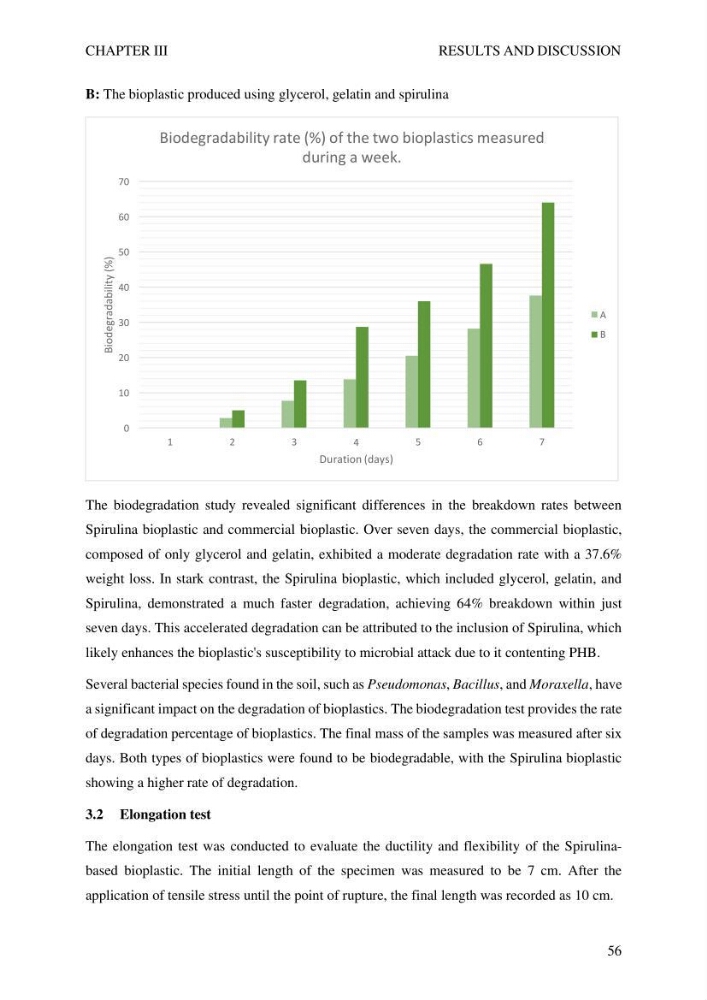
The biodegradation study revealed significant differences in the breakdown rates between
Spirulina bioplastic and commercial bioplastic. Over seven days, the commercial bioplastic,
composed of only glycerol and gelatin, exhibited a moderate degradation rate with a 37.6%
weight loss. In stark contrast, the Spirulina bioplastic, which included glycerol, gelatin, and
Spirulina, demonstrated a much faster degradation, achieving 64% breakdown within just
seven days. This accelerated degradation can be attributed to the inclusion of Spirulina, which
likely enhances the bioplastic's susceptibility to microbial attack due to it contenting PHB.
Several bacterial species found in the soil, such as Pseudomonas, Bacillus, and Moraxella, have
a significant impact on the degradation of bioplastics. The biodegradation test provides the rate
of degradation percentage of bioplastics. The final mass of the samples was measured after six
days. Both types of bioplastics were found to be biodegradable, with the Spirulina bioplastic
showing a higher rate of degradation.
3.2 Elongation test
The elongation test was conducted to evaluate the ductility and flexibility of the Spirulinabased bioplastic. The initial length of the specimen was measured to be 7 cm. After the
application of tensile stress until the point of rupture, the final length was recorded as 10 cm.
Biodegradability rate (%) of the two bioplastics measured
during a week.
70
60
50
40
30
A
B
20
10
0
1
2
3
4
Duration (days)
5
6
7
Biodegradability (%)
RESULTS AND DISCUSSION
56
B: The bioplastic produced using glycerol, gelatin and spirulina
The biodegradation study revealed significant differences in the breakdown rates between
Spirulina bioplastic and commercial bioplastic. Over seven days, the commercial bioplastic,
composed of only glycerol and gelatin, exhibited a moderate degradation rate with a 37.6%
weight loss. In stark contrast, the Spirulina bioplastic, which included glycerol, gelatin, and
Spirulina, demonstrated a much faster degradation, achieving 64% breakdown within just
seven days. This accelerated degradation can be attributed to the inclusion of Spirulina, which
likely enhances the bioplastic's susceptibility to microbial attack due to it contenting PHB.
Several bacterial species found in the soil, such as Pseudomonas, Bacillus, and Moraxella, have
a significant impact on the degradation of bioplastics. The biodegradation test provides the rate
of degradation percentage of bioplastics. The final mass of the samples was measured after six
days. Both types of bioplastics were found to be biodegradable, with the Spirulina bioplastic
showing a higher rate of degradation.
3.2 Elongation test
The elongation test was conducted to evaluate the ductility and flexibility of the Spirulinabased bioplastic. The initial length of the specimen was measured to be 7 cm. After the
application of tensile stress until the point of rupture, the final length was recorded as 10 cm.
Biodegradability rate (%) of the two bioplastics measured
during a week.
70
60
50
40
30
A
B
20
10
0
1
2
3
4
Duration (days)
5
6
7
Biodegradability (%)