

36
2 Basic Ecology
2.3.1.3 Step 3: Sublimation
Sublimation is defined as the conversion from a solid to a gaseous state of matter
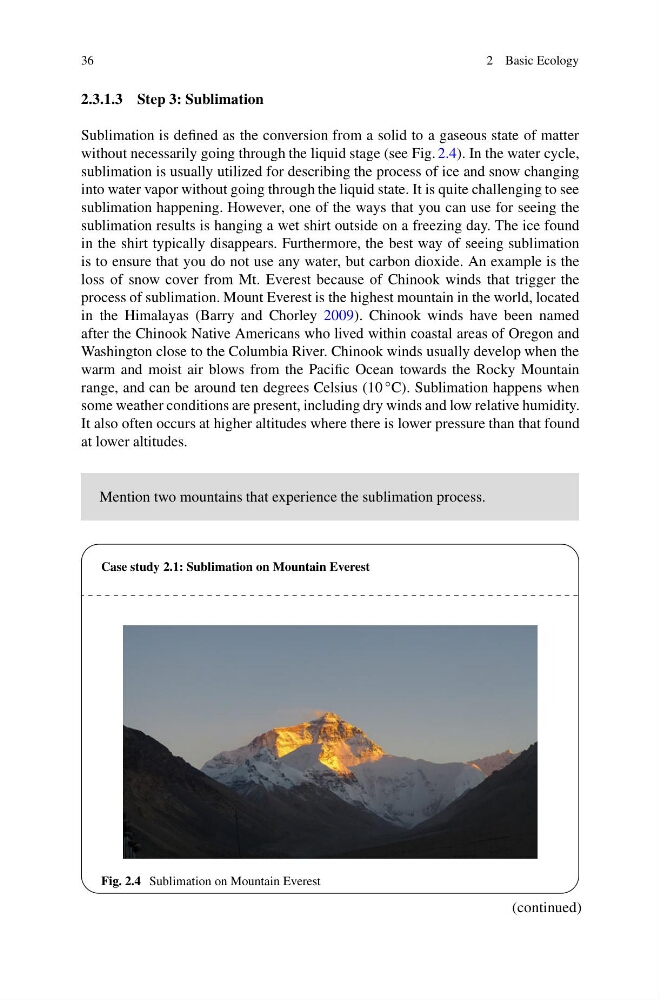
without necessarily going through the liquid stage (see Fig. 2.4). In the water cycle,
sublimation is usually utilized for describing the process of ice and snow changing
into water vapor without going through the liquid state. It is quite challenging to see
sublimation happening. However, one of the ways that you can use for seeing the
sublimation results is hanging a wet shirt outside on a freezing day. The ice found
in the shirt typically disappears. Furthermore, the best way of seeing sublimation
is to ensure that you do not use any water, but carbon dioxide. An example is the
loss of snow cover from Mt. Everest because of Chinook winds that trigger the
process of sublimation. Mount Everest is the highest mountain in the world, located
in the Himalayas (Barry and Chorley 2009). Chinook winds have been named
after the Chinook Native Americans who lived within coastal areas of Oregon and
Washington close to the Columbia River. Chinook winds usually develop when the
warm and moist air blows from the Pacific Ocean towards the Rocky Mountain
range, and can be around ten degrees Celsius (10 ◦ C). Sublimation happens when
some weather conditions are present, including dry winds and low relative humidity.
It also often occurs at higher altitudes where there is lower pressure than that found
at lower altitudes.
Mention two mountains that experience the sublimation process.
(continued)
Case study 2.1: Sublimation on Mountain Everest
Fig. 2.4 Sublimation on Mountain Everest
2 Basic Ecology
2.3.1.3 Step 3: Sublimation
Sublimation is defined as the conversion from a solid to a gaseous state of matter
without necessarily going through the liquid stage (see Fig. 2.4). In the water cycle,
sublimation is usually utilized for describing the process of ice and snow changing
into water vapor without going through the liquid state. It is quite challenging to see
sublimation happening. However, one of the ways that you can use for seeing the
sublimation results is hanging a wet shirt outside on a freezing day. The ice found
in the shirt typically disappears. Furthermore, the best way of seeing sublimation
is to ensure that you do not use any water, but carbon dioxide. An example is the
loss of snow cover from Mt. Everest because of Chinook winds that trigger the
process of sublimation. Mount Everest is the highest mountain in the world, located
in the Himalayas (Barry and Chorley 2009). Chinook winds have been named
after the Chinook Native Americans who lived within coastal areas of Oregon and
Washington close to the Columbia River. Chinook winds usually develop when the
warm and moist air blows from the Pacific Ocean towards the Rocky Mountain
range, and can be around ten degrees Celsius (10 ◦ C). Sublimation happens when
some weather conditions are present, including dry winds and low relative humidity.
It also often occurs at higher altitudes where there is lower pressure than that found
at lower altitudes.
Mention two mountains that experience the sublimation process.
(continued)
Case study 2.1: Sublimation on Mountain Everest
Fig. 2.4 Sublimation on Mountain Everest