

9.4 Environmental Risk Assessment
203
9.4.2 Description of Environmental Risk Assessment (ERA)
As earlier defined, environmental risk assessment (ERA) is a process used for
evaluating the likelihood of human activities causing environmental damage or
harm. It is a formal procedure that is necessary for the identification and estimation
of the risk of environmental damage. The procedure is usually triggered when an
important decision can affect the environment. Despite having numerous stages, it
can be categorized into three major stages: preparation, carrying out the assessment
and interpretation, and application of assessment’s results.
Preparation entails the collection and review of relevant background information
as well as establishing the assessment’s focus. Environmental risk assessment
(ERA) can be applied in various situations, including ones with minimal data
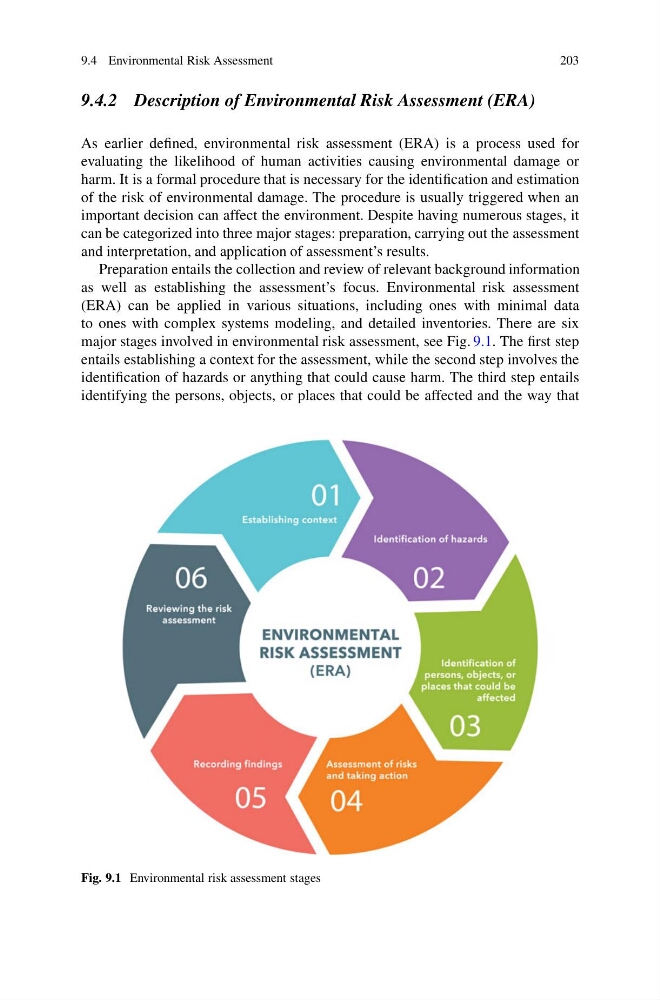
to ones with complex systems modeling, and detailed inventories. There are six
major stages involved in environmental risk assessment, see Fig. 9.1. The first step
entails establishing a context for the assessment, while the second step involves the
identification of hazards or anything that could cause harm. The third step entails
identifying the persons, objects, or places that could be affected and the way that
Fig. 9.1 Environmental risk assessment stages
203
9.4.2 Description of Environmental Risk Assessment (ERA)
As earlier defined, environmental risk assessment (ERA) is a process used for
evaluating the likelihood of human activities causing environmental damage or
harm. It is a formal procedure that is necessary for the identification and estimation
of the risk of environmental damage. The procedure is usually triggered when an
important decision can affect the environment. Despite having numerous stages, it
can be categorized into three major stages: preparation, carrying out the assessment
and interpretation, and application of assessment’s results.
Preparation entails the collection and review of relevant background information
as well as establishing the assessment’s focus. Environmental risk assessment
(ERA) can be applied in various situations, including ones with minimal data
to ones with complex systems modeling, and detailed inventories. There are six
major stages involved in environmental risk assessment, see Fig. 9.1. The first step
entails establishing a context for the assessment, while the second step involves the
identification of hazards or anything that could cause harm. The third step entails
identifying the persons, objects, or places that could be affected and the way that
Fig. 9.1 Environmental risk assessment stages