

184
8 Waste Management
8.8 Challenges of Waste Management in African Countries
Waste management in developing economies experience outdated collection services that are inadequately handled and dumpsites that are insufficiently controlled.
These problems are exacerbated by governance issues. The management of wastes
in these areas is a consistent challenge because of rapid urbanization, weak
institutions, and under-resourcing. Along with various factors, these challenges
influence waste treatment.
Poor urban planning has been one of the major challenges facing waste management in African cities such as Kampala, Nairobi, Kisumu, and Tripoli. The
island of Zanzibar is one of the major examples of obstacles linked to rapid
urbanization in Africa. It does not have an official strategy regarding biomedical
waste management. It is estimated that about 50% of the waste generated in
Zanzibar Town is dumped in the neighborhood or burnt locally (Guerrero et al.
2013). Some of these challenges are also brought about by insufficient funds that
would have enabled the development of an integrated waste management system.
Consequently, there is a need for African countries to re-strategize and develop
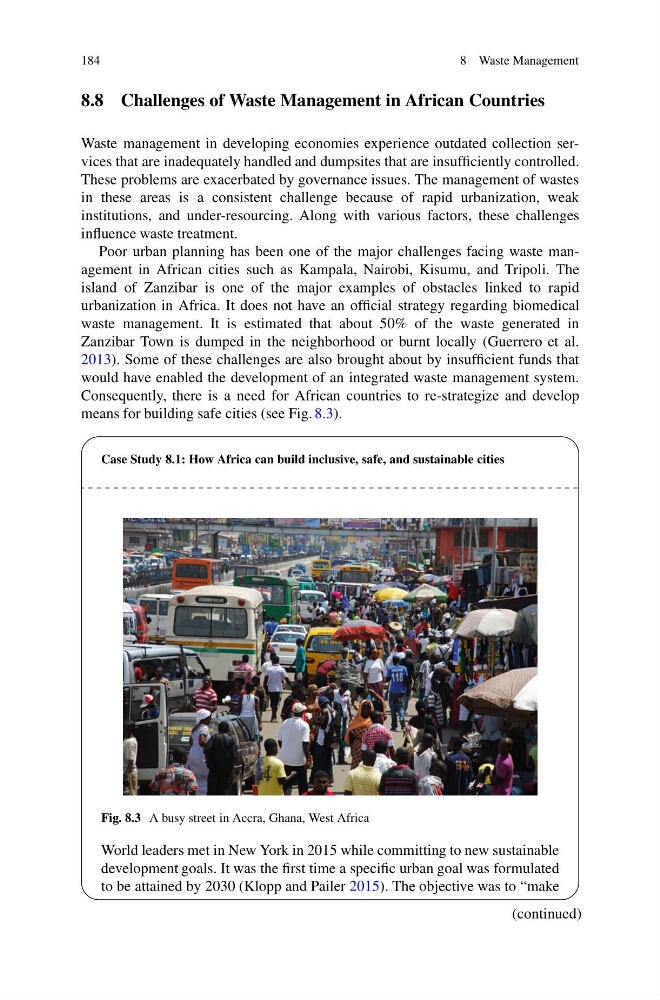
means for building safe cities (see Fig. 8.3).
(continued)
Case Study 8.1: How Africa can build inclusive, safe, and sustainable cities
Fig. 8.3 A busy street in Accra, Ghana, West Africa
World leaders met in New York in 2015 while committing to new sustainable
development goals. It was the first time a specific urban goal was formulated
to be attained by 2030 (Klopp and Pailer 2015). The objective was to “make
8 Waste Management
8.8 Challenges of Waste Management in African Countries
Waste management in developing economies experience outdated collection services that are inadequately handled and dumpsites that are insufficiently controlled.
These problems are exacerbated by governance issues. The management of wastes
in these areas is a consistent challenge because of rapid urbanization, weak
institutions, and under-resourcing. Along with various factors, these challenges
influence waste treatment.
Poor urban planning has been one of the major challenges facing waste management in African cities such as Kampala, Nairobi, Kisumu, and Tripoli. The
island of Zanzibar is one of the major examples of obstacles linked to rapid
urbanization in Africa. It does not have an official strategy regarding biomedical
waste management. It is estimated that about 50% of the waste generated in
Zanzibar Town is dumped in the neighborhood or burnt locally (Guerrero et al.
2013). Some of these challenges are also brought about by insufficient funds that
would have enabled the development of an integrated waste management system.
Consequently, there is a need for African countries to re-strategize and develop
means for building safe cities (see Fig. 8.3).
(continued)
Case Study 8.1: How Africa can build inclusive, safe, and sustainable cities
Fig. 8.3 A busy street in Accra, Ghana, West Africa
World leaders met in New York in 2015 while committing to new sustainable
development goals. It was the first time a specific urban goal was formulated
to be attained by 2030 (Klopp and Pailer 2015). The objective was to “make