

174
8 Waste Management
8.2 Concepts of Waste Management: Definition of Terms
8.2.1 Waste
Waste is defined as any substance that is discarded after its primary use or is
valueless, defective, and of no use (Silva et al. 2017). Some examples of waste
are municipal solid waste, hazardous waste, radioactive waste, and wastewater.
8.2.2 Waste Management
Waste management is defined as the actions and activities that are needed for
managing waste from the start to the final stage of disposal. Some aspects are the
collection, transportation, treatment, disposal, monitoring, regulation, and the legal
and regulatory framework (Silva et al. 2017).
8.2.3 Waste Hierarchy
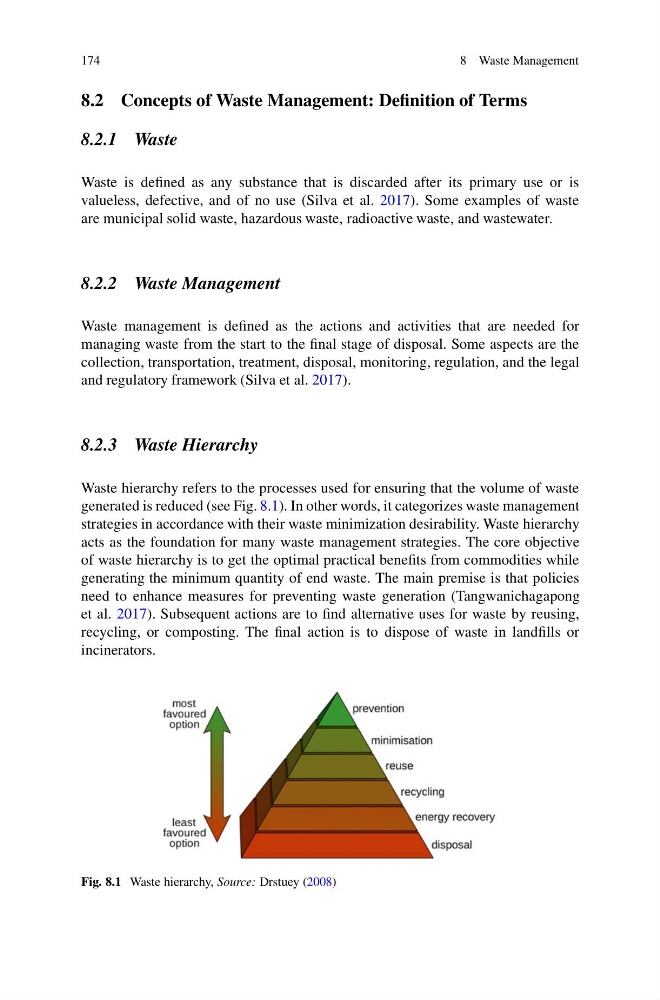
Waste hierarchy refers to the processes used for ensuring that the volume of waste
generated is reduced (see Fig. 8.1). In other words, it categorizes waste management
strategies in accordance with their waste minimization desirability. Waste hierarchy
acts as the foundation for many waste management strategies. The core objective
of waste hierarchy is to get the optimal practical benefits from commodities while
generating the minimum quantity of end waste. The main premise is that policies
need to enhance measures for preventing waste generation (Tangwanichagapong
et al. 2017). Subsequent actions are to find alternative uses for waste by reusing,
recycling, or composting. The final action is to dispose of waste in landfills or
incinerators.
Fig. 8.1 Waste hierarchy, Source: Drstuey (2008)
8 Waste Management
8.2 Concepts of Waste Management: Definition of Terms
8.2.1 Waste
Waste is defined as any substance that is discarded after its primary use or is
valueless, defective, and of no use (Silva et al. 2017). Some examples of waste
are municipal solid waste, hazardous waste, radioactive waste, and wastewater.
8.2.2 Waste Management
Waste management is defined as the actions and activities that are needed for
managing waste from the start to the final stage of disposal. Some aspects are the
collection, transportation, treatment, disposal, monitoring, regulation, and the legal
and regulatory framework (Silva et al. 2017).
8.2.3 Waste Hierarchy
Waste hierarchy refers to the processes used for ensuring that the volume of waste
generated is reduced (see Fig. 8.1). In other words, it categorizes waste management
strategies in accordance with their waste minimization desirability. Waste hierarchy
acts as the foundation for many waste management strategies. The core objective
of waste hierarchy is to get the optimal practical benefits from commodities while
generating the minimum quantity of end waste. The main premise is that policies
need to enhance measures for preventing waste generation (Tangwanichagapong
et al. 2017). Subsequent actions are to find alternative uses for waste by reusing,
recycling, or composting. The final action is to dispose of waste in landfills or
incinerators.
Fig. 8.1 Waste hierarchy, Source: Drstuey (2008)