

140
6 Renewable Energy
Case Study 6.1: Humpback whale
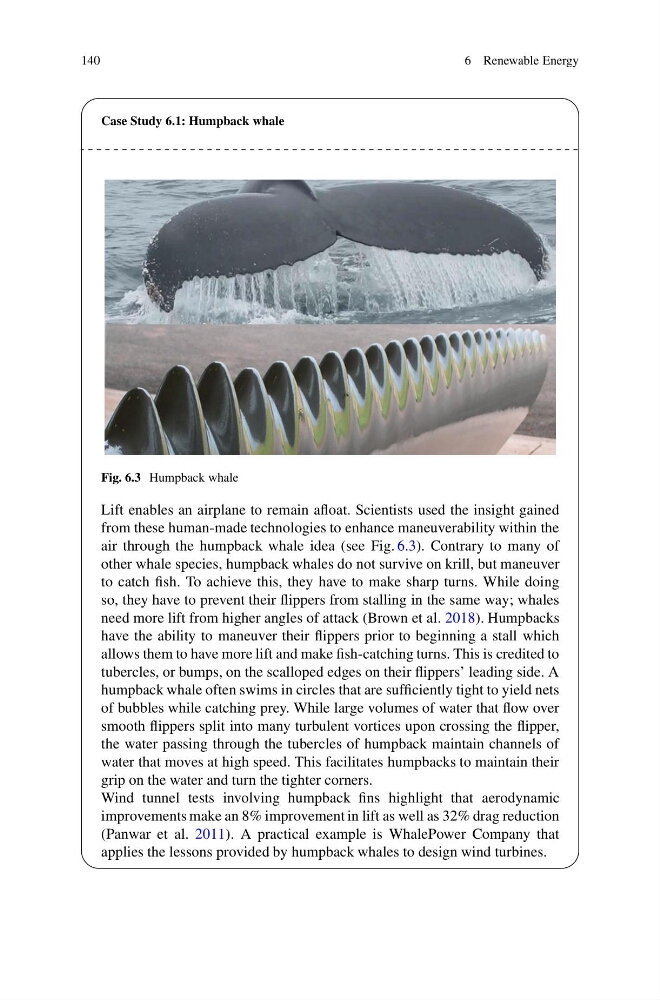
Fig. 6.3 Humpback whale
Lift enables an airplane to remain afloat. Scientists used the insight gained
from these human-made technologies to enhance maneuverability within the
air through the humpback whale idea (see Fig. 6.3). Contrary to many of
other whale species, humpback whales do not survive on krill, but maneuver
to catch fish. To achieve this, they have to make sharp turns. While doing
so, they have to prevent their flippers from stalling in the same way; whales
need more lift from higher angles of attack (Brown et al. 2018). Humpbacks
have the ability to maneuver their flippers prior to beginning a stall which
allows them to have more lift and make fish-catching turns. This is credited to
tubercles, or bumps, on the scalloped edges on their flippers’ leading side. A
humpback whale often swims in circles that are sufficiently tight to yield nets
of bubbles while catching prey. While large volumes of water that flow over
smooth flippers split into many turbulent vortices upon crossing the flipper,
the water passing through the tubercles of humpback maintain channels of
water that moves at high speed. This facilitates humpbacks to maintain their
grip on the water and turn the tighter corners.
Wind tunnel tests involving humpback fins highlight that aerodynamic
improvements make an 8% improvement in lift as well as 32% drag reduction
(Panwar et al. 2011). A practical example is WhalePower Company that
applies the lessons provided by humpback whales to design wind turbines.
6 Renewable Energy
Case Study 6.1: Humpback whale
Fig. 6.3 Humpback whale
Lift enables an airplane to remain afloat. Scientists used the insight gained
from these human-made technologies to enhance maneuverability within the
air through the humpback whale idea (see Fig. 6.3). Contrary to many of
other whale species, humpback whales do not survive on krill, but maneuver
to catch fish. To achieve this, they have to make sharp turns. While doing
so, they have to prevent their flippers from stalling in the same way; whales
need more lift from higher angles of attack (Brown et al. 2018). Humpbacks
have the ability to maneuver their flippers prior to beginning a stall which
allows them to have more lift and make fish-catching turns. This is credited to
tubercles, or bumps, on the scalloped edges on their flippers’ leading side. A
humpback whale often swims in circles that are sufficiently tight to yield nets
of bubbles while catching prey. While large volumes of water that flow over
smooth flippers split into many turbulent vortices upon crossing the flipper,
the water passing through the tubercles of humpback maintain channels of
water that moves at high speed. This facilitates humpbacks to maintain their
grip on the water and turn the tighter corners.
Wind tunnel tests involving humpback fins highlight that aerodynamic
improvements make an 8% improvement in lift as well as 32% drag reduction
(Panwar et al. 2011). A practical example is WhalePower Company that
applies the lessons provided by humpback whales to design wind turbines.