

136
6 Renewable Energy
6.2 Types of Renewable Energy
The main types of renewable energy are solar, wind, geothermal, hydroelectric
power, biomass, and biofuels. As earlier stated, many of these forms rely on
sunlight. Hydroelectric power and wind directly result from differential heating of
the surface of the Earth, which results in wind and precipitation formation as the
air gets lifted. Solar energy directly results from sunlight conversion using solar
collectors or panels (Muruganantham et al. 2017). Geothermal energy does not rely
on sunlight and results from radioactive decay within the crust when combining with
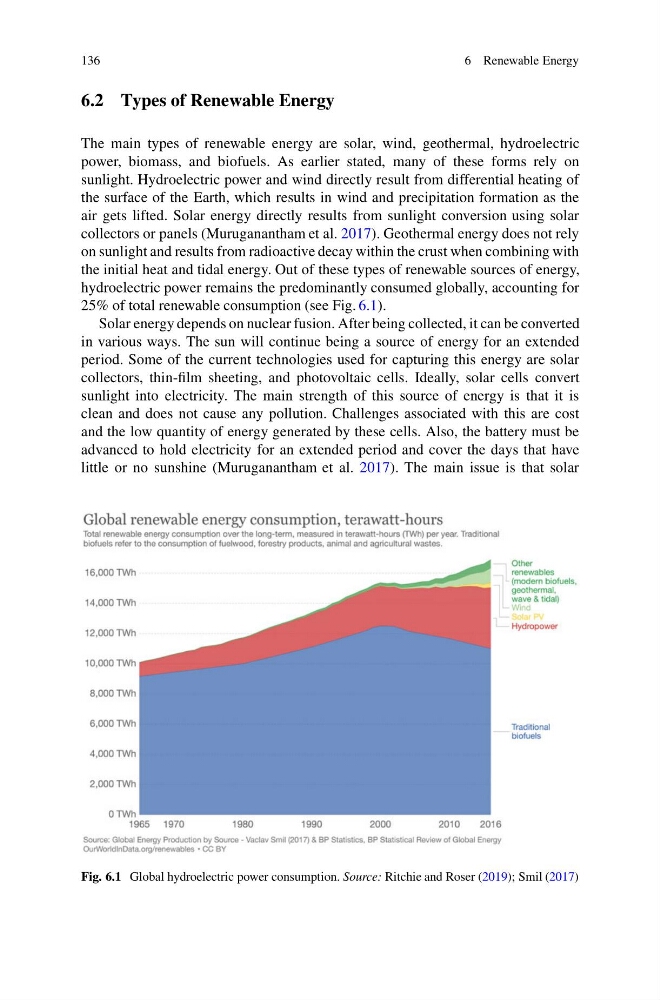
the initial heat and tidal energy. Out of these types of renewable sources of energy,
hydroelectric power remains the predominantly consumed globally, accounting for
25% of total renewable consumption (see Fig. 6.1).
Solar energy depends on nuclear fusion. After being collected, it can be converted
in various ways. The sun will continue being a source of energy for an extended
period. Some of the current technologies used for capturing this energy are solar
collectors, thin-film sheeting, and photovoltaic cells. Ideally, solar cells convert
sunlight into electricity. The main strength of this source of energy is that it is
clean and does not cause any pollution. Challenges associated with this are cost
and the low quantity of energy generated by these cells. Also, the battery must be
advanced to hold electricity for an extended period and cover the days that have
little or no sunshine (Muruganantham et al. 2017). The main issue is that solar
Fig. 6.1 Global hydroelectric power consumption. Source: Ritchie and Roser (2019); Smil (2017)
6 Renewable Energy
6.2 Types of Renewable Energy
The main types of renewable energy are solar, wind, geothermal, hydroelectric
power, biomass, and biofuels. As earlier stated, many of these forms rely on
sunlight. Hydroelectric power and wind directly result from differential heating of
the surface of the Earth, which results in wind and precipitation formation as the
air gets lifted. Solar energy directly results from sunlight conversion using solar
collectors or panels (Muruganantham et al. 2017). Geothermal energy does not rely
on sunlight and results from radioactive decay within the crust when combining with
the initial heat and tidal energy. Out of these types of renewable sources of energy,
hydroelectric power remains the predominantly consumed globally, accounting for
25% of total renewable consumption (see Fig. 6.1).
Solar energy depends on nuclear fusion. After being collected, it can be converted
in various ways. The sun will continue being a source of energy for an extended
period. Some of the current technologies used for capturing this energy are solar
collectors, thin-film sheeting, and photovoltaic cells. Ideally, solar cells convert
sunlight into electricity. The main strength of this source of energy is that it is
clean and does not cause any pollution. Challenges associated with this are cost
and the low quantity of energy generated by these cells. Also, the battery must be
advanced to hold electricity for an extended period and cover the days that have
little or no sunshine (Muruganantham et al. 2017). The main issue is that solar
Fig. 6.1 Global hydroelectric power consumption. Source: Ritchie and Roser (2019); Smil (2017)