

5.2 Sustainable Ways of Managing and Treating Infectious Diseases
117
7. Record the person you shared the body fluids with.
8. Repeat the same steps for the third share or person and record the person
you shared your body fluids with on your table.
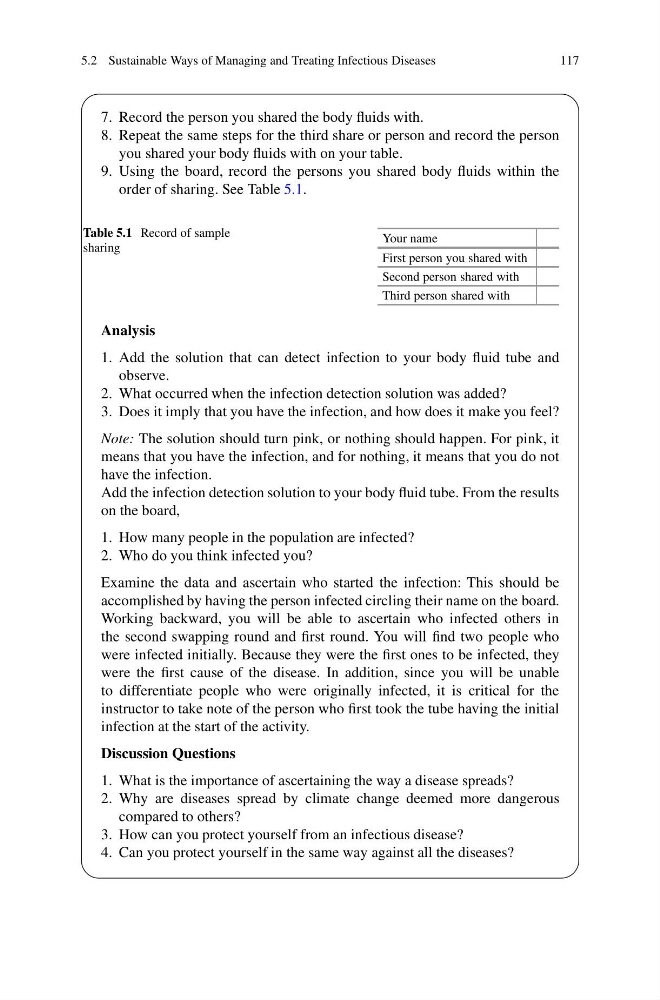
9. Using the board, record the persons you shared body fluids within the
order of sharing. See Table 5.1.
Table 5.1 Record of sample
sharing
Your name
First person you shared with
Second person shared with
Third person shared with
Analysis
1. Add the solution that can detect infection to your body fluid tube and
observe.
2. What occurred when the infection detection solution was added?
3. Does it imply that you have the infection, and how does it make you feel?
Note: The solution should turn pink, or nothing should happen. For pink, it
means that you have the infection, and for nothing, it means that you do not
have the infection.
Add the infection detection solution to your body fluid tube. From the results
on the board,
1. How many people in the population are infected?
2. Who do you think infected you?
Examine the data and ascertain who started the infection: This should be
accomplished by having the person infected circling their name on the board.
Working backward, you will be able to ascertain who infected others in
the second swapping round and first round. You will find two people who
were infected initially. Because they were the first ones to be infected, they
were the first cause of the disease. In addition, since you will be unable
to differentiate people who were originally infected, it is critical for the
instructor to take note of the person who first took the tube having the initial
infection at the start of the activity.
Discussion Questions
1. What is the importance of ascertaining the way a disease spreads?
2. Why are diseases spread by climate change deemed more dangerous
compared to others?
3. How can you protect yourself from an infectious disease?
4. Can you protect yourself in the same way against all the diseases?
117
7. Record the person you shared the body fluids with.
8. Repeat the same steps for the third share or person and record the person
you shared your body fluids with on your table.
9. Using the board, record the persons you shared body fluids within the
order of sharing. See Table 5.1.
Table 5.1 Record of sample
sharing
Your name
First person you shared with
Second person shared with
Third person shared with
Analysis
1. Add the solution that can detect infection to your body fluid tube and
observe.
2. What occurred when the infection detection solution was added?
3. Does it imply that you have the infection, and how does it make you feel?
Note: The solution should turn pink, or nothing should happen. For pink, it
means that you have the infection, and for nothing, it means that you do not
have the infection.
Add the infection detection solution to your body fluid tube. From the results
on the board,
1. How many people in the population are infected?
2. Who do you think infected you?
Examine the data and ascertain who started the infection: This should be
accomplished by having the person infected circling their name on the board.
Working backward, you will be able to ascertain who infected others in
the second swapping round and first round. You will find two people who
were infected initially. Because they were the first ones to be infected, they
were the first cause of the disease. In addition, since you will be unable
to differentiate people who were originally infected, it is critical for the
instructor to take note of the person who first took the tube having the initial
infection at the start of the activity.
Discussion Questions
1. What is the importance of ascertaining the way a disease spreads?
2. Why are diseases spread by climate change deemed more dangerous
compared to others?
3. How can you protect yourself from an infectious disease?
4. Can you protect yourself in the same way against all the diseases?