

68
The potential of mangroves to control erosion is today used in several erosion
prone areas to protect the soil particles from being washed away by tidal activities, currents and wave actions. However all species of mangroves cannot function uniformly in all types of environments, e.g., Sonneratia apetala, S.
caseolaris and Heritiera fomes survive well in hyposaline environment as seen
in stations 1 to 5, but Avicennia spp. thrive luxuriantly in high saline areas with
relatively better survival rate as witnessed in stations 6 to 10 (refer to Fig. 2.4
and Table 2.6 in Chap. 2 for the locations and names of the stations). Depending
on the survival rate and growth of the floral species, the pattern of erosion gets
modified along the intertidal mudflats. The survival rates of common mangrove
species found in Indian Sundarbans in 10 selected stations are presented in
Table 3.3 and Figs. 3.9, 3.10, 3.11, 3.12, 3.13, 3.14, 3.15, 3.16, 3.17, 3.18, 3.19,
3.20, 3.21, 3.22, 3.23 and 3.24.
Survival rate is a signature of the degree of the environmental stress on a particular/group of species. More the stress posed by environmental variables, less is the
chance of survival. Depending on the adaptive capacity of species, the rate of survival varies greatly among different sites.
The western Indian Sundarbans has a different set of environmental parameters
compared to the central sector, particularly with respect to salinity (Mitra et al.
2009; Mitra et al. 2011; Banerjee et al. 2013; Mitra 2013; Raha et al. 2013; Trivedi
et al. 2016; Mitra 2018). This variation in salinity is due to complete blockage of
the fresh water in the central sector of Indian Sundarbans due to Bidhyadhari siltation since the late fifteenth century (Chaudhuri and Choudhury 1994; Mitra 2013),
which has made the region hyper-saline compared to the western sector that receives
fresh water through Farakka barrage discharge. Such a variation of salinity is the
major driving force behind survival percentage in the present geographical locale as
mangrove flora are capable of adjusting in different salinity gradient depending on
their salt regulating capacity.
The present study thus points out very clearly the different degrees of adaptation
of the mangrove species to ambient salinity and suggests the right kind of species
to be planted (as per their respective adaptation to salinity) for controlling erosion
in coastal regions.
Effective control of erosion along the estuaries and beaches can be carried out if
the species are properly selected on the basis of their survival rate and biomass. In
this context a study was conducted covering 24 stations of Indian Sundarbans (see
Fig. 3.31 for the selected stations in the study area) distributed in different salinity
gradients. The study was carried out in three phases during 1996, 2006 and 2015,
and the core findings that came out from the study are (i) Sonneratia apetala is well
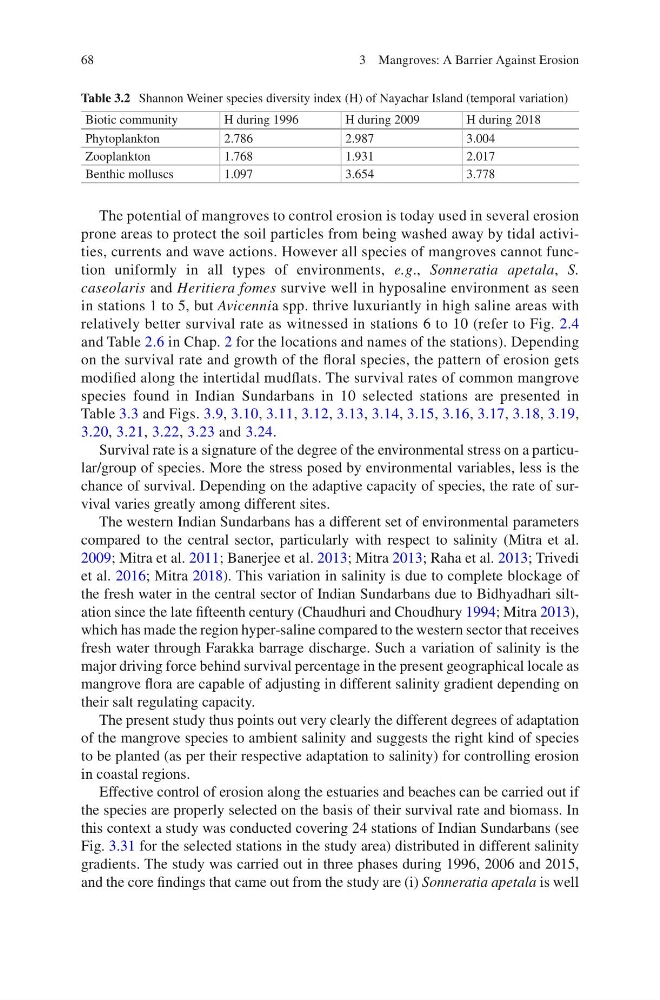
Table 3.2 Shannon Weiner species diversity index (H) of Nayachar Island (temporal variation)
Biotic community
H during 1996
H during 2009
H during 2018
Phytoplankton
2.786
2.987
3.004
Zooplankton
1.768
1.931
2.017
Benthic molluscs
1.097
3.654
3.778
3 Mangroves: A Barrier Against Erosion
The potential of mangroves to control erosion is today used in several erosion
prone areas to protect the soil particles from being washed away by tidal activities, currents and wave actions. However all species of mangroves cannot function uniformly in all types of environments, e.g., Sonneratia apetala, S.
caseolaris and Heritiera fomes survive well in hyposaline environment as seen
in stations 1 to 5, but Avicennia spp. thrive luxuriantly in high saline areas with
relatively better survival rate as witnessed in stations 6 to 10 (refer to Fig. 2.4
and Table 2.6 in Chap. 2 for the locations and names of the stations). Depending
on the survival rate and growth of the floral species, the pattern of erosion gets
modified along the intertidal mudflats. The survival rates of common mangrove
species found in Indian Sundarbans in 10 selected stations are presented in
Table 3.3 and Figs. 3.9, 3.10, 3.11, 3.12, 3.13, 3.14, 3.15, 3.16, 3.17, 3.18, 3.19,
3.20, 3.21, 3.22, 3.23 and 3.24.
Survival rate is a signature of the degree of the environmental stress on a particular/group of species. More the stress posed by environmental variables, less is the
chance of survival. Depending on the adaptive capacity of species, the rate of survival varies greatly among different sites.
The western Indian Sundarbans has a different set of environmental parameters
compared to the central sector, particularly with respect to salinity (Mitra et al.
2009; Mitra et al. 2011; Banerjee et al. 2013; Mitra 2013; Raha et al. 2013; Trivedi
et al. 2016; Mitra 2018). This variation in salinity is due to complete blockage of
the fresh water in the central sector of Indian Sundarbans due to Bidhyadhari siltation since the late fifteenth century (Chaudhuri and Choudhury 1994; Mitra 2013),
which has made the region hyper-saline compared to the western sector that receives
fresh water through Farakka barrage discharge. Such a variation of salinity is the
major driving force behind survival percentage in the present geographical locale as
mangrove flora are capable of adjusting in different salinity gradient depending on
their salt regulating capacity.
The present study thus points out very clearly the different degrees of adaptation
of the mangrove species to ambient salinity and suggests the right kind of species
to be planted (as per their respective adaptation to salinity) for controlling erosion
in coastal regions.
Effective control of erosion along the estuaries and beaches can be carried out if
the species are properly selected on the basis of their survival rate and biomass. In
this context a study was conducted covering 24 stations of Indian Sundarbans (see
Fig. 3.31 for the selected stations in the study area) distributed in different salinity
gradients. The study was carried out in three phases during 1996, 2006 and 2015,
and the core findings that came out from the study are (i) Sonneratia apetala is well
Table 3.2 Shannon Weiner species diversity index (H) of Nayachar Island (temporal variation)
Biotic community
H during 1996
H during 2009
H during 2018
Phytoplankton
2.786
2.987
3.004
Zooplankton
1.768
1.931
2.017
Benthic molluscs
1.097
3.654
3.778
3 Mangroves: A Barrier Against Erosion