

47
The vegetation is considered as cylindrical obstacles and the vegetation properties
as height, width, density, drag-coefficient are used to determine the magnitude of
dissipation term.
The SWAN model is simulated with real time in situ collected data of four dominant mangrove species (Sonneratia apetala, Avicennia marina, Avicennia alba and
Avicennia officinalis) in Hooghly and Matla estuaries. Average salinity in Hooghly
estuary is around 15 psu, whereas in Matla estuary the average salinity is 22 psu.
The Hooghly estuary is hyposaline because of the Farakka Barrage discharge,
whereas the Matla estuary is hypersaline because of the siltation in the head region
blocking the input of fresh water in the estuarine stretch.
The input data includes height of the tree, diameter of the tree (diameter at breast
height as per the standard protocol), mud thickness and bulk density as real time
data for the months of July and November, 2018 representing the monsoon and
postmonsoon seasons respectively. It has been observed that Sonneratia apetala is
adapted to low saline environment (range 5 psu to 15 psu), whereas Avicennia
marina, Avicennia alba and Avicennia officinalis prefer hyper saline condition
(greater than 20 psu as observed in the inshore waters of central Indian Sundarbans)
(Mitra 2013).
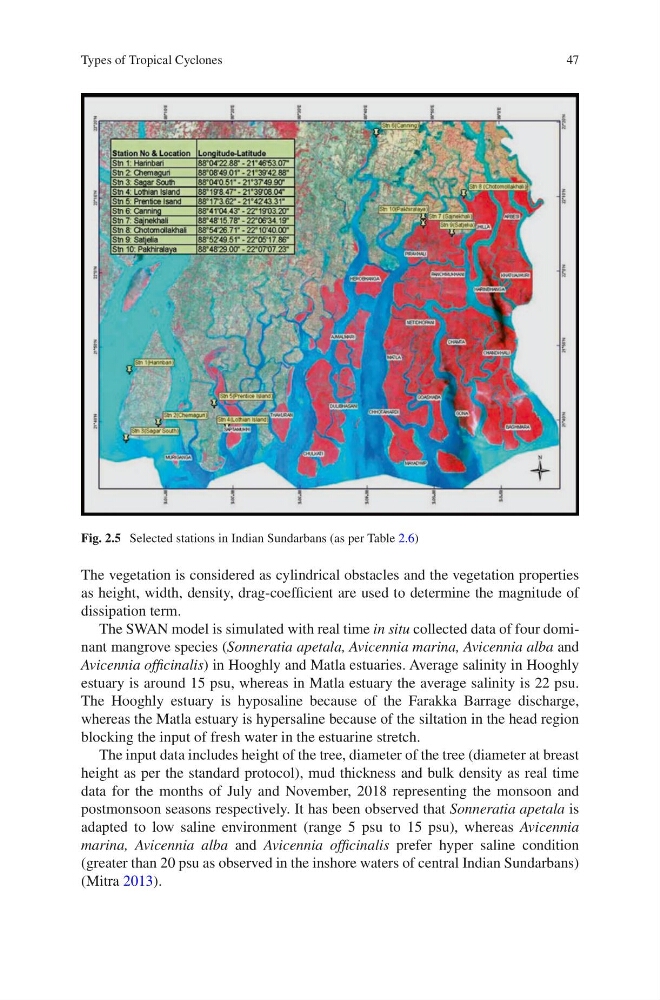
Fig. 2.5 Selected stations in Indian Sundarbans (as per Table 2.6)
Types of Tropical Cyclones
The vegetation is considered as cylindrical obstacles and the vegetation properties
as height, width, density, drag-coefficient are used to determine the magnitude of
dissipation term.
The SWAN model is simulated with real time in situ collected data of four dominant mangrove species (Sonneratia apetala, Avicennia marina, Avicennia alba and
Avicennia officinalis) in Hooghly and Matla estuaries. Average salinity in Hooghly
estuary is around 15 psu, whereas in Matla estuary the average salinity is 22 psu.
The Hooghly estuary is hyposaline because of the Farakka Barrage discharge,
whereas the Matla estuary is hypersaline because of the siltation in the head region
blocking the input of fresh water in the estuarine stretch.
The input data includes height of the tree, diameter of the tree (diameter at breast
height as per the standard protocol), mud thickness and bulk density as real time
data for the months of July and November, 2018 representing the monsoon and
postmonsoon seasons respectively. It has been observed that Sonneratia apetala is
adapted to low saline environment (range 5 psu to 15 psu), whereas Avicennia
marina, Avicennia alba and Avicennia officinalis prefer hyper saline condition
(greater than 20 psu as observed in the inshore waters of central Indian Sundarbans)
(Mitra 2013).
Fig. 2.5 Selected stations in Indian Sundarbans (as per Table 2.6)
Types of Tropical Cyclones