

306
written by Valmiki some two centuries later. The Ramayana mentions Chandrabati’s
Kantha stitching as one of the skills that Sita excelled. Women of Sundarbans are
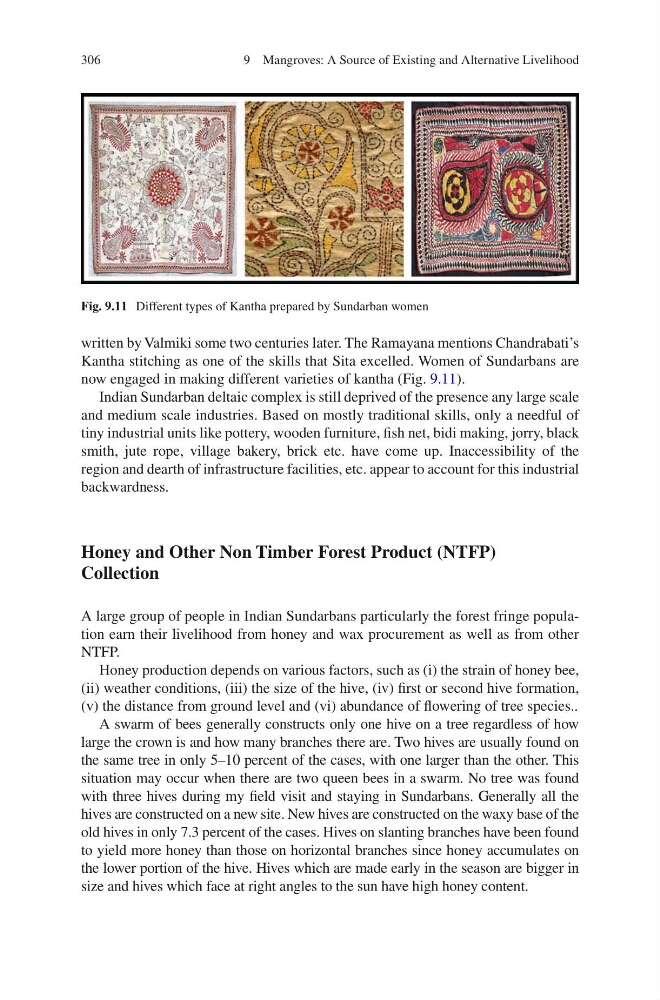
now engaged in making different varieties of kantha (Fig. 9.11).
Indian Sundarban deltaic complex is still deprived of the presence any large scale
and medium scale industries. Based on mostly traditional skills, only a needful of
tiny industrial units like pottery, wooden furniture, fish net, bidi making, jorry, black
smith, jute rope, village bakery, brick etc. have come up. Inaccessibility of the
region and dearth of infrastructure facilities, etc. appear to account for this industrial
backwardness.
Honey and Other Non Timber Forest Product (NTFP)
Collection
A large group of people in Indian Sundarbans particularly the forest fringe population earn their livelihood from honey and wax procurement as well as from other
NTFP.
Honey production depends on various factors, such as (i) the strain of honey bee,
(ii) weather conditions, (iii) the size of the hive, (iv) first or second hive formation,
(v) the distance from ground level and (vi) abundance of flowering of tree species..
A swarm of bees generally constructs only one hive on a tree regardless of how
large the crown is and how many branches there are. Two hives are usually found on
the same tree in only 5–10 percent of the cases, with one larger than the other. This
situation may occur when there are two queen bees in a swarm. No tree was found
with three hives during my field visit and staying in Sundarbans. Generally all the
hives are constructed on a new site. New hives are constructed on the waxy base of the
old hives in only 7.3 percent of the cases. Hives on slanting branches have been found
to yield more honey than those on horizontal branches since honey accumulates on
the lower portion of the hive. Hives which are made early in the season are bigger in
size and hives which face at right angles to the sun have high honey content.
Fig. 9.11 Different types of Kantha prepared by Sundarban women
9 Mangroves: A Source of Existing and Alternative Livelihood
written by Valmiki some two centuries later. The Ramayana mentions Chandrabati’s
Kantha stitching as one of the skills that Sita excelled. Women of Sundarbans are
now engaged in making different varieties of kantha (Fig. 9.11).
Indian Sundarban deltaic complex is still deprived of the presence any large scale
and medium scale industries. Based on mostly traditional skills, only a needful of
tiny industrial units like pottery, wooden furniture, fish net, bidi making, jorry, black
smith, jute rope, village bakery, brick etc. have come up. Inaccessibility of the
region and dearth of infrastructure facilities, etc. appear to account for this industrial
backwardness.
Honey and Other Non Timber Forest Product (NTFP)
Collection
A large group of people in Indian Sundarbans particularly the forest fringe population earn their livelihood from honey and wax procurement as well as from other
NTFP.
Honey production depends on various factors, such as (i) the strain of honey bee,
(ii) weather conditions, (iii) the size of the hive, (iv) first or second hive formation,
(v) the distance from ground level and (vi) abundance of flowering of tree species..
A swarm of bees generally constructs only one hive on a tree regardless of how
large the crown is and how many branches there are. Two hives are usually found on
the same tree in only 5–10 percent of the cases, with one larger than the other. This
situation may occur when there are two queen bees in a swarm. No tree was found
with three hives during my field visit and staying in Sundarbans. Generally all the
hives are constructed on a new site. New hives are constructed on the waxy base of the
old hives in only 7.3 percent of the cases. Hives on slanting branches have been found
to yield more honey than those on horizontal branches since honey accumulates on
the lower portion of the hive. Hives which are made early in the season are bigger in
size and hives which face at right angles to the sun have high honey content.
Fig. 9.11 Different types of Kantha prepared by Sundarban women
9 Mangroves: A Source of Existing and Alternative Livelihood