

279
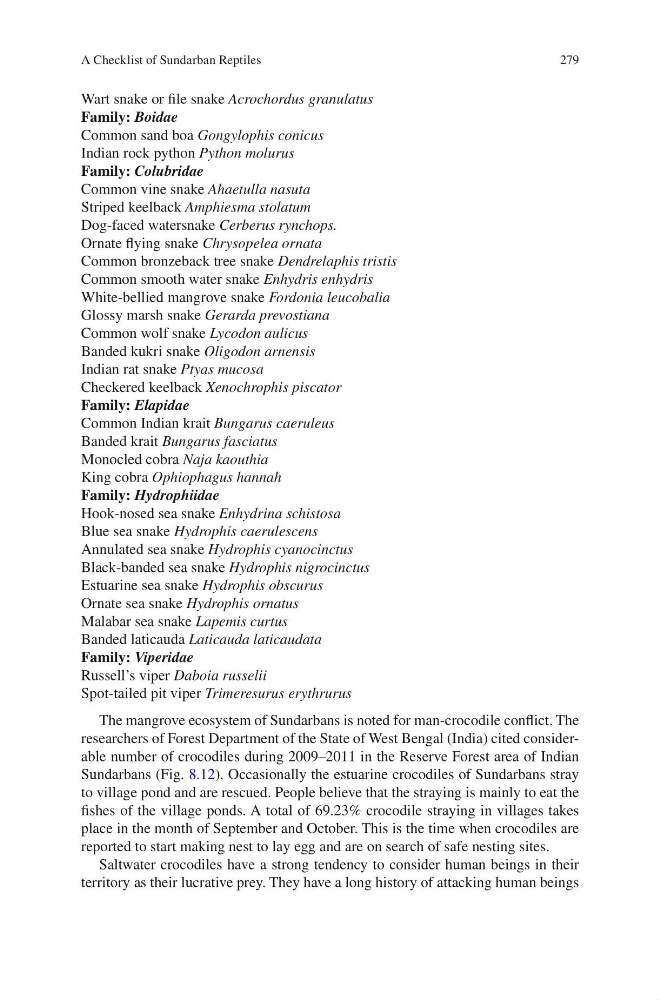
Wart snake or file snake Acrochordus granulatus
Family: Boidae
Common sand boa Gongylophis conicus
Indian rock python Python molurus
Family: Colubridae
Common vine snake Ahaetulla nasuta
Striped keelback Amphiesma stolatum
Dog-faced watersnake Cerberus rynchops.
Ornate flying snake Chrysopelea ornata
Common bronzeback tree snake Dendrelaphis tristis
Common smooth water snake Enhydris enhydris
White-bellied mangrove snake Fordonia leucobalia
Glossy marsh snake Gerarda prevostiana
Common wolf snake Lycodon aulicus
Banded kukri snake Oligodon arnensis
Indian rat snake Ptyas mucosa
Checkered keelback Xenochrophis piscator
Family: Elapidae
Common Indian krait Bungarus caeruleus
Banded krait Bungarus fasciatus
Monocled cobra Naja kaouthia
King cobra Ophiophagus hannah
Family: Hydrophiidae
Hook-nosed sea snake Enhydrina schistosa
Blue sea snake Hydrophis caerulescens
Annulated sea snake Hydrophis cyanocinctus
Black-banded sea snake Hydrophis nigrocinctus
Estuarine sea snake Hydrophis obscurus
Ornate sea snake Hydrophis ornatus
Malabar sea snake Lapemis curtus
Banded laticauda Laticauda laticaudata
Family: Viperidae
Russell’s viper Daboia russelii
Spot-tailed pit viper Trimeresurus erythrurus
The mangrove ecosystem of Sundarbans is noted for man-crocodile conflict. The
researchers of Forest Department of the State of West Bengal (India) cited considerable number of crocodiles during 2009–2011 in the Reserve Forest area of Indian
Sundarbans (Fig. 8.12). Occasionally the estuarine crocodiles of Sundarbans stray
to village pond and are rescued. People believe that the straying is mainly to eat the
fishes of the village ponds. A total of 69.23% crocodile straying in villages takes
place in the month of September and October. This is the time when crocodiles are
reported to start making nest to lay egg and are on search of safe nesting sites.
Saltwater crocodiles have a strong tendency to consider human beings in their
territory as their lucrative prey. They have a long history of attacking human beings
A Checklist of Sundarban Reptiles
Wart snake or file snake Acrochordus granulatus
Family: Boidae
Common sand boa Gongylophis conicus
Indian rock python Python molurus
Family: Colubridae
Common vine snake Ahaetulla nasuta
Striped keelback Amphiesma stolatum
Dog-faced watersnake Cerberus rynchops.
Ornate flying snake Chrysopelea ornata
Common bronzeback tree snake Dendrelaphis tristis
Common smooth water snake Enhydris enhydris
White-bellied mangrove snake Fordonia leucobalia
Glossy marsh snake Gerarda prevostiana
Common wolf snake Lycodon aulicus
Banded kukri snake Oligodon arnensis
Indian rat snake Ptyas mucosa
Checkered keelback Xenochrophis piscator
Family: Elapidae
Common Indian krait Bungarus caeruleus
Banded krait Bungarus fasciatus
Monocled cobra Naja kaouthia
King cobra Ophiophagus hannah
Family: Hydrophiidae
Hook-nosed sea snake Enhydrina schistosa
Blue sea snake Hydrophis caerulescens
Annulated sea snake Hydrophis cyanocinctus
Black-banded sea snake Hydrophis nigrocinctus
Estuarine sea snake Hydrophis obscurus
Ornate sea snake Hydrophis ornatus
Malabar sea snake Lapemis curtus
Banded laticauda Laticauda laticaudata
Family: Viperidae
Russell’s viper Daboia russelii
Spot-tailed pit viper Trimeresurus erythrurus
The mangrove ecosystem of Sundarbans is noted for man-crocodile conflict. The
researchers of Forest Department of the State of West Bengal (India) cited considerable number of crocodiles during 2009–2011 in the Reserve Forest area of Indian
Sundarbans (Fig. 8.12). Occasionally the estuarine crocodiles of Sundarbans stray
to village pond and are rescued. People believe that the straying is mainly to eat the
fishes of the village ponds. A total of 69.23% crocodile straying in villages takes
place in the month of September and October. This is the time when crocodiles are
reported to start making nest to lay egg and are on search of safe nesting sites.
Saltwater crocodiles have a strong tendency to consider human beings in their
territory as their lucrative prey. They have a long history of attacking human beings
A Checklist of Sundarban Reptiles