

263
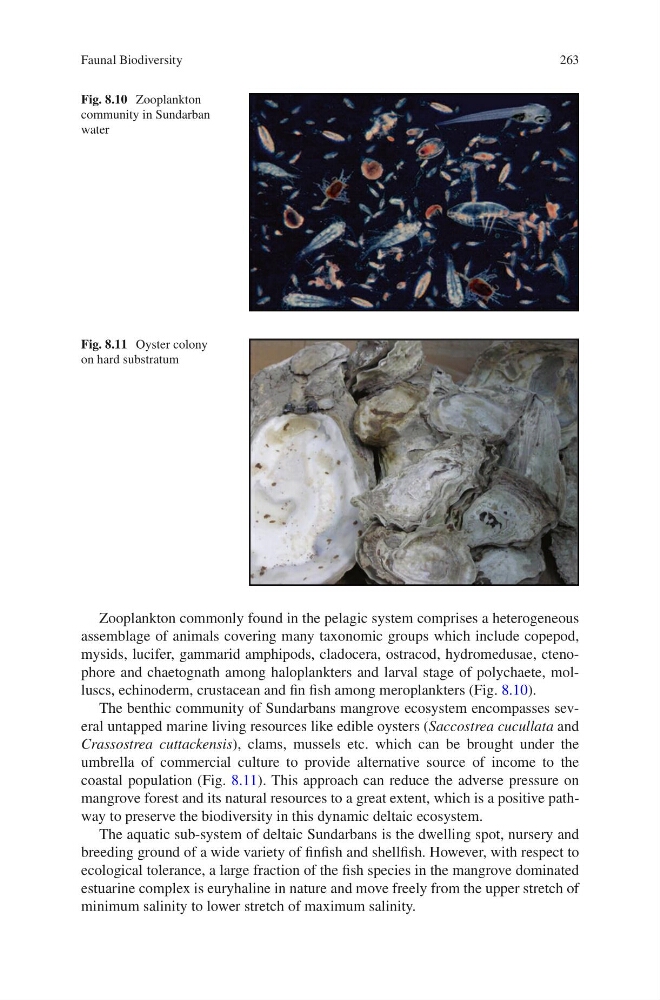
Zooplankton commonly found in the pelagic system comprises a heterogeneous
assemblage of animals covering many taxonomic groups which include copepod,
mysids, lucifer, gammarid amphipods, cladocera, ostracod, hydromedusae, ctenophore and chaetognath among haloplankters and larval stage of polychaete, molluscs, echinoderm, crustacean and fin fish among meroplankters (Fig. 8.10).
The benthic community of Sundarbans mangrove ecosystem encompasses several untapped marine living resources like edible oysters (Saccostrea cucullata and
Crassostrea cuttackensis), clams, mussels etc. which can be brought under the
umbrella of commercial culture to provide alternative source of income to the
coastal population (Fig. 8.11). This approach can reduce the adverse pressure on
mangrove forest and its natural resources to a great extent, which is a positive pathway to preserve the biodiversity in this dynamic deltaic ecosystem.
The aquatic sub-system of deltaic Sundarbans is the dwelling spot, nursery and
breeding ground of a wide variety of finfish and shellfish. However, with respect to
ecological tolerance, a large fraction of the fish species in the mangrove dominated
estuarine complex is euryhaline in nature and move freely from the upper stretch of
minimum salinity to lower stretch of maximum salinity.
Fig. 8.10 Zooplankton
community in Sundarban
water
Fig. 8.11 Oyster colony
on hard substratum
Faunal Biodiversity
Zooplankton commonly found in the pelagic system comprises a heterogeneous
assemblage of animals covering many taxonomic groups which include copepod,
mysids, lucifer, gammarid amphipods, cladocera, ostracod, hydromedusae, ctenophore and chaetognath among haloplankters and larval stage of polychaete, molluscs, echinoderm, crustacean and fin fish among meroplankters (Fig. 8.10).
The benthic community of Sundarbans mangrove ecosystem encompasses several untapped marine living resources like edible oysters (Saccostrea cucullata and
Crassostrea cuttackensis), clams, mussels etc. which can be brought under the
umbrella of commercial culture to provide alternative source of income to the
coastal population (Fig. 8.11). This approach can reduce the adverse pressure on
mangrove forest and its natural resources to a great extent, which is a positive pathway to preserve the biodiversity in this dynamic deltaic ecosystem.
The aquatic sub-system of deltaic Sundarbans is the dwelling spot, nursery and
breeding ground of a wide variety of finfish and shellfish. However, with respect to
ecological tolerance, a large fraction of the fish species in the mangrove dominated
estuarine complex is euryhaline in nature and move freely from the upper stretch of
minimum salinity to lower stretch of maximum salinity.
Fig. 8.10 Zooplankton
community in Sundarban
water
Fig. 8.11 Oyster colony
on hard substratum
Faunal Biodiversity