

242
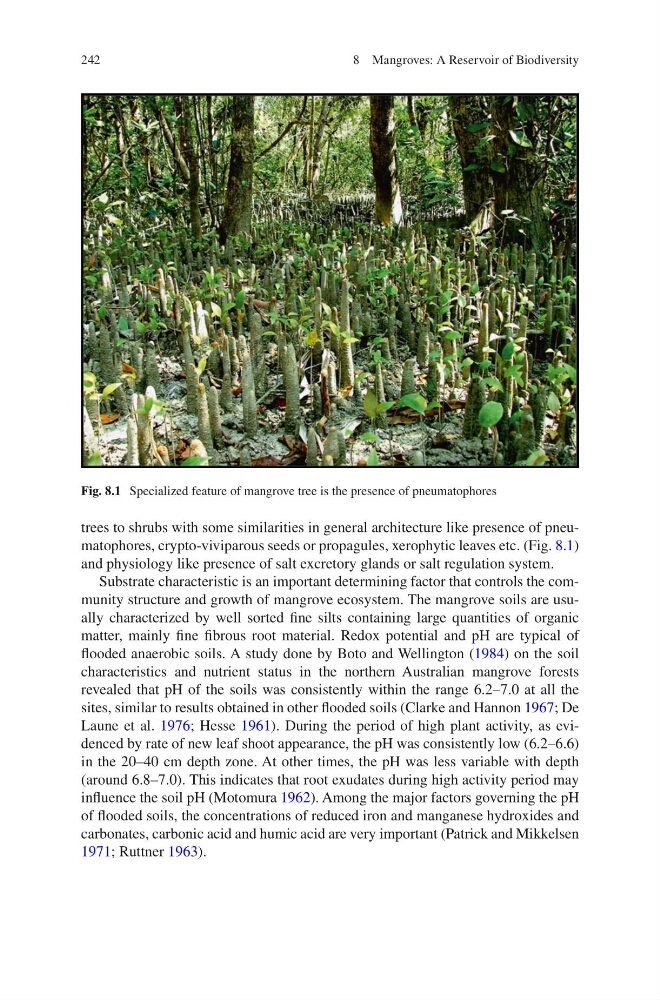
trees to shrubs with some similarities in general architecture like presence of pneumatophores, crypto-viviparous seeds or propagules, xerophytic leaves etc. (Fig. 8.1)
and physiology like presence of salt excretory glands or salt regulation system.
Substrate characteristic is an important determining factor that controls the community structure and growth of mangrove ecosystem. The mangrove soils are usually characterized by well sorted fine silts containing large quantities of organic
matter, mainly fine fibrous root material. Redox potential and pH are typical of
flooded anaerobic soils. A study done by Boto and Wellington (1984) on the soil
characteristics and nutrient status in the northern Australian mangrove forests
revealed that pH of the soils was consistently within the range 6.2–7.0 at all the
sites, similar to results obtained in other flooded soils (Clarke and Hannon 1967; De
Laune et al. 1976; Hesse 1961). During the period of high plant activity, as evidenced by rate of new leaf shoot appearance, the pH was consistently low (6.2–6.6)
in the 20–40 cm depth zone. At other times, the pH was less variable with depth
(around 6.8–7.0). This indicates that root exudates during high activity period may
influence the soil pH (Motomura 1962). Among the major factors governing the pH
of flooded soils, the concentrations of reduced iron and manganese hydroxides and
carbonates, carbonic acid and humic acid are very important (Patrick and Mikkelsen
1971; Ruttner 1963).
Fig. 8.1 Specialized feature of mangrove tree is the presence of pneumatophores
8 Mangroves: A Reservoir of Biodiversity
trees to shrubs with some similarities in general architecture like presence of pneumatophores, crypto-viviparous seeds or propagules, xerophytic leaves etc. (Fig. 8.1)
and physiology like presence of salt excretory glands or salt regulation system.
Substrate characteristic is an important determining factor that controls the community structure and growth of mangrove ecosystem. The mangrove soils are usually characterized by well sorted fine silts containing large quantities of organic
matter, mainly fine fibrous root material. Redox potential and pH are typical of
flooded anaerobic soils. A study done by Boto and Wellington (1984) on the soil
characteristics and nutrient status in the northern Australian mangrove forests
revealed that pH of the soils was consistently within the range 6.2–7.0 at all the
sites, similar to results obtained in other flooded soils (Clarke and Hannon 1967; De
Laune et al. 1976; Hesse 1961). During the period of high plant activity, as evidenced by rate of new leaf shoot appearance, the pH was consistently low (6.2–6.6)
in the 20–40 cm depth zone. At other times, the pH was less variable with depth
(around 6.8–7.0). This indicates that root exudates during high activity period may
influence the soil pH (Motomura 1962). Among the major factors governing the pH
of flooded soils, the concentrations of reduced iron and manganese hydroxides and
carbonates, carbonic acid and humic acid are very important (Patrick and Mikkelsen
1971; Ruttner 1963).
Fig. 8.1 Specialized feature of mangrove tree is the presence of pneumatophores
8 Mangroves: A Reservoir of Biodiversity