

222
In all the 18 stations, selected forest patches were ~11 years old. In each station,
15 sample plots (10 m × 10 m) were laid (in the river bank) through random sampling
in the various qualitatively classified biomass levels. The random sampling accounts
for the largest variability in the biomass range. Samplings in all these stations were
carried out in low tide period during August, 2015.
Above-ground biomass (AGB) in these species refers to the sum of total stem,
branch and leaf biomass that are exposed above the soil. AGB of individual trees of
five dominant species in each plot was estimated and the average values of 15 plots
from each station were finally converted into biomass (tonnes ha
−1
) in the study
area. BGB of the trees could not be assessed as the trees could not be felled as per
the conservation norms.
Above-Ground Stem Biomass Estimation
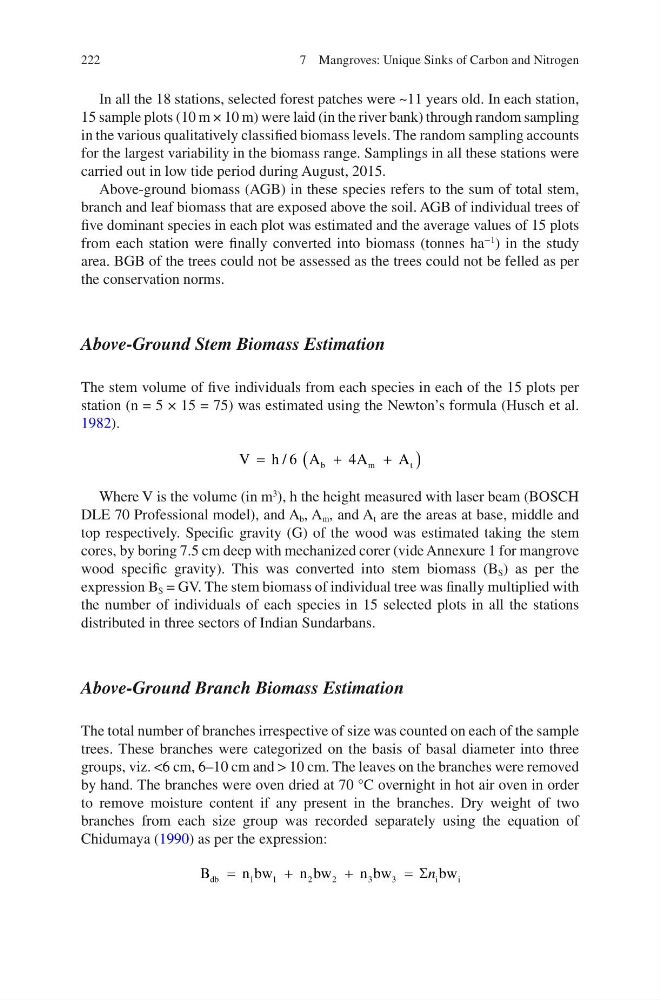
The stem volume of five individuals from each species in each of the 15 plots per
station (n = 5 × 15 = 75) was estimated using the Newton’s formula (Husch et al.
1982).
V h
A
A
A
b
m
t
=
+
+
(
)
/ 6
4
Where V is the volume (in m
3
), h the height measured with laser beam (BOSCH
DLE 70 Professional model), and A b , A m , and A t are the areas at base, middle and
top respectively. Specific gravity (G) of the wood was estimated taking the stem
cores, by boring 7.5 cm deep with mechanized corer (vide Annexure 1 for mangrove
wood specific gravity). This was converted into stem biomass (B S ) as per the
expression B S = GV. The stem biomass of individual tree was finally multiplied with
the number of individuals of each species in 15 selected plots in all the stations
distributed in three sectors of Indian Sundarbans.
Above-Ground Branch Biomass Estimation
The total number of branches irrespective of size was counted on each of the sample
trees. These branches were categorized on the basis of basal diameter into three
groups, viz. <6 cm, 6–10 cm and > 10 cm. The leaves on the branches were removed
by hand. The branches were oven dried at 70 °C overnight in hot air oven in order
to remove moisture content if any present in the branches. Dry weight of two
branches from each size group was recorded separately using the equation of
Chidumaya (1990) as per the expression:
B
n bw
n bw
n bw
bw
db
i
i
=
+
+
=
1
1
2
2
3
3
Σn
7 Mangroves: Unique Sinks of Carbon and Nitrogen
In all the 18 stations, selected forest patches were ~11 years old. In each station,
15 sample plots (10 m × 10 m) were laid (in the river bank) through random sampling
in the various qualitatively classified biomass levels. The random sampling accounts
for the largest variability in the biomass range. Samplings in all these stations were
carried out in low tide period during August, 2015.
Above-ground biomass (AGB) in these species refers to the sum of total stem,
branch and leaf biomass that are exposed above the soil. AGB of individual trees of
five dominant species in each plot was estimated and the average values of 15 plots
from each station were finally converted into biomass (tonnes ha
−1
) in the study
area. BGB of the trees could not be assessed as the trees could not be felled as per
the conservation norms.
Above-Ground Stem Biomass Estimation
The stem volume of five individuals from each species in each of the 15 plots per
station (n = 5 × 15 = 75) was estimated using the Newton’s formula (Husch et al.
1982).
V h
A
A
A
b
m
t
=
+
+
(
)
/ 6
4
Where V is the volume (in m
3
), h the height measured with laser beam (BOSCH
DLE 70 Professional model), and A b , A m , and A t are the areas at base, middle and
top respectively. Specific gravity (G) of the wood was estimated taking the stem
cores, by boring 7.5 cm deep with mechanized corer (vide Annexure 1 for mangrove
wood specific gravity). This was converted into stem biomass (B S ) as per the
expression B S = GV. The stem biomass of individual tree was finally multiplied with
the number of individuals of each species in 15 selected plots in all the stations
distributed in three sectors of Indian Sundarbans.
Above-Ground Branch Biomass Estimation
The total number of branches irrespective of size was counted on each of the sample
trees. These branches were categorized on the basis of basal diameter into three
groups, viz. <6 cm, 6–10 cm and > 10 cm. The leaves on the branches were removed
by hand. The branches were oven dried at 70 °C overnight in hot air oven in order
to remove moisture content if any present in the branches. Dry weight of two
branches from each size group was recorded separately using the equation of
Chidumaya (1990) as per the expression:
B
n bw
n bw
n bw
bw
db
i
i
=
+
+
=
1
1
2
2
3
3
Σn
7 Mangroves: Unique Sinks of Carbon and Nitrogen