

173
mangrove margin position, change in mangrove coordinates will be variable
(Woodroffe 1995). For example, forces affecting sediment-budget balances, including changes in sediment inputs from rivers, variations in coastal currents and wind
directions and strength, and construction of seawalls and other shoreline erosion
control structures, can produce erosion or accretion of the mangrove seaward margin irrespective of any change in sea level. Wave actions and tidal surges arising as
output of cyclones and storms also devastate the coastal zone, although mangroves
can stand as effective barrier to such natural disasters as witnessed during 2004
tsunami. Again in the mangrove dominated Indian parts of Sundarbans, there are
examples in many islands where the mangrove remained unaltered in terms of area,
although land loss occurred with greater magnitude due to super cyclone AILA during May, 2009.
The satellite imageries of pre- and post- AILA period (Figs. 6.11, 6.12, 6.13,
6.14, 6.15, 6.16, 6.17, 6.18, and 6.19) clearly exhibit insignificant changes to mangroves although land areas of nine islands in Indian Sundarbans have changed significantly between years.
The significant change in land area between years (p < 0.01) may be the effect of
erosion or sea level rise caused by subsidence of deltaic region (Table 6.6).
To summarize, it can be stated that the peat building potential of mangroves is a
major weapon of these unique halophytes to combat the sea level rise. Mangroves
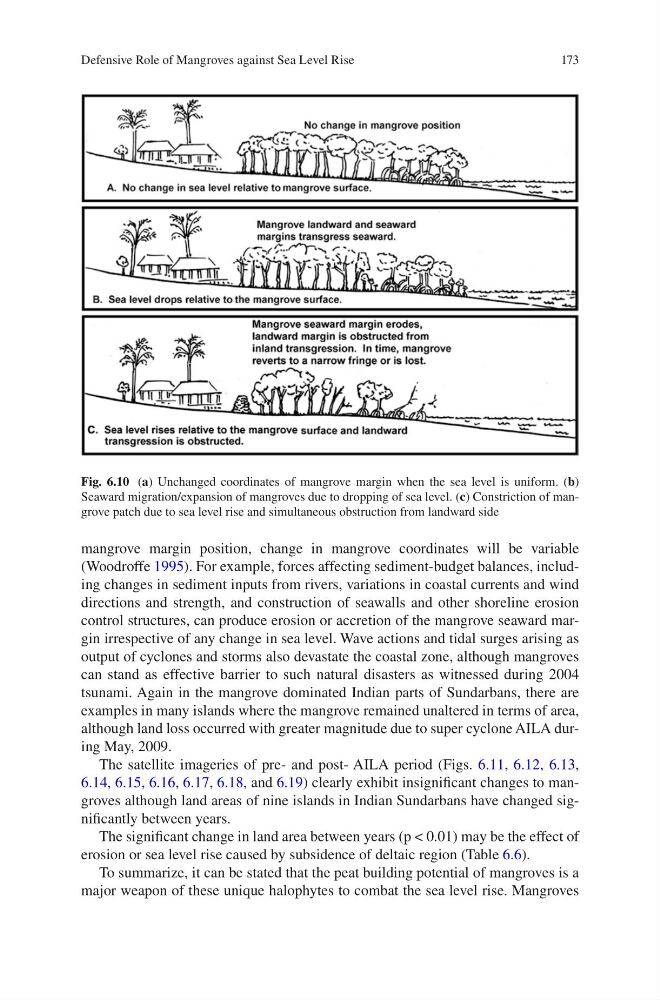
Fig. 6.10 (a) Unchanged coordinates of mangrove margin when the sea level is uniform. (b)
Seaward migration/expansion of mangroves due to dropping of sea level. (c) Constriction of mangrove patch due to sea level rise and simultaneous obstruction from landward side
Defensive Role of Mangroves against Sea Level Rise
mangrove margin position, change in mangrove coordinates will be variable
(Woodroffe 1995). For example, forces affecting sediment-budget balances, including changes in sediment inputs from rivers, variations in coastal currents and wind
directions and strength, and construction of seawalls and other shoreline erosion
control structures, can produce erosion or accretion of the mangrove seaward margin irrespective of any change in sea level. Wave actions and tidal surges arising as
output of cyclones and storms also devastate the coastal zone, although mangroves
can stand as effective barrier to such natural disasters as witnessed during 2004
tsunami. Again in the mangrove dominated Indian parts of Sundarbans, there are
examples in many islands where the mangrove remained unaltered in terms of area,
although land loss occurred with greater magnitude due to super cyclone AILA during May, 2009.
The satellite imageries of pre- and post- AILA period (Figs. 6.11, 6.12, 6.13,
6.14, 6.15, 6.16, 6.17, 6.18, and 6.19) clearly exhibit insignificant changes to mangroves although land areas of nine islands in Indian Sundarbans have changed significantly between years.
The significant change in land area between years (p < 0.01) may be the effect of
erosion or sea level rise caused by subsidence of deltaic region (Table 6.6).
To summarize, it can be stated that the peat building potential of mangroves is a
major weapon of these unique halophytes to combat the sea level rise. Mangroves
Fig. 6.10 (a) Unchanged coordinates of mangrove margin when the sea level is uniform. (b)
Seaward migration/expansion of mangroves due to dropping of sea level. (c) Constriction of mangrove patch due to sea level rise and simultaneous obstruction from landward side
Defensive Role of Mangroves against Sea Level Rise