

3
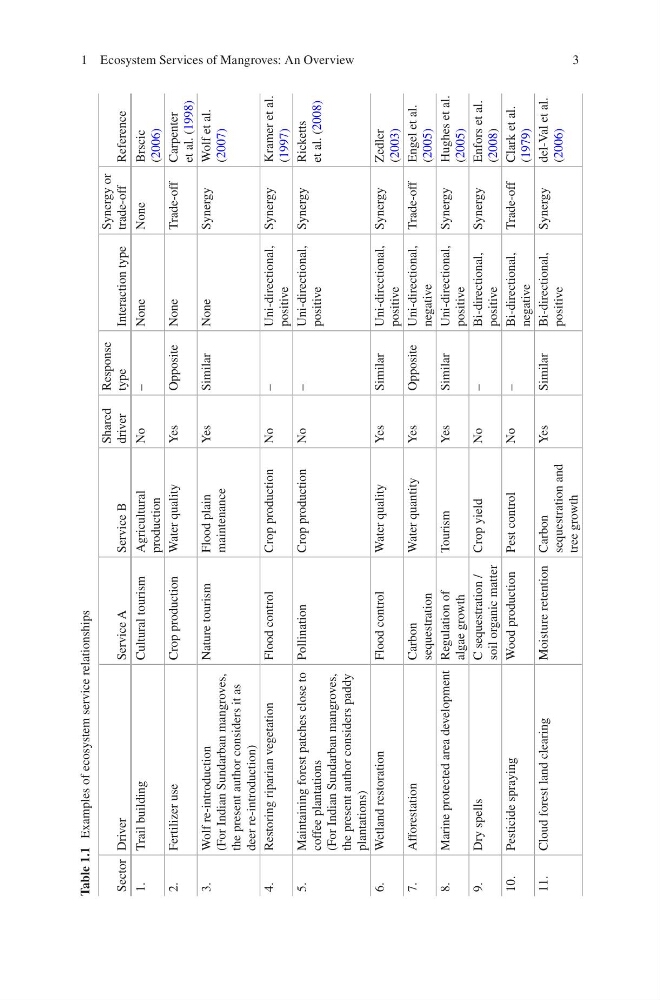
Table 1.1 Examples of ecosystem service relationships
Sector Driver
Service A
Service B
Shared
driver
Response
type
Interaction type
Synergy or
trade-off
Reference
1.
Trail building
Cultural tourism
Agricultural
production
No
–
None
None
Brscic
(2006)
2.
Fertilizer use
Crop production
Water quality
Yes
Opposite None
Trade-off
Carpenter
et al. (1998)
3.
Wolf re-introduction
(For Indian Sundarban mangroves,
the present author considers it as
deer re-introduction)
Nature tourism
Flood plain
maintenance
Yes
Similar
None
Synergy
Wolf et al.
(2007)
4.
Restoring riparian vegetation
Flood control
Crop production
No
–
Uni-directional,
positive
Synergy
Kramer et al.
(1997)
5.
Maintaining forest patches close to
coffee plantations
(For Indian Sundarban mangroves,
the present author considers paddy
plantations)
Pollination
Crop production
No
–
Uni-directional,
positive
Synergy
Ricketts
et al. (2008)
6.
Wetland restoration
Flood control
Water quality
Yes
Similar
Uni-directional,
positive
Synergy
Zedler
(2003)
7.
Afforestation
Carbon
sequestration
Water quantity
Yes
Opposite Uni-directional,
negative
Trade-off
Engel et al.
(2005)
8.
Marine protected area development Regulation of
algae growth
Tourism
Yes
Similar
Uni-directional,
positive
Synergy
Hughes et al.
(2005)
9.
Dry spells
C sequestration /
soil organic matter
Crop yield
No
–
Bi-directional,
positive
Synergy
Enfors et al.
(2008)
10.
Pesticide spraying
Wood production Pest control
No
–
Bi-directional,
negative
Trade-off
Clark et al.
(1979)
11.
Cloud forest land clearing
Moisture retention Carbon
sequestration and
tree growth
Yes
Similar
Bi-directional,
positive
Synergy
del-Val et al.
(2006)
1 Ecosystem Services of Mangroves: An Overview
Table 1.1 Examples of ecosystem service relationships
Sector Driver
Service A
Service B
Shared
driver
Response
type
Interaction type
Synergy or
trade-off
Reference
1.
Trail building
Cultural tourism
Agricultural
production
No
–
None
None
Brscic
(2006)
2.
Fertilizer use
Crop production
Water quality
Yes
Opposite None
Trade-off
Carpenter
et al. (1998)
3.
Wolf re-introduction
(For Indian Sundarban mangroves,
the present author considers it as
deer re-introduction)
Nature tourism
Flood plain
maintenance
Yes
Similar
None
Synergy
Wolf et al.
(2007)
4.
Restoring riparian vegetation
Flood control
Crop production
No
–
Uni-directional,
positive
Synergy
Kramer et al.
(1997)
5.
Maintaining forest patches close to
coffee plantations
(For Indian Sundarban mangroves,
the present author considers paddy
plantations)
Pollination
Crop production
No
–
Uni-directional,
positive
Synergy
Ricketts
et al. (2008)
6.
Wetland restoration
Flood control
Water quality
Yes
Similar
Uni-directional,
positive
Synergy
Zedler
(2003)
7.
Afforestation
Carbon
sequestration
Water quantity
Yes
Opposite Uni-directional,
negative
Trade-off
Engel et al.
(2005)
8.
Marine protected area development Regulation of
algae growth
Tourism
Yes
Similar
Uni-directional,
positive
Synergy
Hughes et al.
(2005)
9.
Dry spells
C sequestration /
soil organic matter
Crop yield
No
–
Bi-directional,
positive
Synergy
Enfors et al.
(2008)
10.
Pesticide spraying
Wood production Pest control
No
–
Bi-directional,
negative
Trade-off
Clark et al.
(1979)
11.
Cloud forest land clearing
Moisture retention Carbon
sequestration and
tree growth
Yes
Similar
Bi-directional,
positive
Synergy
del-Val et al.
(2006)
1 Ecosystem Services of Mangroves: An Overview