

117
Lot of research papers are there on the pollution status in and around Indian
Sundarbans, but very few literatures are available on bioremediation potential of
mangrove flora (Mitra and Chaudhury, 1993; Mitra et al. 1994; Mitra 2013;
Chakraborty et al. 2014; Mitra and Zaman 2015; Chakraborty et al. 2016).
Considering the bioremediation potential of mangroves, the present case study
carried out under the guidance of the present author with Dr. Shankhadeep
Chakraborty, a researcher of Techno India University, West Bengal (India) aimed to
monitor the water quality and bioaccumulation patterns of heavy metals (which are
conservative pollutants) through three well-defined seasons over a period of two
years (2013 and 2014). The area of investigation encompassed 12 stations in Indian
Sundarbans and hence another major aim of this study was to monitor the spatiotemporal variations of heavy metals (zinc, copper, lead and mercury) in the ambient
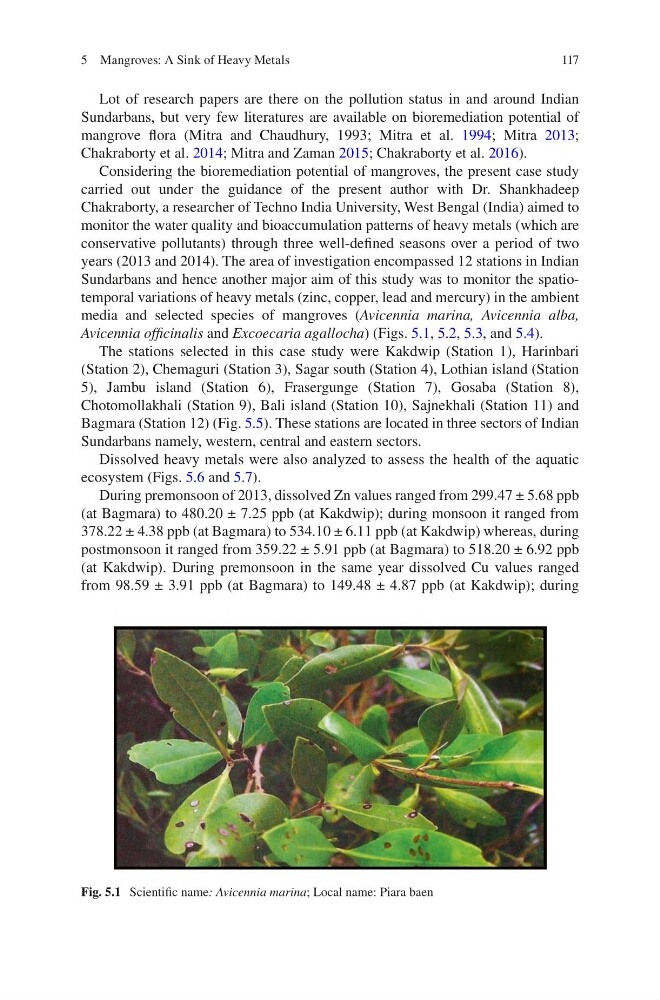
media and selected species of mangroves (Avicennia marina, Avicennia alba,
Avicennia officinalis and Excoecaria agallocha) (Figs. 5.1, 5.2, 5.3, and 5.4).
The stations selected in this case study were Kakdwip (Station 1), Harinbari
(Station 2), Chemaguri (Station 3), Sagar south (Station 4), Lothian island (Station
5), Jambu island (Station 6), Frasergunge (Station 7), Gosaba (Station 8),
Chotomollakhali (Station 9), Bali island (Station 10), Sajnekhali (Station 11) and
Bagmara (Station 12) (Fig. 5.5). These stations are located in three sectors of Indian
Sundarbans namely, western, central and eastern sectors.
Dissolved heavy metals were also analyzed to assess the health of the aquatic
ecosystem (Figs. 5.6 and 5.7).
During premonsoon of 2013, dissolved Zn values ranged from 299.47 ± 5.68 ppb
(at Bagmara) to 480.20 ± 7.25 ppb (at Kakdwip); during monsoon it ranged from
378.22 ± 4.38 ppb (at Bagmara) to 534.10 ± 6.11 ppb (at Kakdwip) whereas, during
postmonsoon it ranged from 359.22 ± 5.91 ppb (at Bagmara) to 518.20 ± 6.92 ppb
(at Kakdwip). During premonsoon in the same year dissolved Cu values ranged
from 98.59 ± 3.91 ppb (at Bagmara) to 149.48 ± 4.87 ppb (at Kakdwip); during
Fig. 5.1 Scientific name: Avicennia marina; Local name: Piara baen
5 Mangroves: A Sink of Heavy Metals
Lot of research papers are there on the pollution status in and around Indian
Sundarbans, but very few literatures are available on bioremediation potential of
mangrove flora (Mitra and Chaudhury, 1993; Mitra et al. 1994; Mitra 2013;
Chakraborty et al. 2014; Mitra and Zaman 2015; Chakraborty et al. 2016).
Considering the bioremediation potential of mangroves, the present case study
carried out under the guidance of the present author with Dr. Shankhadeep
Chakraborty, a researcher of Techno India University, West Bengal (India) aimed to
monitor the water quality and bioaccumulation patterns of heavy metals (which are
conservative pollutants) through three well-defined seasons over a period of two
years (2013 and 2014). The area of investigation encompassed 12 stations in Indian
Sundarbans and hence another major aim of this study was to monitor the spatiotemporal variations of heavy metals (zinc, copper, lead and mercury) in the ambient
media and selected species of mangroves (Avicennia marina, Avicennia alba,
Avicennia officinalis and Excoecaria agallocha) (Figs. 5.1, 5.2, 5.3, and 5.4).
The stations selected in this case study were Kakdwip (Station 1), Harinbari
(Station 2), Chemaguri (Station 3), Sagar south (Station 4), Lothian island (Station
5), Jambu island (Station 6), Frasergunge (Station 7), Gosaba (Station 8),
Chotomollakhali (Station 9), Bali island (Station 10), Sajnekhali (Station 11) and
Bagmara (Station 12) (Fig. 5.5). These stations are located in three sectors of Indian
Sundarbans namely, western, central and eastern sectors.
Dissolved heavy metals were also analyzed to assess the health of the aquatic
ecosystem (Figs. 5.6 and 5.7).
During premonsoon of 2013, dissolved Zn values ranged from 299.47 ± 5.68 ppb
(at Bagmara) to 480.20 ± 7.25 ppb (at Kakdwip); during monsoon it ranged from
378.22 ± 4.38 ppb (at Bagmara) to 534.10 ± 6.11 ppb (at Kakdwip) whereas, during
postmonsoon it ranged from 359.22 ± 5.91 ppb (at Bagmara) to 518.20 ± 6.92 ppb
(at Kakdwip). During premonsoon in the same year dissolved Cu values ranged
from 98.59 ± 3.91 ppb (at Bagmara) to 149.48 ± 4.87 ppb (at Kakdwip); during
Fig. 5.1 Scientific name: Avicennia marina; Local name: Piara baen
5 Mangroves: A Sink of Heavy Metals