

Lasting Luxury: Arts and Crafts with Xia Bu 夏布, a Traditional …
87
The ramie fragments have been discovered in the Neolithic sites dating back to
4700 years ago. In the Tang Dynasty, which has been more than 1000 years old,
ramie textiles are full of variety and variety, and Xia Bu has been exported outside
China, such as Japan and North Korea in much earlier time, and in the eighteenth and
nineteenth centuries, it was introduced to many European and American countries.
3
Ramie is also a bast fibre, the plant is grown for its fibres, such as linen, hemp and
jute. Bast fibre traditionally is used to make paper, cloth or rope.
4 There are different
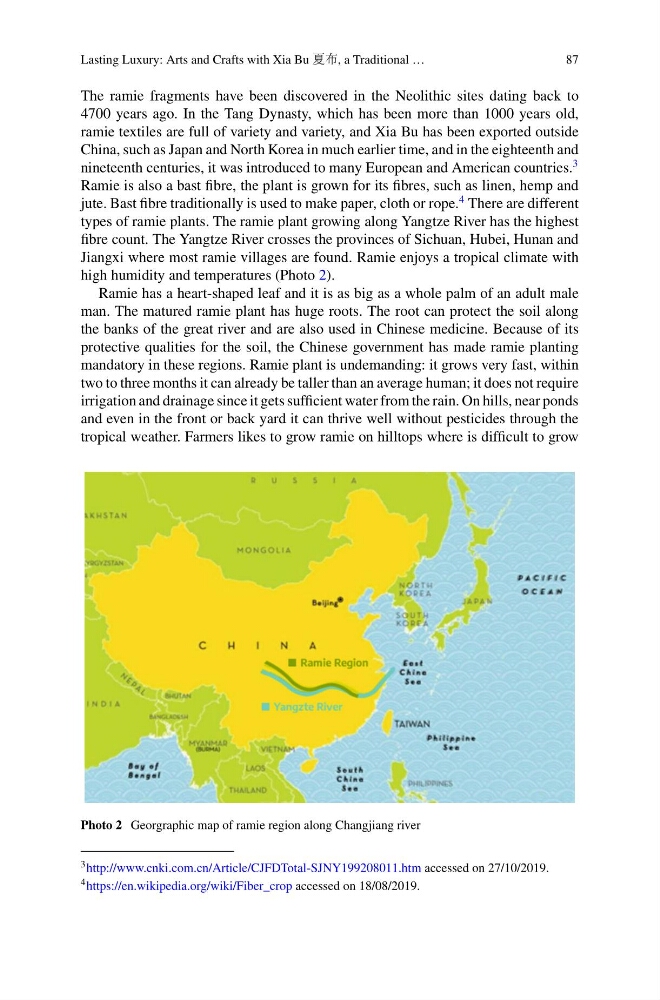
types of ramie plants. The ramie plant growing along Yangtze River has the highest
fibre count. The Yangtze River crosses the provinces of Sichuan, Hubei, Hunan and
Jiangxi where most ramie villages are found. Ramie enjoys a tropical climate with
high humidity and temperatures (Photo 2).
Ramie has a heart-shaped leaf and it is as big as a whole palm of an adult male
man. The matured ramie plant has huge roots. The root can protect the soil along
the banks of the great river and are also used in Chinese medicine. Because of its
protective qualities for the soil, the Chinese government has made ramie planting
mandatory in these regions. Ramie plant is undemanding: it grows very fast, within
two to three months it can already be taller than an average human; it does not require
irrigation and drainage since it gets sufficient water from the rain. On hills, near ponds
and even in the front or back yard it can thrive well without pesticides through the
tropical weather. Farmers likes to grow ramie on hilltops where is difficult to grow
Photo 2 Georgraphic map of ramie region along Changjiang river
3 http://www.cnki.com.cn/Article/CJFDTotal-SJNY199208011.htm accessed on 27/10/2019.
4 https://en.wikipedia.org/wiki/Fiber_crop accessed on 18/08/2019.
87
The ramie fragments have been discovered in the Neolithic sites dating back to
4700 years ago. In the Tang Dynasty, which has been more than 1000 years old,
ramie textiles are full of variety and variety, and Xia Bu has been exported outside
China, such as Japan and North Korea in much earlier time, and in the eighteenth and
nineteenth centuries, it was introduced to many European and American countries.
3
Ramie is also a bast fibre, the plant is grown for its fibres, such as linen, hemp and
jute. Bast fibre traditionally is used to make paper, cloth or rope.
4 There are different
types of ramie plants. The ramie plant growing along Yangtze River has the highest
fibre count. The Yangtze River crosses the provinces of Sichuan, Hubei, Hunan and
Jiangxi where most ramie villages are found. Ramie enjoys a tropical climate with
high humidity and temperatures (Photo 2).
Ramie has a heart-shaped leaf and it is as big as a whole palm of an adult male
man. The matured ramie plant has huge roots. The root can protect the soil along
the banks of the great river and are also used in Chinese medicine. Because of its
protective qualities for the soil, the Chinese government has made ramie planting
mandatory in these regions. Ramie plant is undemanding: it grows very fast, within
two to three months it can already be taller than an average human; it does not require
irrigation and drainage since it gets sufficient water from the rain. On hills, near ponds
and even in the front or back yard it can thrive well without pesticides through the
tropical weather. Farmers likes to grow ramie on hilltops where is difficult to grow
Photo 2 Georgraphic map of ramie region along Changjiang river
3 http://www.cnki.com.cn/Article/CJFDTotal-SJNY199208011.htm accessed on 27/10/2019.
4 https://en.wikipedia.org/wiki/Fiber_crop accessed on 18/08/2019.