

64
M. De Angelis et al.
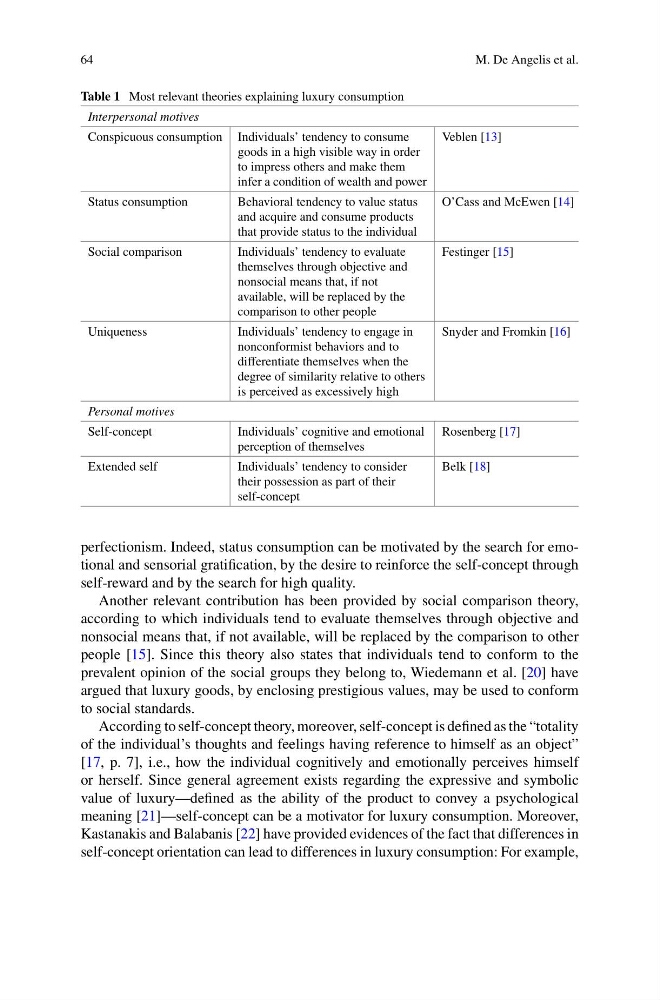
Table 1 Most relevant theories explaining luxury consumption
Interpersonal motives
Conspicuous consumption Individuals’ tendency to consume
goods in a high visible way in order
to impress others and make them
infer a condition of wealth and power
Veblen [13]
Status consumption
Behavioral tendency to value status
and acquire and consume products
that provide status to the individual
O’Cass and McEwen [14]
Social comparison
Individuals’ tendency to evaluate
themselves through objective and
nonsocial means that, if not
available, will be replaced by the
comparison to other people
Festinger [15]
Uniqueness
Individuals’ tendency to engage in
nonconformist behaviors and to
differentiate themselves when the
degree of similarity relative to others
is perceived as excessively high
Snyder and Fromkin [16]
Personal motives
Self-concept
Individuals’ cognitive and emotional
perception of themselves
Rosenberg [17]
Extended self
Individuals’ tendency to consider
their possession as part of their
self-concept
Belk [18]
perfectionism. Indeed, status consumption can be motivated by the search for emotional and sensorial gratification, by the desire to reinforce the self-concept through
self-reward and by the search for high quality.
Another relevant contribution has been provided by social comparison theory,
according to which individuals tend to evaluate themselves through objective and
nonsocial means that, if not available, will be replaced by the comparison to other
people [15]. Since this theory also states that individuals tend to conform to the
prevalent opinion of the social groups they belong to, Wiedemann et al. [20] have
argued that luxury goods, by enclosing prestigious values, may be used to conform
to social standards.
According to self-concept theory, moreover, self-concept is defined as the “totality
of the individual’s thoughts and feelings having reference to himself as an object”
[17, p. 7], i.e., how the individual cognitively and emotionally perceives himself
or herself. Since general agreement exists regarding the expressive and symbolic
value of luxury—defined as the ability of the product to convey a psychological
meaning [21]—self-concept can be a motivator for luxury consumption. Moreover,
Kastanakis and Balabanis [22] have provided evidences of the fact that differences in
self-concept orientation can lead to differences in luxury consumption: For example,
M. De Angelis et al.
Table 1 Most relevant theories explaining luxury consumption
Interpersonal motives
Conspicuous consumption Individuals’ tendency to consume
goods in a high visible way in order
to impress others and make them
infer a condition of wealth and power
Veblen [13]
Status consumption
Behavioral tendency to value status
and acquire and consume products
that provide status to the individual
O’Cass and McEwen [14]
Social comparison
Individuals’ tendency to evaluate
themselves through objective and
nonsocial means that, if not
available, will be replaced by the
comparison to other people
Festinger [15]
Uniqueness
Individuals’ tendency to engage in
nonconformist behaviors and to
differentiate themselves when the
degree of similarity relative to others
is perceived as excessively high
Snyder and Fromkin [16]
Personal motives
Self-concept
Individuals’ cognitive and emotional
perception of themselves
Rosenberg [17]
Extended self
Individuals’ tendency to consider
their possession as part of their
self-concept
Belk [18]
perfectionism. Indeed, status consumption can be motivated by the search for emotional and sensorial gratification, by the desire to reinforce the self-concept through
self-reward and by the search for high quality.
Another relevant contribution has been provided by social comparison theory,
according to which individuals tend to evaluate themselves through objective and
nonsocial means that, if not available, will be replaced by the comparison to other
people [15]. Since this theory also states that individuals tend to conform to the
prevalent opinion of the social groups they belong to, Wiedemann et al. [20] have
argued that luxury goods, by enclosing prestigious values, may be used to conform
to social standards.
According to self-concept theory, moreover, self-concept is defined as the “totality
of the individual’s thoughts and feelings having reference to himself as an object”
[17, p. 7], i.e., how the individual cognitively and emotionally perceives himself
or herself. Since general agreement exists regarding the expressive and symbolic
value of luxury—defined as the ability of the product to convey a psychological
meaning [21]—self-concept can be a motivator for luxury consumption. Moreover,
Kastanakis and Balabanis [22] have provided evidences of the fact that differences in
self-concept orientation can lead to differences in luxury consumption: For example,