

30
R. Amarilla et al.
While this fibre is used to make other items, such as scarfs and throws, the most
famous garments are the ponchos made in the region of Belén. “At the end of the
eighteenth century, the most prestigious ponchos were those confectioned with the
precious vicuña wool of Belén” [5]. The distinctive features of these ponchos have
always been softness, warmth and lightness, since threads produced from vicuña wool
are very fine due to the characteristic animal hair. For example, a vicuña poncho made
in Belén weighs less than 225 g and is one of the warmest ponchos [4].
Moreover, this fibre is still positioned among the most exclusive yarns thanks to
highly skilled artisans, who chose to continue with their tradition despite the advent
and quick, widespread adoption of cotton and other fibres.
3 The Vicuña Poncho of Cooperativa Mesa Local Laguna
Blanca
3.1 Laguna Blanca: What Is It? History
The process to weave a vicuña poncho requires history and context. Without such
history and context, it is easy to assume that, to make a vicuña poncho, the same
effort and processes are used to get the same outstanding result.
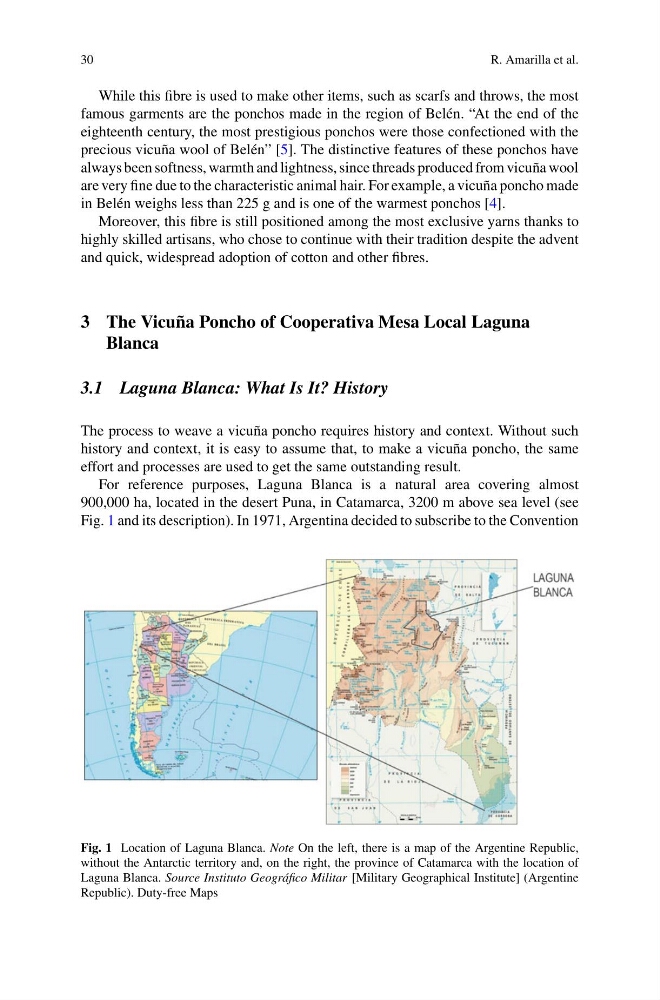
For reference purposes, Laguna Blanca is a natural area covering almost
900,000 ha, located in the desert Puna, in Catamarca, 3200 m above sea level (see
Fig. 1 and its description). In 1971, Argentina decided to subscribe to the Convention
Fig. 1 Location of Laguna Blanca. Note On the left, there is a map of the Argentine Republic,
without the Antarctic territory and, on the right, the province of Catamarca with the location of
Laguna Blanca. Source Instituto Geográfico Militar [Military Geographical Institute] (Argentine
Republic). Duty-free Maps
R. Amarilla et al.
While this fibre is used to make other items, such as scarfs and throws, the most
famous garments are the ponchos made in the region of Belén. “At the end of the
eighteenth century, the most prestigious ponchos were those confectioned with the
precious vicuña wool of Belén” [5]. The distinctive features of these ponchos have
always been softness, warmth and lightness, since threads produced from vicuña wool
are very fine due to the characteristic animal hair. For example, a vicuña poncho made
in Belén weighs less than 225 g and is one of the warmest ponchos [4].
Moreover, this fibre is still positioned among the most exclusive yarns thanks to
highly skilled artisans, who chose to continue with their tradition despite the advent
and quick, widespread adoption of cotton and other fibres.
3 The Vicuña Poncho of Cooperativa Mesa Local Laguna
Blanca
3.1 Laguna Blanca: What Is It? History
The process to weave a vicuña poncho requires history and context. Without such
history and context, it is easy to assume that, to make a vicuña poncho, the same
effort and processes are used to get the same outstanding result.
For reference purposes, Laguna Blanca is a natural area covering almost
900,000 ha, located in the desert Puna, in Catamarca, 3200 m above sea level (see
Fig. 1 and its description). In 1971, Argentina decided to subscribe to the Convention
Fig. 1 Location of Laguna Blanca. Note On the left, there is a map of the Argentine Republic,
without the Antarctic territory and, on the right, the province of Catamarca with the location of
Laguna Blanca. Source Instituto Geográfico Militar [Military Geographical Institute] (Argentine
Republic). Duty-free Maps