

156
A. Condello
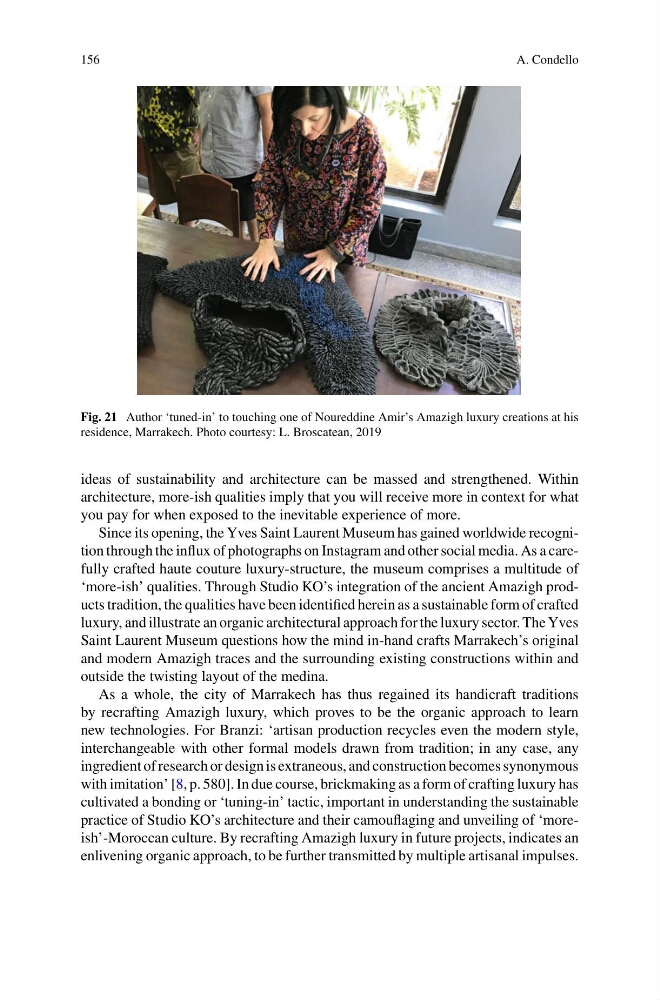
Fig. 21 Author ‘tuned-in’ to touching one of Noureddine Amir’s Amazigh luxury creations at his
residence, Marrakech. Photo courtesy: L. Broscatean, 2019
ideas of sustainability and architecture can be massed and strengthened. Within
architecture, more-ish qualities imply that you will receive more in context for what
you pay for when exposed to the inevitable experience of more.
Since its opening, the Yves Saint Laurent Museum has gained worldwide recognition through the influx of photographs on Instagram and other social media. As a carefully crafted haute couture luxury-structure, the museum comprises a multitude of
‘more-ish’ qualities. Through Studio KO’s integration of the ancient Amazigh products tradition, the qualities have been identified herein as a sustainable form of crafted
luxury, and illustrate an organic architectural approach for the luxury sector. The Yves
Saint Laurent Museum questions how the mind in-hand crafts Marrakech’s original
and modern Amazigh traces and the surrounding existing constructions within and
outside the twisting layout of the medina.
As a whole, the city of Marrakech has thus regained its handicraft traditions
by recrafting Amazigh luxury, which proves to be the organic approach to learn
new technologies. For Branzi: ‘artisan production recycles even the modern style,
interchangeable with other formal models drawn from tradition; in any case, any
ingredient of research or design is extraneous, and construction becomes synonymous
with imitation’ [8, p. 580]. In due course, brickmaking as a form of crafting luxury has
cultivated a bonding or ‘tuning-in’ tactic, important in understanding the sustainable
practice of Studio KO’s architecture and their camouflaging and unveiling of ‘moreish’-Moroccan culture. By recrafting Amazigh luxury in future projects, indicates an
enlivening organic approach, to be further transmitted by multiple artisanal impulses.
A. Condello
Fig. 21 Author ‘tuned-in’ to touching one of Noureddine Amir’s Amazigh luxury creations at his
residence, Marrakech. Photo courtesy: L. Broscatean, 2019
ideas of sustainability and architecture can be massed and strengthened. Within
architecture, more-ish qualities imply that you will receive more in context for what
you pay for when exposed to the inevitable experience of more.
Since its opening, the Yves Saint Laurent Museum has gained worldwide recognition through the influx of photographs on Instagram and other social media. As a carefully crafted haute couture luxury-structure, the museum comprises a multitude of
‘more-ish’ qualities. Through Studio KO’s integration of the ancient Amazigh products tradition, the qualities have been identified herein as a sustainable form of crafted
luxury, and illustrate an organic architectural approach for the luxury sector. The Yves
Saint Laurent Museum questions how the mind in-hand crafts Marrakech’s original
and modern Amazigh traces and the surrounding existing constructions within and
outside the twisting layout of the medina.
As a whole, the city of Marrakech has thus regained its handicraft traditions
by recrafting Amazigh luxury, which proves to be the organic approach to learn
new technologies. For Branzi: ‘artisan production recycles even the modern style,
interchangeable with other formal models drawn from tradition; in any case, any
ingredient of research or design is extraneous, and construction becomes synonymous
with imitation’ [8, p. 580]. In due course, brickmaking as a form of crafting luxury has
cultivated a bonding or ‘tuning-in’ tactic, important in understanding the sustainable
practice of Studio KO’s architecture and their camouflaging and unveiling of ‘moreish’-Moroccan culture. By recrafting Amazigh luxury in future projects, indicates an
enlivening organic approach, to be further transmitted by multiple artisanal impulses.