

146
A. Condello
tea ceremony had already been established as a state-of-the-art custom, sitting in
amongst modern Amazigh crafts, as well as throughout the rest of northern African
countries. There, mint tea leaves were a ready-to-cook concoction to sip from the
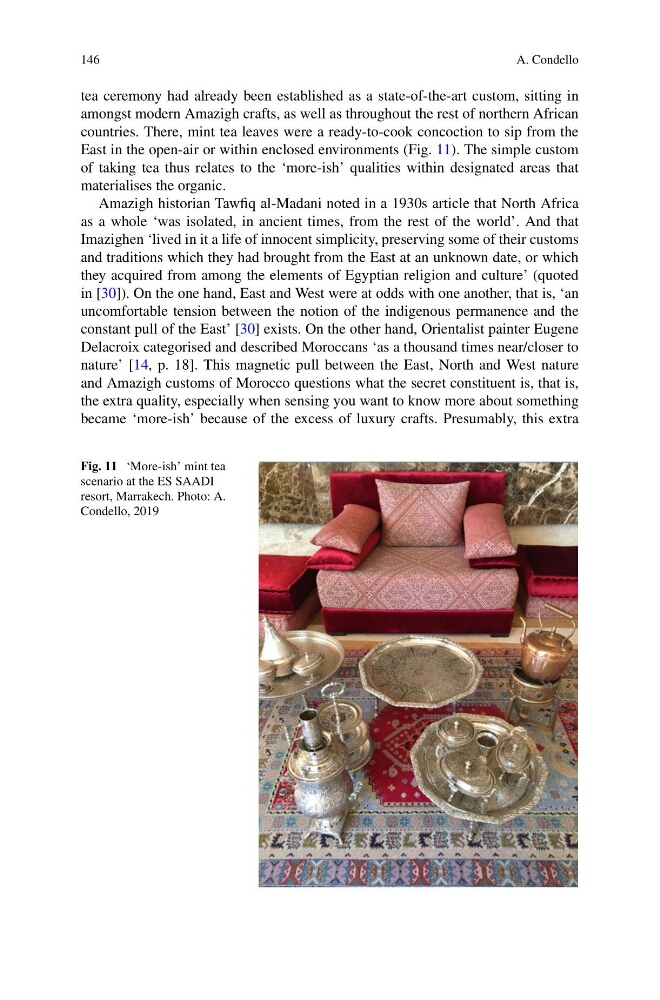
East in the open-air or within enclosed environments (Fig. 11). The simple custom
of taking tea thus relates to the ‘more-ish’ qualities within designated areas that
materialises the organic.
Amazigh historian Tawfiq al-Madani noted in a 1930s article that North Africa
as a whole ‘was isolated, in ancient times, from the rest of the world’. And that
Imazighen ‘lived in it a life of innocent simplicity, preserving some of their customs
and traditions which they had brought from the East at an unknown date, or which
they acquired from among the elements of Egyptian religion and culture’ (quoted
in [30]). On the one hand, East and West were at odds with one another, that is, ‘an
uncomfortable tension between the notion of the indigenous permanence and the
constant pull of the East’ [30] exists. On the other hand, Orientalist painter Eugene
Delacroix categorised and described Moroccans ‘as a thousand times near/closer to
nature’ [14, p. 18]. This magnetic pull between the East, North and West nature
and Amazigh customs of Morocco questions what the secret constituent is, that is,
the extra quality, especially when sensing you want to know more about something
became ‘more-ish’ because of the excess of luxury crafts. Presumably, this extra
Fig. 11 ‘More-ish’ mint tea
scenario at the ES SAADI
resort, Marrakech. Photo: A.
Condello, 2019
A. Condello
tea ceremony had already been established as a state-of-the-art custom, sitting in
amongst modern Amazigh crafts, as well as throughout the rest of northern African
countries. There, mint tea leaves were a ready-to-cook concoction to sip from the
East in the open-air or within enclosed environments (Fig. 11). The simple custom
of taking tea thus relates to the ‘more-ish’ qualities within designated areas that
materialises the organic.
Amazigh historian Tawfiq al-Madani noted in a 1930s article that North Africa
as a whole ‘was isolated, in ancient times, from the rest of the world’. And that
Imazighen ‘lived in it a life of innocent simplicity, preserving some of their customs
and traditions which they had brought from the East at an unknown date, or which
they acquired from among the elements of Egyptian religion and culture’ (quoted
in [30]). On the one hand, East and West were at odds with one another, that is, ‘an
uncomfortable tension between the notion of the indigenous permanence and the
constant pull of the East’ [30] exists. On the other hand, Orientalist painter Eugene
Delacroix categorised and described Moroccans ‘as a thousand times near/closer to
nature’ [14, p. 18]. This magnetic pull between the East, North and West nature
and Amazigh customs of Morocco questions what the secret constituent is, that is,
the extra quality, especially when sensing you want to know more about something
became ‘more-ish’ because of the excess of luxury crafts. Presumably, this extra
Fig. 11 ‘More-ish’ mint tea
scenario at the ES SAADI
resort, Marrakech. Photo: A.
Condello, 2019