

130
A. Condello
Marrakech was, and still is, recognised primarily as a tourist destination for nonconformists whom made, or make, the extra effort to bond with ancient cultures and
popularise Morocco’s unfamiliar luxury crafts abroad. Marrakech’s location was
considered the ‘cross-roads of the whole north-west of the continent … where desert
caravans arrive and depart when Bedouin meets Moor and camel meets lorry’ [23,
p. 178]. After Morocco’s Independence (1956) as well as the counterculture of the
1960s and 1970s, French haute couture designer Yves Saint Laurent frequented the
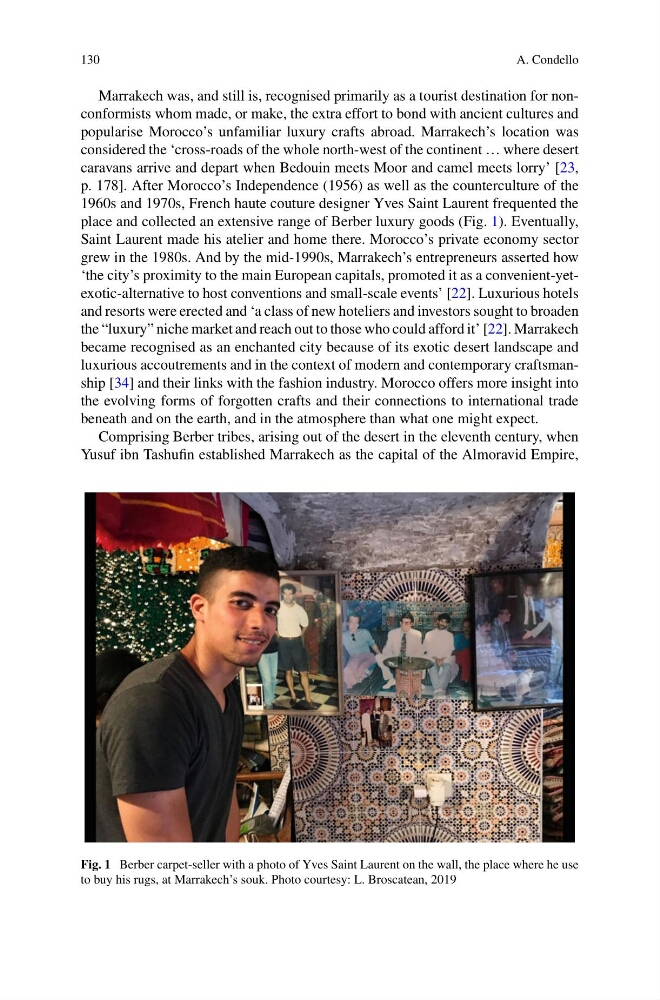
place and collected an extensive range of Berber luxury goods (Fig. 1). Eventually,
Saint Laurent made his atelier and home there. Morocco’s private economy sector
grew in the 1980s. And by the mid-1990s, Marrakech’s entrepreneurs asserted how
‘the city’s proximity to the main European capitals, promoted it as a convenient-yetexotic-alternative to host conventions and small-scale events’ [22]. Luxurious hotels
and resorts were erected and ‘a class of new hoteliers and investors sought to broaden
the “luxury” niche market and reach out to those who could afford it’ [22]. Marrakech
became recognised as an enchanted city because of its exotic desert landscape and
luxurious accoutrements and in the context of modern and contemporary craftsmanship [34] and their links with the fashion industry. Morocco offers more insight into
the evolving forms of forgotten crafts and their connections to international trade
beneath and on the earth, and in the atmosphere than what one might expect.
Comprising Berber tribes, arising out of the desert in the eleventh century, when
Yusuf ibn Tashufin established Marrakech as the capital of the Almoravid Empire,
Fig. 1 Berber carpet-seller with a photo of Yves Saint Laurent on the wall, the place where he use
to buy his rugs, at Marrakech’s souk. Photo courtesy: L. Broscatean, 2019
A. Condello
Marrakech was, and still is, recognised primarily as a tourist destination for nonconformists whom made, or make, the extra effort to bond with ancient cultures and
popularise Morocco’s unfamiliar luxury crafts abroad. Marrakech’s location was
considered the ‘cross-roads of the whole north-west of the continent … where desert
caravans arrive and depart when Bedouin meets Moor and camel meets lorry’ [23,
p. 178]. After Morocco’s Independence (1956) as well as the counterculture of the
1960s and 1970s, French haute couture designer Yves Saint Laurent frequented the
place and collected an extensive range of Berber luxury goods (Fig. 1). Eventually,
Saint Laurent made his atelier and home there. Morocco’s private economy sector
grew in the 1980s. And by the mid-1990s, Marrakech’s entrepreneurs asserted how
‘the city’s proximity to the main European capitals, promoted it as a convenient-yetexotic-alternative to host conventions and small-scale events’ [22]. Luxurious hotels
and resorts were erected and ‘a class of new hoteliers and investors sought to broaden
the “luxury” niche market and reach out to those who could afford it’ [22]. Marrakech
became recognised as an enchanted city because of its exotic desert landscape and
luxurious accoutrements and in the context of modern and contemporary craftsmanship [34] and their links with the fashion industry. Morocco offers more insight into
the evolving forms of forgotten crafts and their connections to international trade
beneath and on the earth, and in the atmosphere than what one might expect.
Comprising Berber tribes, arising out of the desert in the eleventh century, when
Yusuf ibn Tashufin established Marrakech as the capital of the Almoravid Empire,
Fig. 1 Berber carpet-seller with a photo of Yves Saint Laurent on the wall, the place where he use
to buy his rugs, at Marrakech’s souk. Photo courtesy: L. Broscatean, 2019