

Luxury Craftsmanship as an Alternative to Building Social …
103
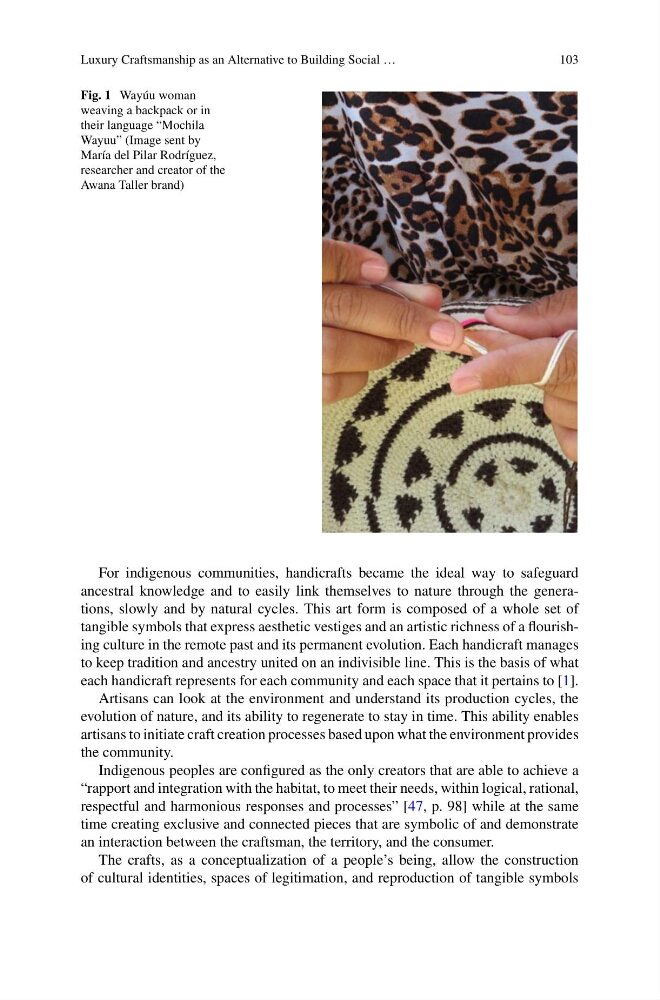
Fig. 1 Wayúu woman
weaving a backpack or in
their language “Mochila
Wayuu” (Image sent by
María del Pilar Rodríguez,
researcher and creator of the
Awana Taller brand)
For indigenous communities, handicrafts became the ideal way to safeguard
ancestral knowledge and to easily link themselves to nature through the generations, slowly and by natural cycles. This art form is composed of a whole set of
tangible symbols that express aesthetic vestiges and an artistic richness of a flourishing culture in the remote past and its permanent evolution. Each handicraft manages
to keep tradition and ancestry united on an indivisible line. This is the basis of what
each handicraft represents for each community and each space that it pertains to [1].
Artisans can look at the environment and understand its production cycles, the
evolution of nature, and its ability to regenerate to stay in time. This ability enables
artisans to initiate craft creation processes based upon what the environment provides
the community.
Indigenous peoples are configured as the only creators that are able to achieve a
“rapport and integration with the habitat, to meet their needs, within logical, rational,
respectful and harmonious responses and processes” [47, p. 98] while at the same
time creating exclusive and connected pieces that are symbolic of and demonstrate
an interaction between the craftsman, the territory, and the consumer.
The crafts, as a conceptualization of a people’s being, allow the construction
of cultural identities, spaces of legitimation, and reproduction of tangible symbols
103
Fig. 1 Wayúu woman
weaving a backpack or in
their language “Mochila
Wayuu” (Image sent by
María del Pilar Rodríguez,
researcher and creator of the
Awana Taller brand)
For indigenous communities, handicrafts became the ideal way to safeguard
ancestral knowledge and to easily link themselves to nature through the generations, slowly and by natural cycles. This art form is composed of a whole set of
tangible symbols that express aesthetic vestiges and an artistic richness of a flourishing culture in the remote past and its permanent evolution. Each handicraft manages
to keep tradition and ancestry united on an indivisible line. This is the basis of what
each handicraft represents for each community and each space that it pertains to [1].
Artisans can look at the environment and understand its production cycles, the
evolution of nature, and its ability to regenerate to stay in time. This ability enables
artisans to initiate craft creation processes based upon what the environment provides
the community.
Indigenous peoples are configured as the only creators that are able to achieve a
“rapport and integration with the habitat, to meet their needs, within logical, rational,
respectful and harmonious responses and processes” [47, p. 98] while at the same
time creating exclusive and connected pieces that are symbolic of and demonstrate
an interaction between the craftsman, the territory, and the consumer.
The crafts, as a conceptualization of a people’s being, allow the construction
of cultural identities, spaces of legitimation, and reproduction of tangible symbols