

Vol:.(1234567890)
Research Article
SN Applied Sciences
(2023) 5:158
| https://doi.org/10.1007/s42452-023-05376-x
the systematic environmental conservation planning
process near the Arzew coast.
3.1 Background to the spill and response decision
3.1.1 At sea
Given the evaporation rate of light crude oil, one of
the most appropriate remedies for tiny spills is to allow
the condensate spread out and evaporate naturally.
The risk area, national rules, the probability of drift,
and the potential environmental and socio-economic
repercussions determine the definition of these modest volumes (a few m
3
). For medium to large spills, the
lightest hydrocarbons, which have an evaporation rate
of more than 70%, similar to petrol and kerosene, have
a low persistence while posing a high risk to responders
(explosive environment). In this scenario, doing nothing
and leaving things alone is advised.
3.1.2 In coastal areas
Pollution response operations should be carried out when
the pollutant drifts towards the coast or ecologically or
socio-economically sensitive areas, regardless of the volumes spilled (generally speaking, a slick move with the
current and under the influence of the wind). It can be
envisaged to protect these areas by booms, if possible
fireproof. It is important to note that these measures
involve the use of nautical means, which must therefore
be employed well before the arrival of the pollutant. Dispersants or in-situ burning is necessarily more delicate
than recovery, which must be prioritized. Geographical
limits generally apply to using dispersants near the coast,
sometimes qualified by the volumes spilled. In the case
of burning, the first question is regulatory, as this technique is banned in many countries. In the case of a spill
of the order of a few m
3
, very close to the coast or on the
coast, it may be possible, if the slick is naturally contained,
to recover the pollutant after covering it with a carpet of
low or medium expansion foam, to limit the formation of
flammable vapors. Recovery will occur with a floating suction head adapted to recover the pollutant under the foam
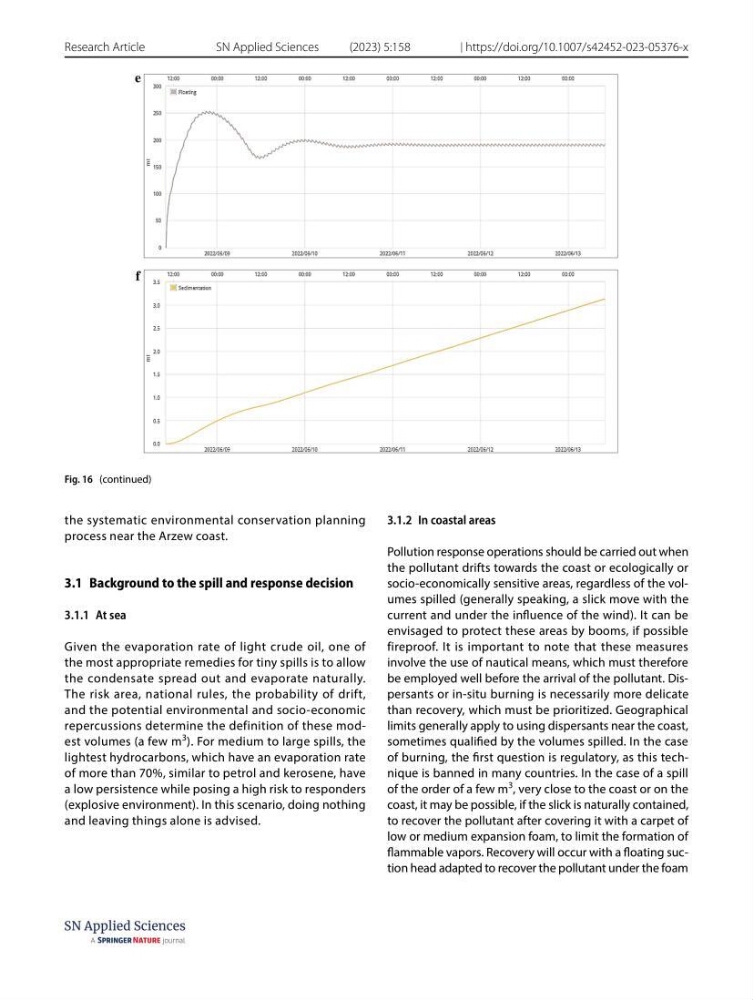
Fig. 16 (continued)
Research Article
SN Applied Sciences
(2023) 5:158
| https://doi.org/10.1007/s42452-023-05376-x
the systematic environmental conservation planning
process near the Arzew coast.
3.1 Background to the spill and response decision
3.1.1 At sea
Given the evaporation rate of light crude oil, one of
the most appropriate remedies for tiny spills is to allow
the condensate spread out and evaporate naturally.
The risk area, national rules, the probability of drift,
and the potential environmental and socio-economic
repercussions determine the definition of these modest volumes (a few m
3
). For medium to large spills, the
lightest hydrocarbons, which have an evaporation rate
of more than 70%, similar to petrol and kerosene, have
a low persistence while posing a high risk to responders
(explosive environment). In this scenario, doing nothing
and leaving things alone is advised.
3.1.2 In coastal areas
Pollution response operations should be carried out when
the pollutant drifts towards the coast or ecologically or
socio-economically sensitive areas, regardless of the volumes spilled (generally speaking, a slick move with the
current and under the influence of the wind). It can be
envisaged to protect these areas by booms, if possible
fireproof. It is important to note that these measures
involve the use of nautical means, which must therefore
be employed well before the arrival of the pollutant. Dispersants or in-situ burning is necessarily more delicate
than recovery, which must be prioritized. Geographical
limits generally apply to using dispersants near the coast,
sometimes qualified by the volumes spilled. In the case
of burning, the first question is regulatory, as this technique is banned in many countries. In the case of a spill
of the order of a few m
3
, very close to the coast or on the
coast, it may be possible, if the slick is naturally contained,
to recover the pollutant after covering it with a carpet of
low or medium expansion foam, to limit the formation of
flammable vapors. Recovery will occur with a floating suction head adapted to recover the pollutant under the foam
Fig. 16 (continued)