

92
S. Adeel et al.
3.1.5 Bio-stoning
In the early 1980s or late 1970s, pumice stone washing was developed by denim
garments to give fashionable contrast and worn look [43, 44] while the worn look
of blue jeans was obtained by non-homogenous removal of indigo dye [45]. The
consequences of pumice stone washing were very harsh for garments, equipment as
well as for machine [46, 47]. Introduction of microbial cellulases for denim washing
in the mid of 1980s presented an alternate of pumice stone washing [48]. It has been
proved that cellulase has produced high productivity, reduce time and minimized
the damage to a machine with less pumice dust through less use of stones [49–52]
To achieve better or lighter shades of indigo-dyed denim, stone washing can be
combined with laccase mediated bleaching [53]. Nowadays bio-washing and biodesizing can be successfully performed in one step by using laccases, cellulase, and
amylases without influencing the color of garment [35, 50].
The aged appearance of denim garment could be produced by combining stone
and cellulase washing [54]. The surface of cellulose plays a major role in enzymatic
decolorization treatment because enzymes, give softness and brightness to the fabric by hydrolyzing cellulose and removing surface naps [55, 56]. Traditional stone
washing has a problem in disposing of sands produced by stones eroding therefore; it
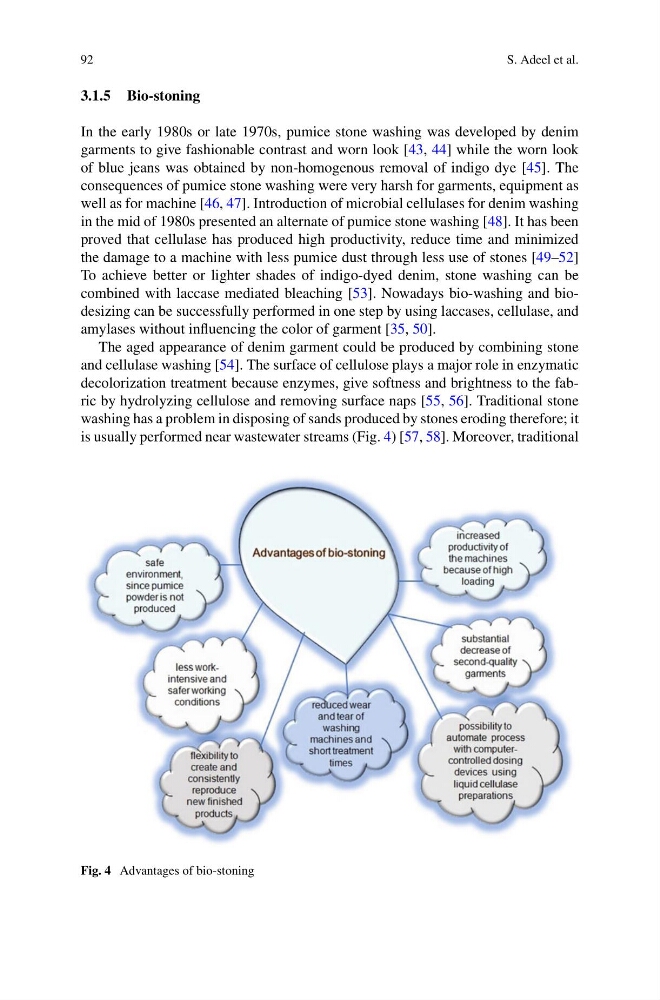
is usually performed near wastewater streams (Fig. 4) [57, 58]. Moreover, traditional
Fig. 4 Advantages of bio-stoning
S. Adeel et al.
3.1.5 Bio-stoning
In the early 1980s or late 1970s, pumice stone washing was developed by denim
garments to give fashionable contrast and worn look [43, 44] while the worn look
of blue jeans was obtained by non-homogenous removal of indigo dye [45]. The
consequences of pumice stone washing were very harsh for garments, equipment as
well as for machine [46, 47]. Introduction of microbial cellulases for denim washing
in the mid of 1980s presented an alternate of pumice stone washing [48]. It has been
proved that cellulase has produced high productivity, reduce time and minimized
the damage to a machine with less pumice dust through less use of stones [49–52]
To achieve better or lighter shades of indigo-dyed denim, stone washing can be
combined with laccase mediated bleaching [53]. Nowadays bio-washing and biodesizing can be successfully performed in one step by using laccases, cellulase, and
amylases without influencing the color of garment [35, 50].
The aged appearance of denim garment could be produced by combining stone
and cellulase washing [54]. The surface of cellulose plays a major role in enzymatic
decolorization treatment because enzymes, give softness and brightness to the fabric by hydrolyzing cellulose and removing surface naps [55, 56]. Traditional stone
washing has a problem in disposing of sands produced by stones eroding therefore; it
is usually performed near wastewater streams (Fig. 4) [57, 58]. Moreover, traditional
Fig. 4 Advantages of bio-stoning