

Biotechnology: An Eco-friendly Tool of Nature for Textile …
89
3 Textile Processing: Applications of Green Catalysts
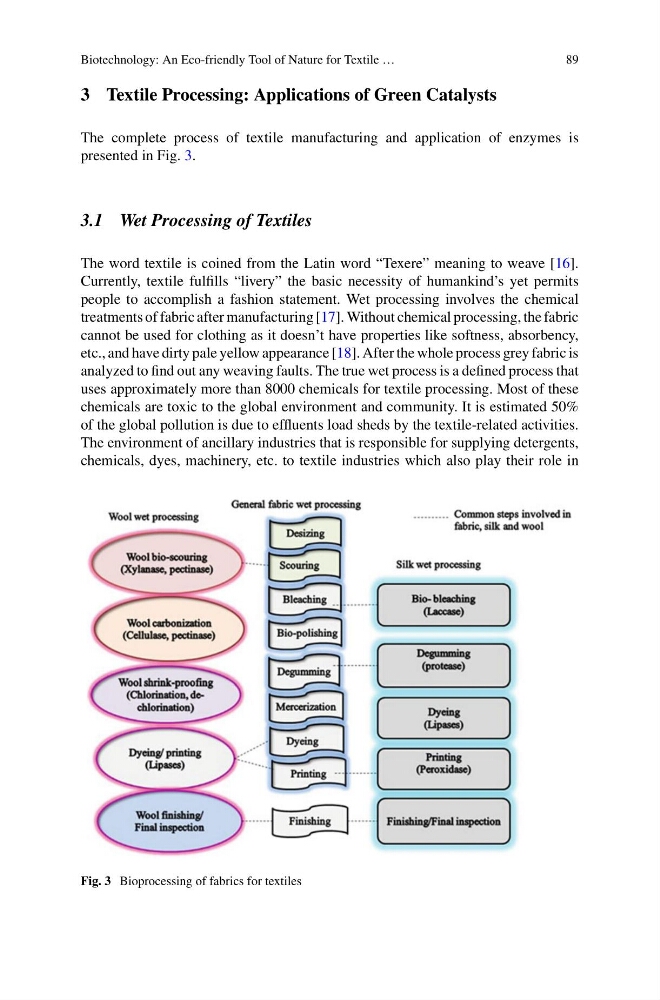
The complete process of textile manufacturing and application of enzymes is
presented in Fig. 3.
3.1 Wet Processing of Textiles
The word textile is coined from the Latin word “Texere” meaning to weave [16].
Currently, textile fulfills “livery” the basic necessity of humankind’s yet permits
people to accomplish a fashion statement. Wet processing involves the chemical
treatments of fabric after manufacturing [17]. Without chemical processing, the fabric
cannot be used for clothing as it doesn’t have properties like softness, absorbency,
etc., and have dirty pale yellow appearance [18]. After the whole process grey fabric is
analyzed to find out any weaving faults. The true wet process is a defined process that
uses approximately more than 8000 chemicals for textile processing. Most of these
chemicals are toxic to the global environment and community. It is estimated 50%
of the global pollution is due to effluents load sheds by the textile-related activities.
The environment of ancillary industries that is responsible for supplying detergents,
chemicals, dyes, machinery, etc. to textile industries which also play their role in
Fig. 3 Bioprocessing of fabrics for textiles
89
3 Textile Processing: Applications of Green Catalysts
The complete process of textile manufacturing and application of enzymes is
presented in Fig. 3.
3.1 Wet Processing of Textiles
The word textile is coined from the Latin word “Texere” meaning to weave [16].
Currently, textile fulfills “livery” the basic necessity of humankind’s yet permits
people to accomplish a fashion statement. Wet processing involves the chemical
treatments of fabric after manufacturing [17]. Without chemical processing, the fabric
cannot be used for clothing as it doesn’t have properties like softness, absorbency,
etc., and have dirty pale yellow appearance [18]. After the whole process grey fabric is
analyzed to find out any weaving faults. The true wet process is a defined process that
uses approximately more than 8000 chemicals for textile processing. Most of these
chemicals are toxic to the global environment and community. It is estimated 50%
of the global pollution is due to effluents load sheds by the textile-related activities.
The environment of ancillary industries that is responsible for supplying detergents,
chemicals, dyes, machinery, etc. to textile industries which also play their role in
Fig. 3 Bioprocessing of fabrics for textiles