

Environmental Profile of Nano-finished Textile …
61
3.1 Inorganic Nanomaterials and Their Nanocomposites
The most common inorganic nanomaterials are titanium dioxide (metallic and
non-metallic composites), silver (nano-structured materials based on silver and
silver-modified montmorillonites), zinc oxide, copper, gallium, gold nano-particles,
carbon nanotubes, nano-layered clay including its modified species (silver-nanoclay/chitosan and clay–polyvinyl pyridinium), and their respective nano-composites.
3.1.1 Titanium Dioxide (TiO 2 ) Nanoparticles
Currently, titanium dioxide in the form of nano-antibacterials has created remarkable
additions in its application field for developing attractive multi-functional materials.
It possesses high stability and broad spectrum activity [12]. Photo-catalytic activity
of TiO 2 is a function of structure and powder purification which makes it one of
the efficient candidates for anti-bacterial, UV protecting, self-cleaning, water and air
purifier, environmental purification, in solar cells and gas sensors [13–17]. Among the
various crystal structures of TiO 2 , anatase due to its high surface area finds extensive
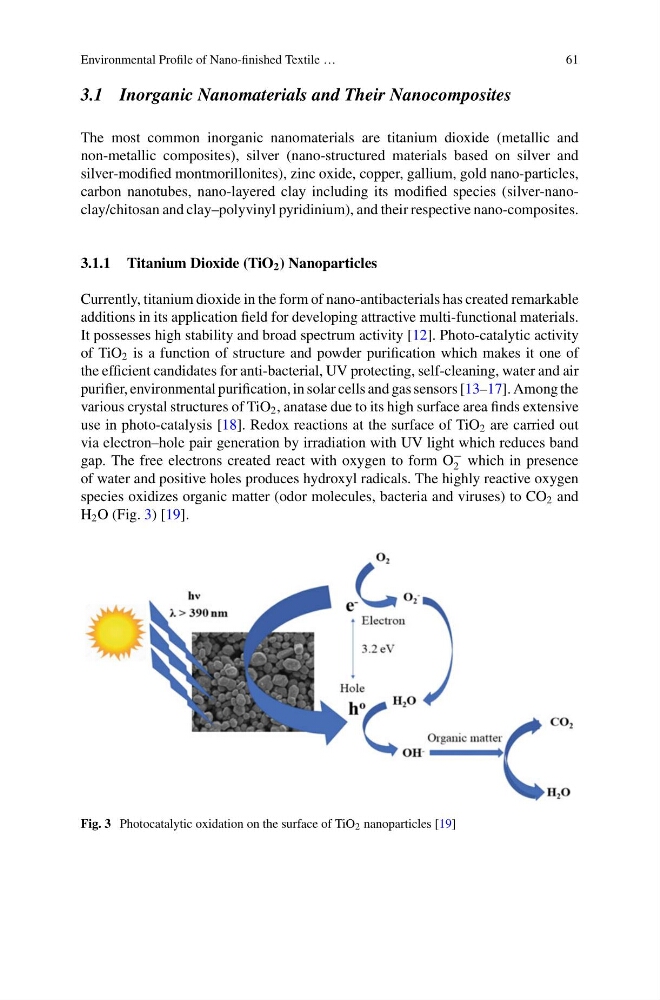
use in photo-catalysis [18]. Redox reactions at the surface of TiO 2 are carried out
via electron–hole pair generation by irradiation with UV light which reduces band
gap. The free electrons created react with oxygen to form O
−
2 which in presence
of water and positive holes produces hydroxyl radicals. The highly reactive oxygen
species oxidizes organic matter (odor molecules, bacteria and viruses) to CO 2 and
H 2 O (Fig. 3) [19].
Fig. 3 Photocatalytic oxidation on the surface of TiO 2 nanoparticles [19]
61
3.1 Inorganic Nanomaterials and Their Nanocomposites
The most common inorganic nanomaterials are titanium dioxide (metallic and
non-metallic composites), silver (nano-structured materials based on silver and
silver-modified montmorillonites), zinc oxide, copper, gallium, gold nano-particles,
carbon nanotubes, nano-layered clay including its modified species (silver-nanoclay/chitosan and clay–polyvinyl pyridinium), and their respective nano-composites.
3.1.1 Titanium Dioxide (TiO 2 ) Nanoparticles
Currently, titanium dioxide in the form of nano-antibacterials has created remarkable
additions in its application field for developing attractive multi-functional materials.
It possesses high stability and broad spectrum activity [12]. Photo-catalytic activity
of TiO 2 is a function of structure and powder purification which makes it one of
the efficient candidates for anti-bacterial, UV protecting, self-cleaning, water and air
purifier, environmental purification, in solar cells and gas sensors [13–17]. Among the
various crystal structures of TiO 2 , anatase due to its high surface area finds extensive
use in photo-catalysis [18]. Redox reactions at the surface of TiO 2 are carried out
via electron–hole pair generation by irradiation with UV light which reduces band
gap. The free electrons created react with oxygen to form O
−
2 which in presence
of water and positive holes produces hydroxyl radicals. The highly reactive oxygen
species oxidizes organic matter (odor molecules, bacteria and viruses) to CO 2 and
H 2 O (Fig. 3) [19].
Fig. 3 Photocatalytic oxidation on the surface of TiO 2 nanoparticles [19]