

Functional Finishing of Cotton Textiles Using Nanomaterials
53
element. Graphene is being routinely evaluated for coating on the surface of cotton
fabrics to make it electro conductive [44]. Another research team [45] deposited
graphene oxide on the surface of cotton to form the conductive cotton fabric that viability as a strain sensor even after 400 bending cycles. The deposited graphene oxide
was reduced by hot press method at 180 °C for 60 min without the use of chemical
reducing agent. In yet another work, the cotton T-shirt was converted into highly conductive and flexible activated carbon textiles by a chemical activation route, resulting
in an ideal electrical double-layer capacitive behavior [46]. A conductive activated
cotton textile with porous tubular structure was prepared from cotton textile to load
sulfur that was further wrapped with partially reduced graphene oxide to immobilize
the lithium polysulfides [47]. This was used to prepare lithium-sulfur battery that
exceptional capacity and rate performance.
8 Safety Aspects
The use of nanomaterials for nanofinishing of cotton textiles is on the rise and, it
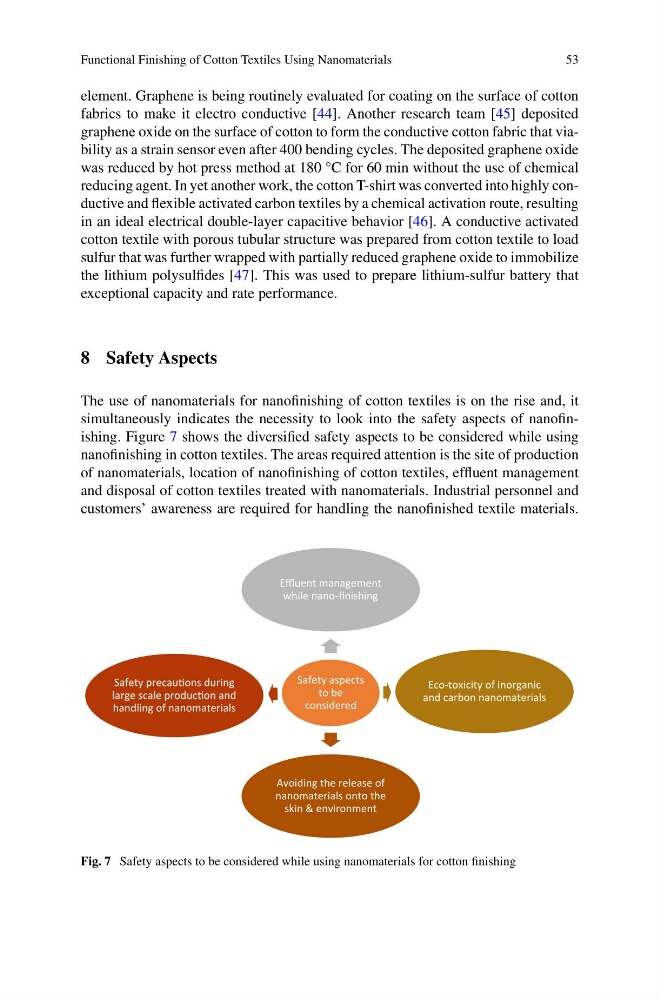
simultaneously indicates the necessity to look into the safety aspects of nanofinishing. Figure 7 shows the diversified safety aspects to be considered while using
nanofinishing in cotton textiles. The areas required attention is the site of production
of nanomaterials, location of nanofinishing of cotton textiles, effluent management
and disposal of cotton textiles treated with nanomaterials. Industrial personnel and
customers’ awareness are required for handling the nanofinished textile materials.
Safety aspects
to be
considered
Effluent management
while nano-finishing
Eco-toxicity of inorganic
and carbon nanomaterials
Avoiding the release of
nanomaterials onto the
skin & environment
Safety precauons during
large scale producon and
handling of nanomaterials
Fig. 7 Safety aspects to be considered while using nanomaterials for cotton finishing
53
element. Graphene is being routinely evaluated for coating on the surface of cotton
fabrics to make it electro conductive [44]. Another research team [45] deposited
graphene oxide on the surface of cotton to form the conductive cotton fabric that viability as a strain sensor even after 400 bending cycles. The deposited graphene oxide
was reduced by hot press method at 180 °C for 60 min without the use of chemical
reducing agent. In yet another work, the cotton T-shirt was converted into highly conductive and flexible activated carbon textiles by a chemical activation route, resulting
in an ideal electrical double-layer capacitive behavior [46]. A conductive activated
cotton textile with porous tubular structure was prepared from cotton textile to load
sulfur that was further wrapped with partially reduced graphene oxide to immobilize
the lithium polysulfides [47]. This was used to prepare lithium-sulfur battery that
exceptional capacity and rate performance.
8 Safety Aspects
The use of nanomaterials for nanofinishing of cotton textiles is on the rise and, it
simultaneously indicates the necessity to look into the safety aspects of nanofinishing. Figure 7 shows the diversified safety aspects to be considered while using
nanofinishing in cotton textiles. The areas required attention is the site of production
of nanomaterials, location of nanofinishing of cotton textiles, effluent management
and disposal of cotton textiles treated with nanomaterials. Industrial personnel and
customers’ awareness are required for handling the nanofinished textile materials.
Safety aspects
to be
considered
Effluent management
while nano-finishing
Eco-toxicity of inorganic
and carbon nanomaterials
Avoiding the release of
nanomaterials onto the
skin & environment
Safety precauons during
large scale producon and
handling of nanomaterials
Fig. 7 Safety aspects to be considered while using nanomaterials for cotton finishing