

32
D. K. Subbiah et al.
pressure could be measured in a cuff-less method; by using a life belt, the mother and
the unborn baby (fetus) could be supervised in the transabdominal condition for a
longer duration. Such a design would be essential and beneficial for pregnant women
staying in remote areas who face specific fitness issues.
4.6 Conductive Fabrics
In the past few decades, most of the developed surface modified fabrics showed great
promise as wearable e-textiles owing to their high flexibility [154], high conductivity [155], low cost [156] and light weighted electronic platform [157]. Integration
of several flexible electronic devices on fabrics, textiles, and fibers need electrically
conducting and semi-conducting platforms such as polymers, metals, metal oxides
and its composites. Thus, materials play an important role in realising wearable,
light-weight, easy to process, tough, flexible and portable e-textiles for various versatile interactive electronic applications. The chemical, electrical and mechanical
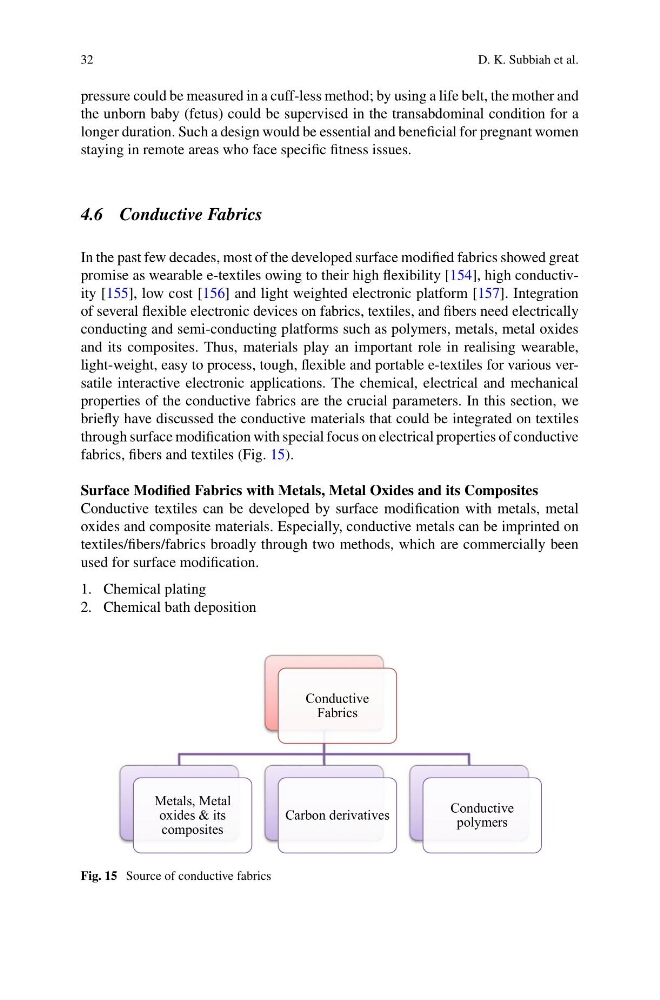
properties of the conductive fabrics are the crucial parameters. In this section, we
briefly have discussed the conductive materials that could be integrated on textiles
through surface modification with special focus on electrical properties of conductive
fabrics, fibers and textiles (Fig. 15).
Surface Modified Fabrics with Metals, Metal Oxides and its Composites
Conductive textiles can be developed by surface modification with metals, metal
oxides and composite materials. Especially, conductive metals can be imprinted on
textiles/fibers/fabrics broadly through two methods, which are commercially been
used for surface modification.
1. Chemical plating
2. Chemical bath deposition
Conductive
Fabrics
Metals, Metal
oxides & its
composites
Carbon derivatives
Conductive
polymers
Fig. 15 Source of conductive fabrics
D. K. Subbiah et al.
pressure could be measured in a cuff-less method; by using a life belt, the mother and
the unborn baby (fetus) could be supervised in the transabdominal condition for a
longer duration. Such a design would be essential and beneficial for pregnant women
staying in remote areas who face specific fitness issues.
4.6 Conductive Fabrics
In the past few decades, most of the developed surface modified fabrics showed great
promise as wearable e-textiles owing to their high flexibility [154], high conductivity [155], low cost [156] and light weighted electronic platform [157]. Integration
of several flexible electronic devices on fabrics, textiles, and fibers need electrically
conducting and semi-conducting platforms such as polymers, metals, metal oxides
and its composites. Thus, materials play an important role in realising wearable,
light-weight, easy to process, tough, flexible and portable e-textiles for various versatile interactive electronic applications. The chemical, electrical and mechanical
properties of the conductive fabrics are the crucial parameters. In this section, we
briefly have discussed the conductive materials that could be integrated on textiles
through surface modification with special focus on electrical properties of conductive
fabrics, fibers and textiles (Fig. 15).
Surface Modified Fabrics with Metals, Metal Oxides and its Composites
Conductive textiles can be developed by surface modification with metals, metal
oxides and composite materials. Especially, conductive metals can be imprinted on
textiles/fibers/fabrics broadly through two methods, which are commercially been
used for surface modification.
1. Chemical plating
2. Chemical bath deposition
Conductive
Fabrics
Metals, Metal
oxides & its
composites
Carbon derivatives
Conductive
polymers
Fig. 15 Source of conductive fabrics