

Plasma Treatment Technology for Surface Modification …
285
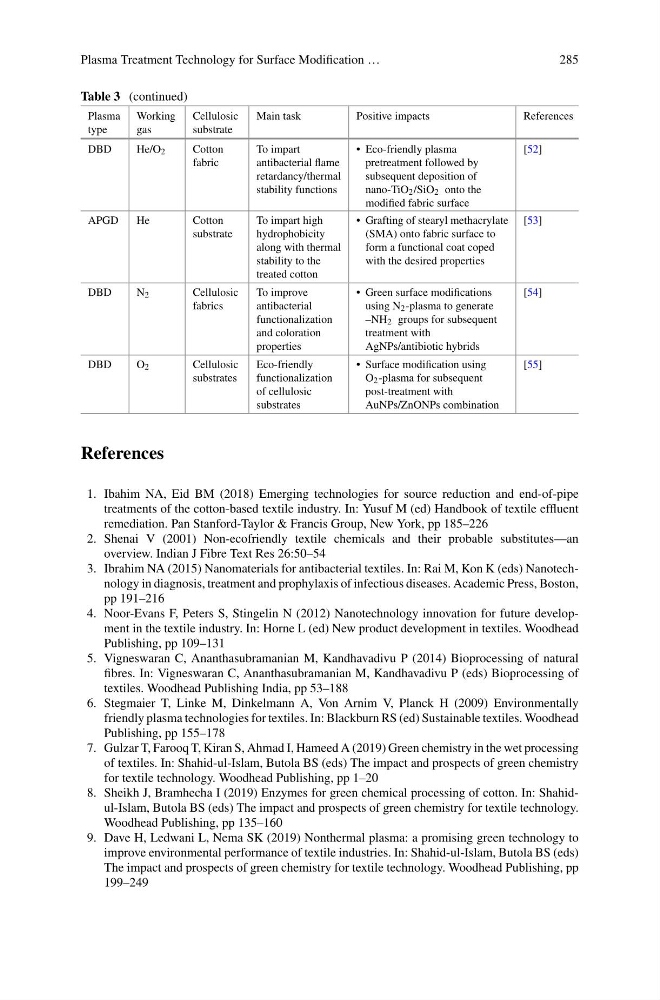
Table 3 (continued)
Plasma
type
Working
gas
Cellulosic
substrate
Main task
Positive impacts
References
DBD
He/O 2
Cotton
fabric
To impart
antibacterial flame
retardancy/thermal
stability functions
• Eco-friendly plasma
pretreatment followed by
subsequent deposition of
nano-TiO 2 /SiO 2 onto the
modified fabric surface
[52]
APGD
He
Cotton
substrate
To impart high
hydrophobicity
along with thermal
stability to the
treated cotton
• Grafting of stearyl methacrylate
(SMA) onto fabric surface to
form a functional coat coped
with the desired properties
[53]
DBD
N 2
Cellulosic
fabrics
To improve
antibacterial
functionalization
and coloration
properties
• Green surface modifications
using N 2 -plasma to generate
–NH 2 groups for subsequent
treatment with
AgNPs/antibiotic hybrids
[54]
DBD
O 2
Cellulosic
substrates
Eco-friendly
functionalization
of cellulosic
substrates
• Surface modification using
O 2 -plasma for subsequent
post-treatment with
AuNPs/ZnONPs combination
[55]
References
1. Ibahim NA, Eid BM (2018) Emerging technologies for source reduction and end-of-pipe
treatments of the cotton-based textile industry. In: Yusuf M (ed) Handbook of textile effluent
remediation. Pan Stanford-Taylor & Francis Group, New York, pp 185–226
2. Shenai V (2001) Non-ecofriendly textile chemicals and their probable substitutes—an
overview. Indian J Fibre Text Res 26:50–54
3. Ibrahim NA (2015) Nanomaterials for antibacterial textiles. In: Rai M, Kon K (eds) Nanotechnology in diagnosis, treatment and prophylaxis of infectious diseases. Academic Press, Boston,
pp 191–216
4. Noor-Evans F, Peters S, Stingelin N (2012) Nanotechnology innovation for future development in the textile industry. In: Horne L (ed) New product development in textiles. Woodhead
Publishing, pp 109–131
5. Vigneswaran C, Ananthasubramanian M, Kandhavadivu P (2014) Bioprocessing of natural
fibres. In: Vigneswaran C, Ananthasubramanian M, Kandhavadivu P (eds) Bioprocessing of
textiles. Woodhead Publishing India, pp 53–188
6. Stegmaier T, Linke M, Dinkelmann A, Von Arnim V, Planck H (2009) Environmentally
friendly plasma technologies for textiles. In: Blackburn RS (ed) Sustainable textiles. Woodhead
Publishing, pp 155–178
7. Gulzar T, Farooq T, Kiran S, Ahmad I, Hameed A (2019) Green chemistry in the wet processing
of textiles. In: Shahid-ul-Islam, Butola BS (eds) The impact and prospects of green chemistry
for textile technology. Woodhead Publishing, pp 1–20
8. Sheikh J, Bramhecha I (2019) Enzymes for green chemical processing of cotton. In: Shahidul-Islam, Butola BS (eds) The impact and prospects of green chemistry for textile technology.
Woodhead Publishing, pp 135–160
9. Dave H, Ledwani L, Nema SK (2019) Nonthermal plasma: a promising green technology to
improve environmental performance of textile industries. In: Shahid-ul-Islam, Butola BS (eds)
The impact and prospects of green chemistry for textile technology. Woodhead Publishing, pp
199–249
285
Table 3 (continued)
Plasma
type
Working
gas
Cellulosic
substrate
Main task
Positive impacts
References
DBD
He/O 2
Cotton
fabric
To impart
antibacterial flame
retardancy/thermal
stability functions
• Eco-friendly plasma
pretreatment followed by
subsequent deposition of
nano-TiO 2 /SiO 2 onto the
modified fabric surface
[52]
APGD
He
Cotton
substrate
To impart high
hydrophobicity
along with thermal
stability to the
treated cotton
• Grafting of stearyl methacrylate
(SMA) onto fabric surface to
form a functional coat coped
with the desired properties
[53]
DBD
N 2
Cellulosic
fabrics
To improve
antibacterial
functionalization
and coloration
properties
• Green surface modifications
using N 2 -plasma to generate
–NH 2 groups for subsequent
treatment with
AgNPs/antibiotic hybrids
[54]
DBD
O 2
Cellulosic
substrates
Eco-friendly
functionalization
of cellulosic
substrates
• Surface modification using
O 2 -plasma for subsequent
post-treatment with
AuNPs/ZnONPs combination
[55]
References
1. Ibahim NA, Eid BM (2018) Emerging technologies for source reduction and end-of-pipe
treatments of the cotton-based textile industry. In: Yusuf M (ed) Handbook of textile effluent
remediation. Pan Stanford-Taylor & Francis Group, New York, pp 185–226
2. Shenai V (2001) Non-ecofriendly textile chemicals and their probable substitutes—an
overview. Indian J Fibre Text Res 26:50–54
3. Ibrahim NA (2015) Nanomaterials for antibacterial textiles. In: Rai M, Kon K (eds) Nanotechnology in diagnosis, treatment and prophylaxis of infectious diseases. Academic Press, Boston,
pp 191–216
4. Noor-Evans F, Peters S, Stingelin N (2012) Nanotechnology innovation for future development in the textile industry. In: Horne L (ed) New product development in textiles. Woodhead
Publishing, pp 109–131
5. Vigneswaran C, Ananthasubramanian M, Kandhavadivu P (2014) Bioprocessing of natural
fibres. In: Vigneswaran C, Ananthasubramanian M, Kandhavadivu P (eds) Bioprocessing of
textiles. Woodhead Publishing India, pp 53–188
6. Stegmaier T, Linke M, Dinkelmann A, Von Arnim V, Planck H (2009) Environmentally
friendly plasma technologies for textiles. In: Blackburn RS (ed) Sustainable textiles. Woodhead
Publishing, pp 155–178
7. Gulzar T, Farooq T, Kiran S, Ahmad I, Hameed A (2019) Green chemistry in the wet processing
of textiles. In: Shahid-ul-Islam, Butola BS (eds) The impact and prospects of green chemistry
for textile technology. Woodhead Publishing, pp 1–20
8. Sheikh J, Bramhecha I (2019) Enzymes for green chemical processing of cotton. In: Shahidul-Islam, Butola BS (eds) The impact and prospects of green chemistry for textile technology.
Woodhead Publishing, pp 135–160
9. Dave H, Ledwani L, Nema SK (2019) Nonthermal plasma: a promising green technology to
improve environmental performance of textile industries. In: Shahid-ul-Islam, Butola BS (eds)
The impact and prospects of green chemistry for textile technology. Woodhead Publishing, pp
199–249