

260
T. A. Khattab and M. S. Abdelrahman
improve our understanding of the behavior of existing chromic colorants employed
onto textiles under optimized conditions. Those efforts are needed to deepen into
future if the determined targets are to be recognized.
3 Photochromic Colorants
Photochromism is a process in which a substance can go through a reversible color
change between two different chemical species of different absorption spectra upon
irradiation with ultraviolet or white light. This color change process can be reverted
back to the pristine color or colorless state upon the removal of the light source [39,
40]. Irradiation of a photochromic colorless molecule leads to an isomerism process
to an intensely colored molecular species. The reversible process may revert back
to the pristine colorless molecular form either by removing the light source or by
another external stimulus, such as heat. Spiropyrans have been used extensively in
commercial products due to their relatively simple preparation and ability to provide
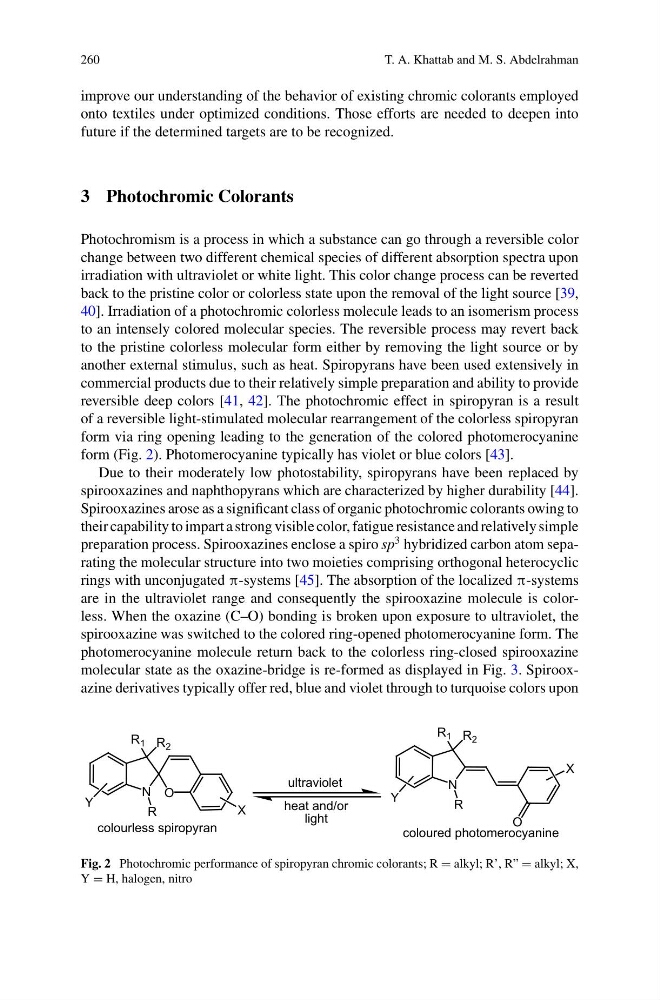
reversible deep colors [41, 42]. The photochromic effect in spiropyran is a result
of a reversible light-stimulated molecular rearrangement of the colorless spiropyran
form via ring opening leading to the generation of the colored photomerocyanine
form (Fig. 2). Photomerocyanine typically has violet or blue colors [43].
Due to their moderately low photostability, spiropyrans have been replaced by
spirooxazines and naphthopyrans which are characterized by higher durability [44].
Spirooxazines arose as a significant class of organic photochromic colorants owing to
their capability to impart a strong visible color, fatigue resistance and relatively simple
preparation process. Spirooxazines enclose a spiro sp
3 hybridized carbon atom separating the molecular structure into two moieties comprising orthogonal heterocyclic
rings with unconjugated π-systems [45]. The absorption of the localized π-systems
are in the ultraviolet range and consequently the spirooxazine molecule is colorless. When the oxazine (C–O) bonding is broken upon exposure to ultraviolet, the
spirooxazine was switched to the colored ring-opened photomerocyanine form. The
photomerocyanine molecule return back to the colorless ring-closed spirooxazine
molecular state as the oxazine-bridge is re-formed as displayed in Fig. 3. Spirooxazine derivatives typically offer red, blue and violet through to turquoise colors upon
O
N
R 1 R 2
R
Y
X
Y
X
N
R 1 R 2
R
O
colourless spiropyran
coloured photomerocyanine
heat and/or
light
ultraviolet
Fig. 2 Photochromic performance of spiropyran chromic colorants; R = alkyl; R’, R” = alkyl; X,
Y = H, halogen, nitro
T. A. Khattab and M. S. Abdelrahman
improve our understanding of the behavior of existing chromic colorants employed
onto textiles under optimized conditions. Those efforts are needed to deepen into
future if the determined targets are to be recognized.
3 Photochromic Colorants
Photochromism is a process in which a substance can go through a reversible color
change between two different chemical species of different absorption spectra upon
irradiation with ultraviolet or white light. This color change process can be reverted
back to the pristine color or colorless state upon the removal of the light source [39,
40]. Irradiation of a photochromic colorless molecule leads to an isomerism process
to an intensely colored molecular species. The reversible process may revert back
to the pristine colorless molecular form either by removing the light source or by
another external stimulus, such as heat. Spiropyrans have been used extensively in
commercial products due to their relatively simple preparation and ability to provide
reversible deep colors [41, 42]. The photochromic effect in spiropyran is a result
of a reversible light-stimulated molecular rearrangement of the colorless spiropyran
form via ring opening leading to the generation of the colored photomerocyanine
form (Fig. 2). Photomerocyanine typically has violet or blue colors [43].
Due to their moderately low photostability, spiropyrans have been replaced by
spirooxazines and naphthopyrans which are characterized by higher durability [44].
Spirooxazines arose as a significant class of organic photochromic colorants owing to
their capability to impart a strong visible color, fatigue resistance and relatively simple
preparation process. Spirooxazines enclose a spiro sp
3 hybridized carbon atom separating the molecular structure into two moieties comprising orthogonal heterocyclic
rings with unconjugated π-systems [45]. The absorption of the localized π-systems
are in the ultraviolet range and consequently the spirooxazine molecule is colorless. When the oxazine (C–O) bonding is broken upon exposure to ultraviolet, the
spirooxazine was switched to the colored ring-opened photomerocyanine form. The
photomerocyanine molecule return back to the colorless ring-closed spirooxazine
molecular state as the oxazine-bridge is re-formed as displayed in Fig. 3. Spirooxazine derivatives typically offer red, blue and violet through to turquoise colors upon
O
N
R 1 R 2
R
Y
X
Y
X
N
R 1 R 2
R
O
colourless spiropyran
coloured photomerocyanine
heat and/or
light
ultraviolet
Fig. 2 Photochromic performance of spiropyran chromic colorants; R = alkyl; R’, R” = alkyl; X,
Y = H, halogen, nitro