

218
S. Maity et al.
solid textile surface and droplet of contact-fluid. The wettability of the solid surface
depends on the surface energy of the solid and the liquid. Depending on the difference in surface energy the contact angle is subtended in smooth surface. There are
wettability theories proposed in literature for smooth and rough surfaces. For smooth
surface, Young model (Eq. 1) was proposed which is based on the three interfacial
energies per unit area which are in equilibrium at the droplet resting on solid surface.
γ sv = γ sl + γ lv cosθ
(1)
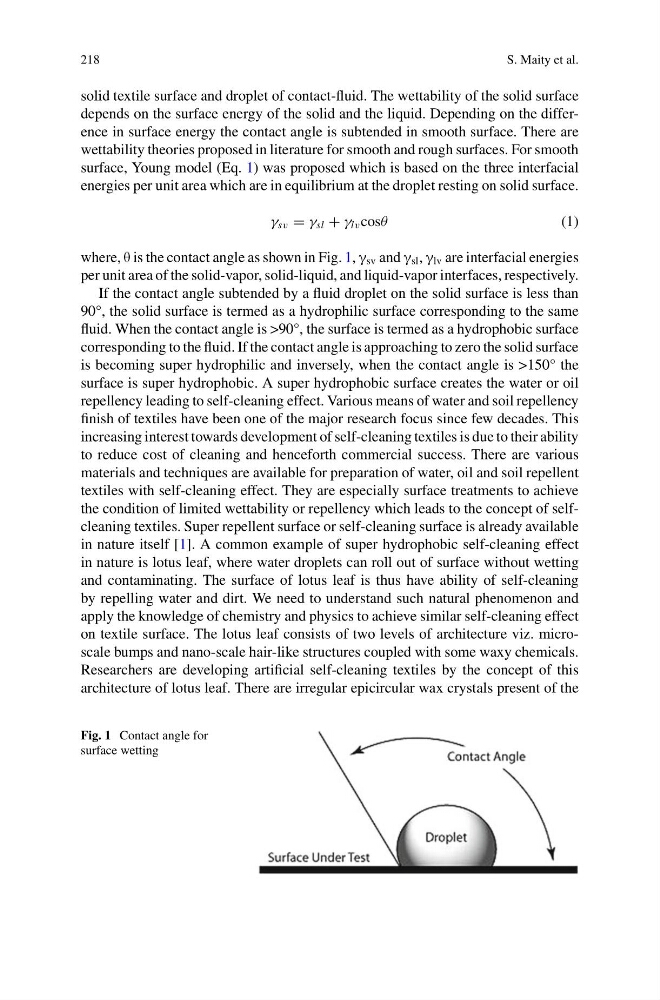
where, θ is the contact angle as shown in Fig. 1, γ sv and γ sl , γ lv are interfacial energies
per unit area of the solid-vapor, solid-liquid, and liquid-vapor interfaces, respectively.
If the contact angle subtended by a fluid droplet on the solid surface is less than
90°, the solid surface is termed as a hydrophilic surface corresponding to the same
fluid. When the contact angle is >90°, the surface is termed as a hydrophobic surface
corresponding to the fluid. If the contact angle is approaching to zero the solid surface
is becoming super hydrophilic and inversely, when the contact angle is >150° the
surface is super hydrophobic. A super hydrophobic surface creates the water or oil
repellency leading to self-cleaning effect. Various means of water and soil repellency
finish of textiles have been one of the major research focus since few decades. This
increasing interest towards development of self-cleaning textiles is due to their ability
to reduce cost of cleaning and henceforth commercial success. There are various
materials and techniques are available for preparation of water, oil and soil repellent
textiles with self-cleaning effect. They are especially surface treatments to achieve
the condition of limited wettability or repellency which leads to the concept of selfcleaning textiles. Super repellent surface or self-cleaning surface is already available
in nature itself [1]. A common example of super hydrophobic self-cleaning effect
in nature is lotus leaf, where water droplets can roll out of surface without wetting
and contaminating. The surface of lotus leaf is thus have ability of self-cleaning
by repelling water and dirt. We need to understand such natural phenomenon and
apply the knowledge of chemistry and physics to achieve similar self-cleaning effect
on textile surface. The lotus leaf consists of two levels of architecture viz. microscale bumps and nano-scale hair-like structures coupled with some waxy chemicals.
Researchers are developing artificial self-cleaning textiles by the concept of this
architecture of lotus leaf. There are irregular epicircular wax crystals present of the
Fig. 1 Contact angle for
surface wetting
S. Maity et al.
solid textile surface and droplet of contact-fluid. The wettability of the solid surface
depends on the surface energy of the solid and the liquid. Depending on the difference in surface energy the contact angle is subtended in smooth surface. There are
wettability theories proposed in literature for smooth and rough surfaces. For smooth
surface, Young model (Eq. 1) was proposed which is based on the three interfacial
energies per unit area which are in equilibrium at the droplet resting on solid surface.
γ sv = γ sl + γ lv cosθ
(1)
where, θ is the contact angle as shown in Fig. 1, γ sv and γ sl , γ lv are interfacial energies
per unit area of the solid-vapor, solid-liquid, and liquid-vapor interfaces, respectively.
If the contact angle subtended by a fluid droplet on the solid surface is less than
90°, the solid surface is termed as a hydrophilic surface corresponding to the same
fluid. When the contact angle is >90°, the surface is termed as a hydrophobic surface
corresponding to the fluid. If the contact angle is approaching to zero the solid surface
is becoming super hydrophilic and inversely, when the contact angle is >150° the
surface is super hydrophobic. A super hydrophobic surface creates the water or oil
repellency leading to self-cleaning effect. Various means of water and soil repellency
finish of textiles have been one of the major research focus since few decades. This
increasing interest towards development of self-cleaning textiles is due to their ability
to reduce cost of cleaning and henceforth commercial success. There are various
materials and techniques are available for preparation of water, oil and soil repellent
textiles with self-cleaning effect. They are especially surface treatments to achieve
the condition of limited wettability or repellency which leads to the concept of selfcleaning textiles. Super repellent surface or self-cleaning surface is already available
in nature itself [1]. A common example of super hydrophobic self-cleaning effect
in nature is lotus leaf, where water droplets can roll out of surface without wetting
and contaminating. The surface of lotus leaf is thus have ability of self-cleaning
by repelling water and dirt. We need to understand such natural phenomenon and
apply the knowledge of chemistry and physics to achieve similar self-cleaning effect
on textile surface. The lotus leaf consists of two levels of architecture viz. microscale bumps and nano-scale hair-like structures coupled with some waxy chemicals.
Researchers are developing artificial self-cleaning textiles by the concept of this
architecture of lotus leaf. There are irregular epicircular wax crystals present of the
Fig. 1 Contact angle for
surface wetting