

160
S. Riaz and M. Ashraf
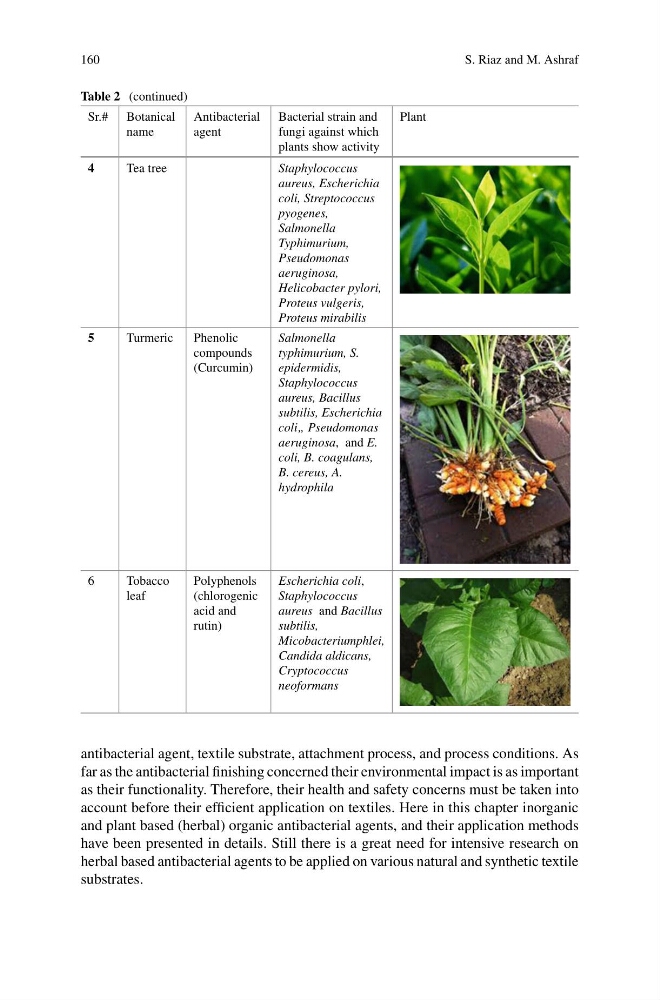
Table 2 (continued)
Sr.# Botanical
name
Antibacterial
agent
Bacterial strain and
fungi against which
plants show activity
Plant
4
Tea tree
Staphylococcus
aureus, Escherichia
coli, Streptococcus
pyogenes,
Salmonella
Typhimurium,
Pseudomonas
aeruginosa,
Helicobacter pylori,
Proteus vulgeris,
Proteus mirabilis
5
Turmeric
Phenolic
compounds
(Curcumin)
Salmonella
typhimurium, S.
epidermidis,
Staphylococcus
aureus, Bacillus
subtilis, Escherichia
coli„ Pseudomonas
aeruginosa, and E.
coli, B. coagulans,
B. cereus, A.
hydrophila
6
Tobacco
leaf
Polyphenols
(chlorogenic
acid and
rutin)
Escherichia coli,
Staphylococcus
aureus and Bacillus
subtilis,
Micobacteriumphlei,
Candida aldicans,
Cryptococcus
neoformans
antibacterial agent, textile substrate, attachment process, and process conditions. As
far as the antibacterial finishing concerned their environmental impact is as important
as their functionality. Therefore, their health and safety concerns must be taken into
account before their efficient application on textiles. Here in this chapter inorganic
and plant based (herbal) organic antibacterial agents, and their application methods
have been presented in details. Still there is a great need for intensive research on
herbal based antibacterial agents to be applied on various natural and synthetic textile
substrates.
S. Riaz and M. Ashraf
Table 2 (continued)
Sr.# Botanical
name
Antibacterial
agent
Bacterial strain and
fungi against which
plants show activity
Plant
4
Tea tree
Staphylococcus
aureus, Escherichia
coli, Streptococcus
pyogenes,
Salmonella
Typhimurium,
Pseudomonas
aeruginosa,
Helicobacter pylori,
Proteus vulgeris,
Proteus mirabilis
5
Turmeric
Phenolic
compounds
(Curcumin)
Salmonella
typhimurium, S.
epidermidis,
Staphylococcus
aureus, Bacillus
subtilis, Escherichia
coli„ Pseudomonas
aeruginosa, and E.
coli, B. coagulans,
B. cereus, A.
hydrophila
6
Tobacco
leaf
Polyphenols
(chlorogenic
acid and
rutin)
Escherichia coli,
Staphylococcus
aureus and Bacillus
subtilis,
Micobacteriumphlei,
Candida aldicans,
Cryptococcus
neoformans
antibacterial agent, textile substrate, attachment process, and process conditions. As
far as the antibacterial finishing concerned their environmental impact is as important
as their functionality. Therefore, their health and safety concerns must be taken into
account before their efficient application on textiles. Here in this chapter inorganic
and plant based (herbal) organic antibacterial agents, and their application methods
have been presented in details. Still there is a great need for intensive research on
herbal based antibacterial agents to be applied on various natural and synthetic textile
substrates.