

Recent Advances in Development of Antimicrobial Textiles
151
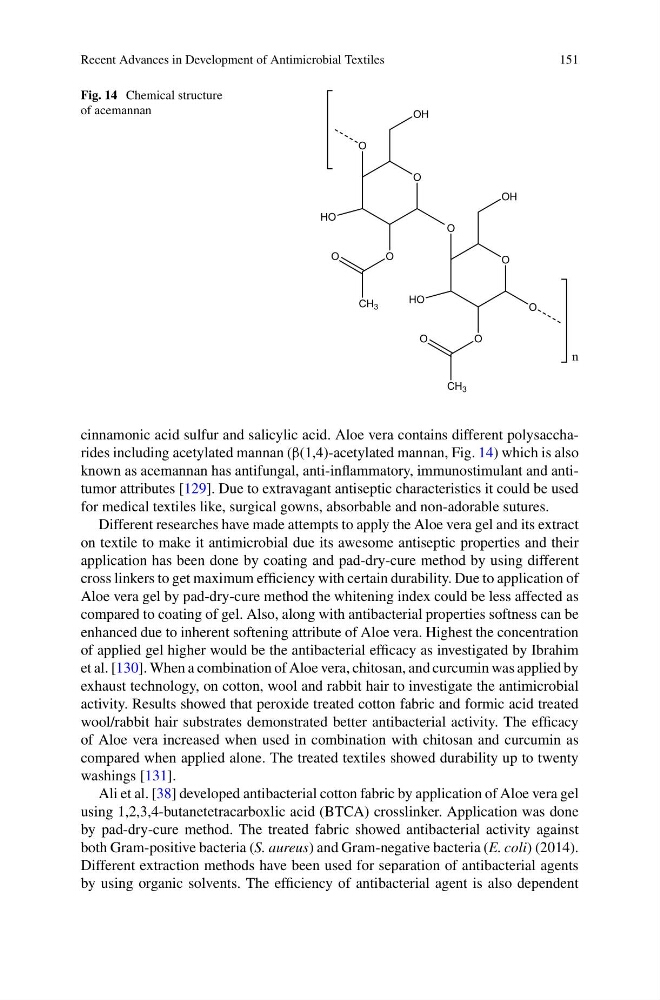
Fig. 14 Chemical structure
of acemannan
O
O
O
CH 3
HO
O
OH
O
O
O
O
CH 3
HO
O
OH
n
cinnamonic acid sulfur and salicylic acid. Aloe vera contains different polysaccharides including acetylated mannan (β(1,4)-acetylated mannan, Fig. 14) which is also
known as acemannan has antifungal, anti-inflammatory, immunostimulant and antitumor attributes [129]. Due to extravagant antiseptic characteristics it could be used
for medical textiles like, surgical gowns, absorbable and non-adorable sutures.
Different researches have made attempts to apply the Aloe vera gel and its extract
on textile to make it antimicrobial due its awesome antiseptic properties and their
application has been done by coating and pad-dry-cure method by using different
cross linkers to get maximum efficiency with certain durability. Due to application of
Aloe vera gel by pad-dry-cure method the whitening index could be less affected as
compared to coating of gel. Also, along with antibacterial properties softness can be
enhanced due to inherent softening attribute of Aloe vera. Highest the concentration
of applied gel higher would be the antibacterial efficacy as investigated by Ibrahim
et al. [130]. When a combination of Aloe vera, chitosan, and curcumin was applied by
exhaust technology, on cotton, wool and rabbit hair to investigate the antimicrobial
activity. Results showed that peroxide treated cotton fabric and formic acid treated
wool/rabbit hair substrates demonstrated better antibacterial activity. The efficacy
of Aloe vera increased when used in combination with chitosan and curcumin as
compared when applied alone. The treated textiles showed durability up to twenty
washings [131].
Ali et al. [38] developed antibacterial cotton fabric by application of Aloe vera gel
using 1,2,3,4-butanetetracarboxlic acid (BTCA) crosslinker. Application was done
by pad-dry-cure method. The treated fabric showed antibacterial activity against
both Gram-positive bacteria (S. aureus) and Gram-negative bacteria (E. coli) (2014).
Different extraction methods have been used for separation of antibacterial agents
by using organic solvents. The efficiency of antibacterial agent is also dependent
151
Fig. 14 Chemical structure
of acemannan
O
O
O
CH 3
HO
O
OH
O
O
O
O
CH 3
HO
O
OH
n
cinnamonic acid sulfur and salicylic acid. Aloe vera contains different polysaccharides including acetylated mannan (β(1,4)-acetylated mannan, Fig. 14) which is also
known as acemannan has antifungal, anti-inflammatory, immunostimulant and antitumor attributes [129]. Due to extravagant antiseptic characteristics it could be used
for medical textiles like, surgical gowns, absorbable and non-adorable sutures.
Different researches have made attempts to apply the Aloe vera gel and its extract
on textile to make it antimicrobial due its awesome antiseptic properties and their
application has been done by coating and pad-dry-cure method by using different
cross linkers to get maximum efficiency with certain durability. Due to application of
Aloe vera gel by pad-dry-cure method the whitening index could be less affected as
compared to coating of gel. Also, along with antibacterial properties softness can be
enhanced due to inherent softening attribute of Aloe vera. Highest the concentration
of applied gel higher would be the antibacterial efficacy as investigated by Ibrahim
et al. [130]. When a combination of Aloe vera, chitosan, and curcumin was applied by
exhaust technology, on cotton, wool and rabbit hair to investigate the antimicrobial
activity. Results showed that peroxide treated cotton fabric and formic acid treated
wool/rabbit hair substrates demonstrated better antibacterial activity. The efficacy
of Aloe vera increased when used in combination with chitosan and curcumin as
compared when applied alone. The treated textiles showed durability up to twenty
washings [131].
Ali et al. [38] developed antibacterial cotton fabric by application of Aloe vera gel
using 1,2,3,4-butanetetracarboxlic acid (BTCA) crosslinker. Application was done
by pad-dry-cure method. The treated fabric showed antibacterial activity against
both Gram-positive bacteria (S. aureus) and Gram-negative bacteria (E. coli) (2014).
Different extraction methods have been used for separation of antibacterial agents
by using organic solvents. The efficiency of antibacterial agent is also dependent