

124
S. Sarkar et al.
also being used in recent research for remediation of dye containing waste water.
Textile finishing process is based on enzymatic treatment which is environment
friendly. The releasing dyes and aromatic compounds are also being treated by ecofriendly enzymatic process. This is more acceptable to environment due to its less
pollution capacity.
7 Patenting Trends on Use of Microbial Enzymes on Textile
Finishing
Patenting trends of enzymes in textile finishing are also interesting. Cellulase is
mostly used enzyme in textile. As per this perspective, it has been found that there
are a number of petants on cellulase. Europe, United Kingdom, United State have
several patent from 1990s. Previously, patents were done based on application as
detergent or starch. Later, due to some trade legal issues, laundries increased their use
of cellulase [17]. In fact for antimicrobial finishing different types of enzymes from
microbial origin are being used and patented commercially from diverse countries
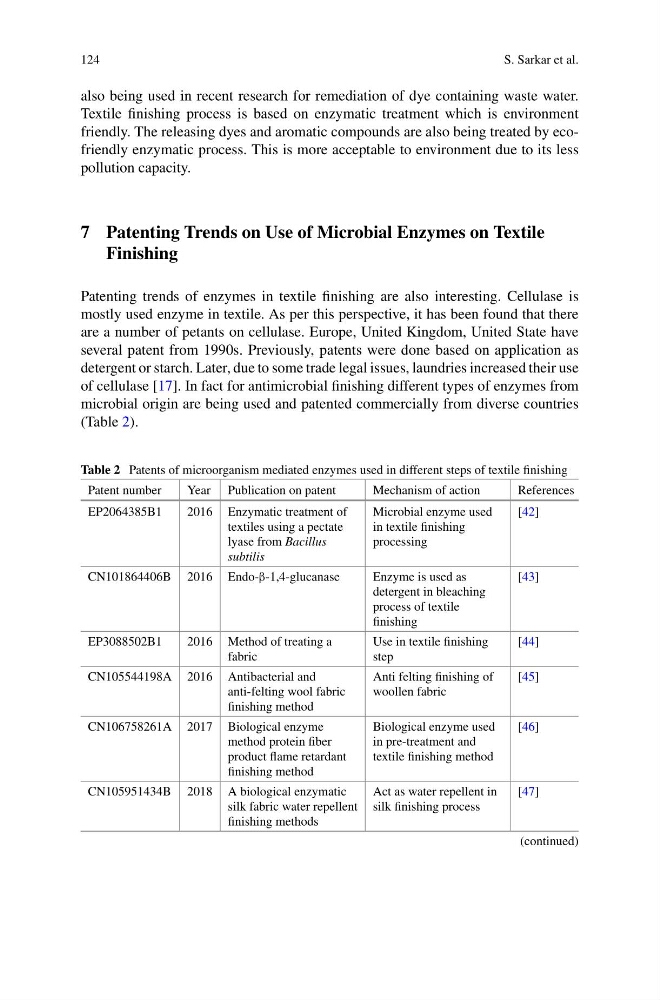
(Table 2).
Table 2 Patents of microorganism mediated enzymes used in different steps of textile finishing
Patent number
Year Publication on patent
Mechanism of action
References
EP2064385B1
2016 Enzymatic treatment of
textiles using a pectate
lyase from Bacillus
subtilis
Microbial enzyme used
in textile finishing
processing
[42]
CN101864406B 2016 Endo-β-1,4-glucanase
Enzyme is used as
detergent in bleaching
process of textile
finishing
[43]
EP3088502B1
2016 Method of treating a
fabric
Use in textile finishing
step
[44]
CN105544198A 2016 Antibacterial and
anti-felting wool fabric
finishing method
Anti felting finishing of
woollen fabric
[45]
CN106758261A 2017 Biological enzyme
method protein fiber
product flame retardant
finishing method
Biological enzyme used
in pre-treatment and
textile finishing method
[46]
CN105951434B 2018 A biological enzymatic
silk fabric water repellent
finishing methods
Act as water repellent in
silk finishing process
[47]
(continued)
S. Sarkar et al.
also being used in recent research for remediation of dye containing waste water.
Textile finishing process is based on enzymatic treatment which is environment
friendly. The releasing dyes and aromatic compounds are also being treated by ecofriendly enzymatic process. This is more acceptable to environment due to its less
pollution capacity.
7 Patenting Trends on Use of Microbial Enzymes on Textile
Finishing
Patenting trends of enzymes in textile finishing are also interesting. Cellulase is
mostly used enzyme in textile. As per this perspective, it has been found that there
are a number of petants on cellulase. Europe, United Kingdom, United State have
several patent from 1990s. Previously, patents were done based on application as
detergent or starch. Later, due to some trade legal issues, laundries increased their use
of cellulase [17]. In fact for antimicrobial finishing different types of enzymes from
microbial origin are being used and patented commercially from diverse countries
(Table 2).
Table 2 Patents of microorganism mediated enzymes used in different steps of textile finishing
Patent number
Year Publication on patent
Mechanism of action
References
EP2064385B1
2016 Enzymatic treatment of
textiles using a pectate
lyase from Bacillus
subtilis
Microbial enzyme used
in textile finishing
processing
[42]
CN101864406B 2016 Endo-β-1,4-glucanase
Enzyme is used as
detergent in bleaching
process of textile
finishing
[43]
EP3088502B1
2016 Method of treating a
fabric
Use in textile finishing
step
[44]
CN105544198A 2016 Antibacterial and
anti-felting wool fabric
finishing method
Anti felting finishing of
woollen fabric
[45]
CN106758261A 2017 Biological enzyme
method protein fiber
product flame retardant
finishing method
Biological enzyme used
in pre-treatment and
textile finishing method
[46]
CN105951434B 2018 A biological enzymatic
silk fabric water repellent
finishing methods
Act as water repellent in
silk finishing process
[47]
(continued)