

90
5 Reinforcing Mechanism of Rubber by Nanofiller
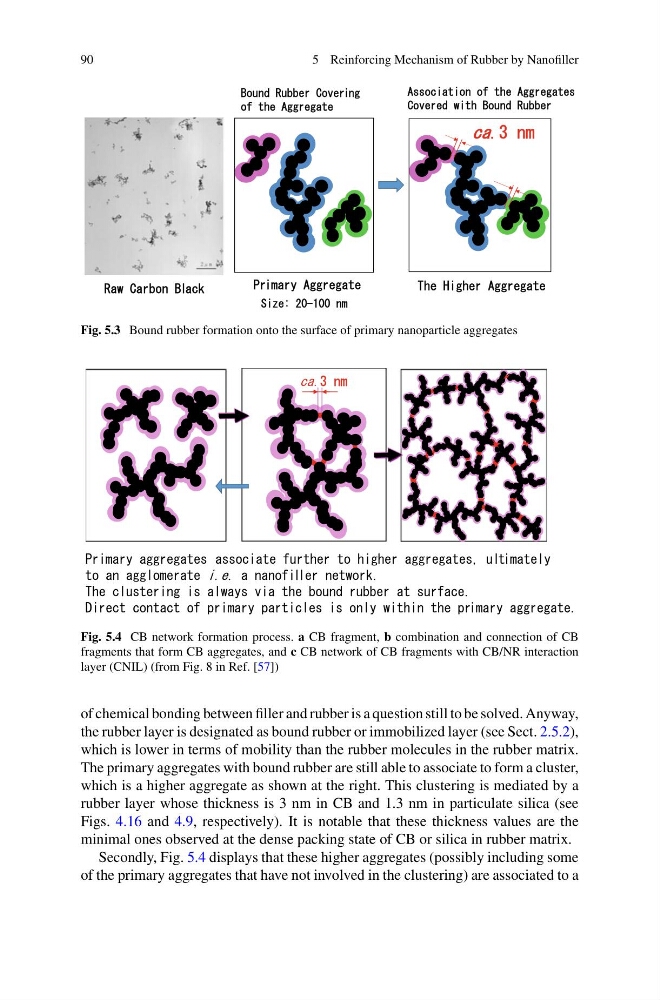
Fig. 5.3 Bound rubber formation onto the surface of primary nanoparticle aggregates
Fig. 5.4 CB network formation process. a CB fragment, b combination and connection of CB
fragments that form CB aggregates, and c CB network of CB fragments with CB/NR interaction
layer (CNIL) (from Fig. 8 in Ref. [57])
of chemical bonding between filler and rubber is a question still to be solved. Anyway,
the rubber layer is designated as bound rubber or immobilized layer (see Sect. 2.5.2),
which is lower in terms of mobility than the rubber molecules in the rubber matrix.
The primary aggregates with bound rubber are still able to associate to form a cluster,
which is a higher aggregate as shown at the right. This clustering is mediated by a
rubber layer whose thickness is 3 nm in CB and 1.3 nm in particulate silica (see
Figs. 4.16 and 4.9, respectively). It is notable that these thickness values are the
minimal ones observed at the dense packing state of CB or silica in rubber matrix.
Secondly, Fig. 5.4 displays that these higher aggregates (possibly including some
of the primary aggregates that have not involved in the clustering) are associated to a
5 Reinforcing Mechanism of Rubber by Nanofiller
Fig. 5.3 Bound rubber formation onto the surface of primary nanoparticle aggregates
Fig. 5.4 CB network formation process. a CB fragment, b combination and connection of CB
fragments that form CB aggregates, and c CB network of CB fragments with CB/NR interaction
layer (CNIL) (from Fig. 8 in Ref. [57])
of chemical bonding between filler and rubber is a question still to be solved. Anyway,
the rubber layer is designated as bound rubber or immobilized layer (see Sect. 2.5.2),
which is lower in terms of mobility than the rubber molecules in the rubber matrix.
The primary aggregates with bound rubber are still able to associate to form a cluster,
which is a higher aggregate as shown at the right. This clustering is mediated by a
rubber layer whose thickness is 3 nm in CB and 1.3 nm in particulate silica (see
Figs. 4.16 and 4.9, respectively). It is notable that these thickness values are the
minimal ones observed at the dense packing state of CB or silica in rubber matrix.
Secondly, Fig. 5.4 displays that these higher aggregates (possibly including some
of the primary aggregates that have not involved in the clustering) are associated to a