

70
4 Nanofiller Dispersion in Rubber as Revealed by 3D-TEM
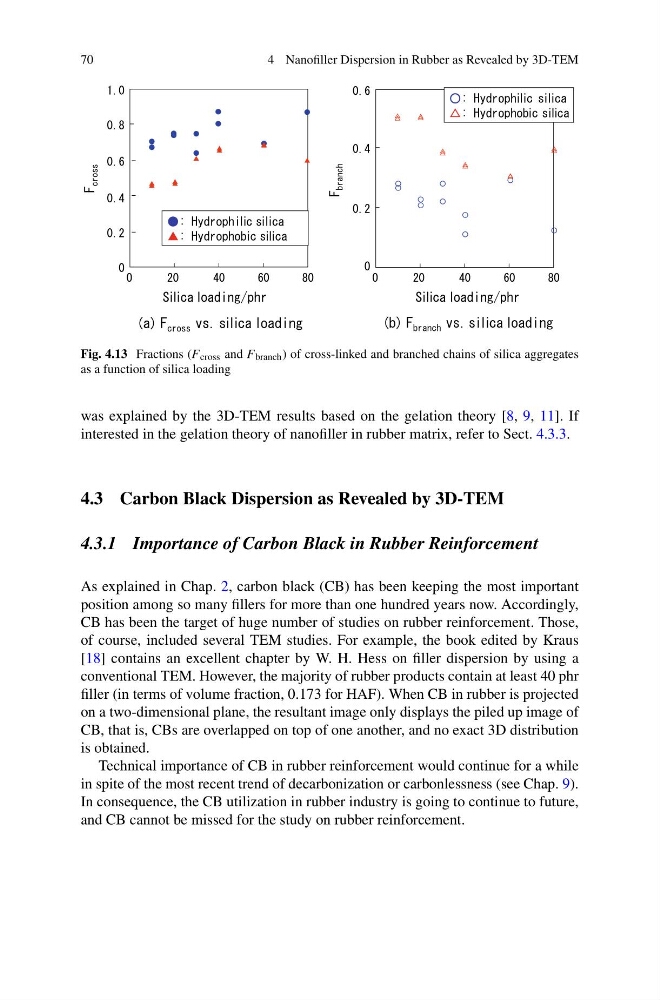
Fig. 4.13 Fractions (F cross and F branch ) of cross-linked and branched chains of silica aggregates
as a function of silica loading
was explained by the 3D-TEM results based on the gelation theory [8, 9, 11]. If
interested in the gelation theory of nanofiller in rubber matrix, refer to Sect. 4.3.3.
4.3 Carbon Black Dispersion as Revealed by 3D-TEM
4.3.1 Importance of Carbon Black in Rubber Reinforcement
As explained in Chap. 2, carbon black (CB) has been keeping the most important
position among so many fillers for more than one hundred years now. Accordingly,
CB has been the target of huge number of studies on rubber reinforcement. Those,
of course, included several TEM studies. For example, the book edited by Kraus
[18] contains an excellent chapter by W. H. Hess on filler dispersion by using a
conventional TEM. However, the majority of rubber products contain at least 40 phr
filler (in terms of volume fraction, 0.173 for HAF). When CB in rubber is projected
on a two-dimensional plane, the resultant image only displays the piled up image of
CB, that is, CBs are overlapped on top of one another, and no exact 3D distribution
is obtained.
Technical importance of CB in rubber reinforcement would continue for a while
in spite of the most recent trend of decarbonization or carbonlessness (see Chap. 9).
In consequence, the CB utilization in rubber industry is going to continue to future,
and CB cannot be missed for the study on rubber reinforcement.
4 Nanofiller Dispersion in Rubber as Revealed by 3D-TEM
Fig. 4.13 Fractions (F cross and F branch ) of cross-linked and branched chains of silica aggregates
as a function of silica loading
was explained by the 3D-TEM results based on the gelation theory [8, 9, 11]. If
interested in the gelation theory of nanofiller in rubber matrix, refer to Sect. 4.3.3.
4.3 Carbon Black Dispersion as Revealed by 3D-TEM
4.3.1 Importance of Carbon Black in Rubber Reinforcement
As explained in Chap. 2, carbon black (CB) has been keeping the most important
position among so many fillers for more than one hundred years now. Accordingly,
CB has been the target of huge number of studies on rubber reinforcement. Those,
of course, included several TEM studies. For example, the book edited by Kraus
[18] contains an excellent chapter by W. H. Hess on filler dispersion by using a
conventional TEM. However, the majority of rubber products contain at least 40 phr
filler (in terms of volume fraction, 0.173 for HAF). When CB in rubber is projected
on a two-dimensional plane, the resultant image only displays the piled up image of
CB, that is, CBs are overlapped on top of one another, and no exact 3D distribution
is obtained.
Technical importance of CB in rubber reinforcement would continue for a while
in spite of the most recent trend of decarbonization or carbonlessness (see Chap. 9).
In consequence, the CB utilization in rubber industry is going to continue to future,
and CB cannot be missed for the study on rubber reinforcement.